-
+86 13720060320
-
lanna@haitangs.com

Custom Torque Hinge Design Requirements for OEM Equipment
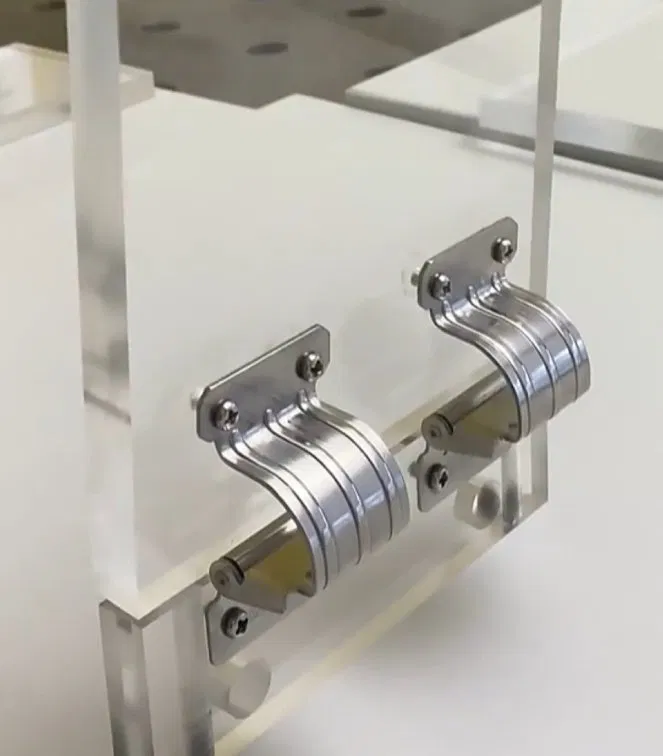
A torque hinge can look correct on a drawing and still fail after it is installed in the real equipment. The panel may drift at service angles, feel too stiff at low temperature, loosen after repeated use, or place uneven load on a thin mounting surface. In each case, the problem is not necessarily the basic hinge type. The standard model may simply have been designed around different geometry, loads, operating conditions, or lifecycle expectations.
For OEM equipment, customization should solve a defined integration problem. It may involve changing the torque value, torque direction, mounting bracket, hole pattern, opening limit, material, finish, lubricant, or internal friction structure. It does not always require a completely new hinge.
This guide explains when a standard torque hinge is no longer sufficient, which parameters can be customized, how to choose between an existing-platform modification and a fully custom design, and what should be validated before production. If your team is still deciding whether this type of hinge is appropriate, start with our overview of how torque hinges work.
Design boundary: Use a standard model when its torque range, mounting geometry, material, and validated operating conditions already match the equipment. Consider customization only when one of those requirements cannot be met without redesigning the door, panel, display, or surrounding structure.
When a Standard Torque Hinge Is Enough—and When It Is Not
Not every OEM project needs a custom part. Starting from an existing hinge platform usually reduces development risk because the basic mechanism, materials, manufacturing process, and torque behavior are already understood. The first decision is therefore not “How do we design a new hinge?” but “What prevents an existing model from working?”
| Project Condition | Recommended Route | Reason |
|---|---|---|
| Catalog torque and dimensions already fit | Use a standard hinge | Avoid unnecessary tooling and validation work |
| Only the torque value or finish needs adjustment | Modify an existing platform | The proven structure may remain unchanged |
| Hole pattern, bracket, shaft direction, or opening limit must change | Semi-custom design | The hinge can be adapted to the equipment interface |
| Required torque density exceeds the available package size | Engineering review | Internal structure or load distribution may need to change |
| Motion behavior, envelope, and internal mechanism are all different | Fully custom development | An existing platform may no longer provide a reliable base |
| Volume is low and the door design is still flexible | Prefer a standard platform | Changing the equipment may be more practical than creating new tooling |
Why Standard Torque Hinges Can Fall Short After Integration
A bench test checks the hinge by itself. The finished equipment adds door flex, gasket reaction, wiring resistance, temperature variation, contamination, assembly tolerance, and operator force. These factors can change how the hinge feels and how much holding torque reaches the panel.
- The real moment is higher than expected. Added displays, covers, cables, handles, or accessories move the center of gravity and increase the load at the hinge axis.
- The required motion is different from the catalog assumption. A panel may need low opening effort but stronger closing resistance, or it may need to hold only within a defined service range.
- The mounting structure is too flexible. Thin sheet metal, long brackets, or non-coaxial hinge locations can twist before the hinge develops its intended resistance.
- Temperature changes the operating feel. Friction materials and lubricant behavior can make a hinge feel looser or stiffer outside room-temperature conditions.
- The environment attacks the assembly. Humidity, salt, cleaning chemicals, dust, or oil mist can affect surfaces, friction interfaces, fasteners, or adjacent equipment materials.
- Torque retention was not defined. A hinge may meet its initial torque requirement but no longer hold the panel after repeated cycling.
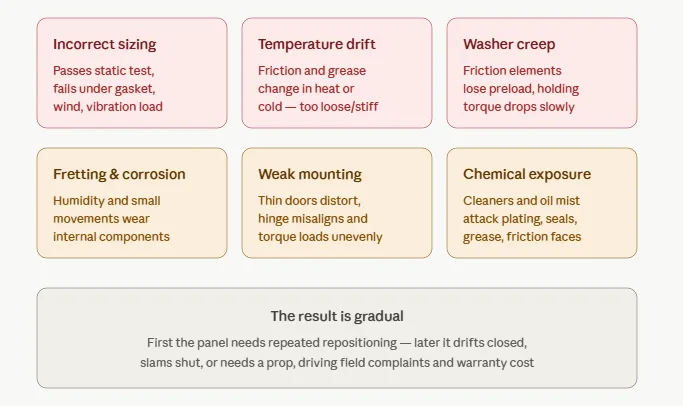
The correct response is not automatically “increase the torque.” More torque can raise user effort, stress the mounting points, and hide a structural or alignment problem. A custom design should address the actual failure mechanism.
What Can Be Customized in a Torque Hinge?
Customization can affect how the hinge moves, how it mounts, how it survives the environment, and how consistently it performs across production. The table below separates the major design variables.
| Custom Parameter | What It Controls | Typical Reason for Changing It |
|---|---|---|
| Nominal torque | Holding resistance at the hinge axis | Match the actual panel moment |
| Torque tolerance | Unit-to-unit consistency | Control user feel across equipment builds |
| Opening and closing torque | Resistance in each direction | Create balanced, asymmetric, or one-way motion |
| Breakaway torque | Force required to start movement | Prevent a sticky or abrupt first movement |
| Torque curve through the angle | How resistance changes during rotation | Support a heavy zone or reduce effort near closing |
| Opening range or mechanical stop | Maximum permitted rotation | Prevent cable strain, collision, or overtravel |
| Detent position | Defined holding points | Create service, inspection, or viewing positions |
| Mounting bracket and hole pattern | Interface with the equipment | Fit an existing enclosure without redesign |
| Shaft direction and handedness | Left/right installation and assembly orientation | Match the door layout or production process |
| Package size and profile | Space occupied by the hinge | Fit compact displays, covers, or internal assemblies |
| Body, shaft, and fastener materials | Strength, corrosion resistance, and compatibility | Address outdoor, washdown, medical, vehicle, or coastal use |
| Surface treatment | Corrosion protection and appearance | Match the equipment finish or exposure level |
| Friction material and lubricant | Temperature behavior, wear, and motion quality | Improve stability across the operating range |
| Cycle-life target | Required service duration | Define acceptable torque retention after use |
Important: Some parameters interact. Increasing torque inside the same package may increase breakaway force, heat, wear, or stress on the mounting ears. Changing material can also change manufacturability and dimensional tolerance. The complete requirement must be reviewed as a system rather than as separate line items.
Define the Real Door System Before Changing the Hinge
The target torque should be based on the complete moving assembly—not the bare sheet-metal panel. Include the display, cover, handle, gasket reaction, cables, hoses, protective sleeves, and any accessories that move with the door. The distance from the hinge axis to the actual center of gravity matters as much as the mass.
Also define the angles where the panel must remain stable. A service door that must hold at 90° creates a different design problem from a display that must stay at any angle between 20° and 110°. A limited-angle cover may need a stop, while a rotating display may need continuous motion and cable-routing space.
For the full calculation method, examples, and safety-factor discussion, use the torque hinge calculation guide. The torque hinge calculator can provide an initial per-hinge target from the panel mass, center-of-gravity distance, angle, and number of hinges. That result is a starting point for design review, not a substitute for testing the complete assembly.
Standard Modification vs. Fully Custom Development
The lowest-risk custom route is usually the smallest change that solves the problem. A useful design review therefore separates changes that can be made on an existing platform from changes that require a new structure.
| Requirement | Existing-Platform Modification | Fully Custom Design |
|---|---|---|
| Different torque value | Often possible within the platform range | Needed if the mechanism cannot safely reach the target |
| Different finish or material | Possible when manufacturing and friction interfaces remain compatible | Needed if the material change affects the full structure |
| Adjusted hole pattern or bracket | Often possible with a new leaf or mounting part | Needed when the complete load path changes |
| New opening stop or handedness | May be added to an existing mechanism | Needed when packaging or internal geometry conflicts |
| One-way or shaped torque behavior | Possible only on suitable platforms | Likely when the current mechanism provides symmetric resistance |
| Much smaller package at the same torque | Limited by stress and friction area | May require a new internal layout |
| New motion axis or cable path | Possible if an existing swivel platform matches | Needed when the rotation and routing architecture are new |
Using an existing platform does not mean accepting a generic part. It means retaining the portions that already work—such as the internal friction mechanism or shaft structure—while adapting the interface and performance variables that are specific to the equipment.
Application-Specific Design Priorities
The same torque value can lead to different hinge designs because equipment categories expose the hinge to different risks.
| Application | Main Integration Risks | Custom Design Priorities |
|---|---|---|
| Outdoor telecom or energy-storage enclosure | Temperature cycles, wind, dust, condensation, possible salt exposure | Temperature-stable motion, corrosion-compatible materials, rigid mounting, protected friction interfaces |
| Medical cart or diagnostic display | Frequent repositioning, wiping agents, user-force limits | Smooth breakaway, consistent feel, cleanable geometry, controlled torque tolerance |
| Food-processing cover | Washdown, chemical cleaners, residue traps | Material compatibility, cleanable surfaces, protected gaps, documented cleaning limits |
| Industrial HMI or operator panel | Vibration, oil mist, wide panels, cable resistance | Rigid interface, anti-loosening features, stable holding through the working angle |
| Vehicle or rail equipment | Shock, vibration, inclined installation, repeated service access | Secure retention, robust mounting, project-specific material and documentation review |
| Kiosk or self-service equipment | Compact packaging, frequent maintenance, cosmetic requirements | Controlled opening, compact profile, repeatable operation, concealed or clean mounting |
Integration Errors That Can Invalidate a Custom Design
A custom hinge cannot compensate for every equipment-side problem. Before approving the design, check the load path and assembly method around the hinge.
Non-Coaxial Hinge Axes
When two hinge axes are not aligned, the assembly can bind and place radial loads on the shafts. The operator may interpret the binding as “more torque,” but the extra resistance is uncontrolled and can accelerate wear.
Flexible Door or Frame
If the panel twists before both hinges rotate together, one hinge can carry more of the load. Reinforcement plates, shorter brackets, or a different mounting location may be more effective than increasing the nominal torque.
Uncontrolled Fastener Installation
Over-tightening can distort a mounting ear or thin panel. Under-tightening can allow micro-movement and fretting. Define the fastener size, engagement, washers, thread-locking method where appropriate, and assembly torque in the equipment drawing.
Cable and Gasket Reaction
Wire looms, hoses, protective sleeves, and compressed gaskets can apply force in a direction that changes through the opening range. Sample testing should use the production-intent cable routing and sealing system.
Judging Performance Only by Hand Feel
Hand feel matters, but it should be paired with measured torque and defined acceptance limits. Otherwise, two reviewers may approve different motion behavior, and production consistency becomes difficult to control.
How to Validate Custom Torque Hinge Samples
Test the hinge inside the actual equipment or a representative fixture. A loose bench sample cannot reproduce panel flex, cable force, gasket reaction, fastener behavior, or real user leverage.
Motion and Torque Behavior
- Measure opening and closing torque through the intended angle range.
- Confirm that the panel holds at every required service or viewing position.
- Check breakaway force after the equipment has remained stationary.
- Look for sticking, sudden release, noise, or angle-dependent drift.
- Confirm that user effort remains acceptable with the real handle location.
Measure opening, closing, breakaway, and running behavior under a controlled fixture, angle, speed, dwell, and direction. Use our hinge torque measurement method to define the test setup and reported outputs.
Lifecycle and Torque Retention
Cycle life should include a functional retention target, not only a pass/fail movement count. Define the initial measurement, cycling conditions, inspection intervals, and acceptable remaining torque. Our torque hinge cycle-life guide explains why a hinge can continue moving after it has already lost the ability to hold the panel correctly.
Temperature and Environment
- Check operation at the project’s minimum, room, and maximum temperatures.
- Inspect for corrosion or coating changes after the required exposure test.
- Verify compatibility with cleaning chemicals, oil, or other process fluids where applicable.
- Confirm that dust, residue, or moisture cannot create an unexpected friction path.
- Review project-specific material declarations or compliance documents before approval.
Assembly and Fit
- Confirm mounting-hole position and access for installation tools.
- Check screw length, thread engagement, and interference behind the mounting surface.
- Verify door gaps and gasket compression through the full opening range.
- Test worst-case dimensional tolerances, not only nominal parts.
- Confirm that replacing the hinge in service does not require destructive disassembly unless that is intentional.
Information Needed for an Engineering Feasibility Review
An initial engineering review does not need a finished purchasing package. Six inputs are usually enough to determine whether a standard platform, semi-custom modification, or fully custom hinge should be considered:
- The complete moving-panel weight and center-of-gravity location
- The required opening range and positions where the panel must hold
- The available mounting envelope, hole pattern, and panel or frame thickness
- The operating environment, including temperature and relevant exposure
- The expected usage frequency and lifecycle target
- A drawing, 3D model, sample, or clear photographs of the installation
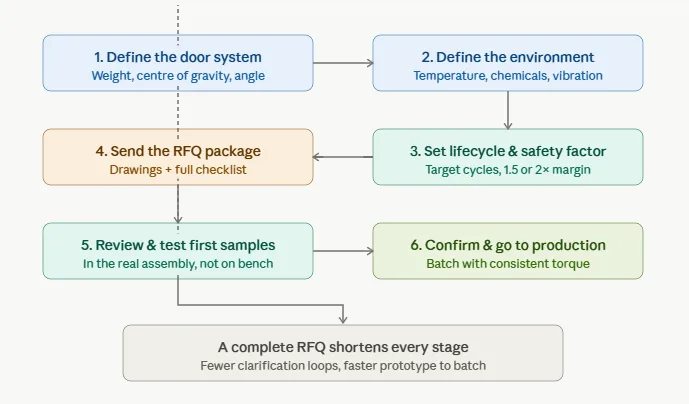
Once the technical route is clear, procurement can add annual volume, timing, documentation, packaging, and commercial requirements. Use the separate five-step torque hinge RFQ guide to prepare that complete sourcing package. Keeping the engineering feasibility review separate from the commercial RFQ prevents early design decisions from being reduced to price alone.
Pre-Production Design Review Checklist
- The complete panel mass and center of gravity match the tested assembly.
- The selected torque does not create excessive user effort or mounting stress.
- Opening and closing behavior is defined separately where required.
- Both hinge axes remain aligned across the equipment tolerance range.
- The panel and frame are stiff enough to share load between hinges.
- Materials, finishes, lubricants, and fasteners match the real environment.
- Cycle testing includes an acceptable torque-retention limit.
- Temperature and exposure tests use agreed conditions and acceptance criteria.
- Production drawings control mounting orientation, handedness, and fastener installation.
- The approved sample and measurement method are retained as production references.
Summary: Customize the Constraint, Not the Label
A custom torque hinge should exist because the equipment has a measurable requirement that a standard model cannot meet. That requirement may be torque behavior, mounting geometry, package size, opening range, material compatibility, temperature performance, lifecycle retention, or a combination of these factors.
Start with the real moving assembly and identify the failure mechanism before changing the hinge. Then choose the smallest reliable development route: standard model, existing-platform modification, semi-custom interface, or fully custom design. Validate the result in the complete equipment with defined measurements and acceptance limits.
| Request a Custom Torque Hinge Design Review Send the panel weight, center-of-gravity location, opening range, available mounting space, operating environment, lifecycle target, and installation drawing. Our engineering team can review whether an existing platform can be adapted or a new hinge structure is required. Contact our engineers → |