-
+86 13720060320
-
lanna@haitangs.com

What Is a Torque Hinge? The Engineer’s Complete Reference
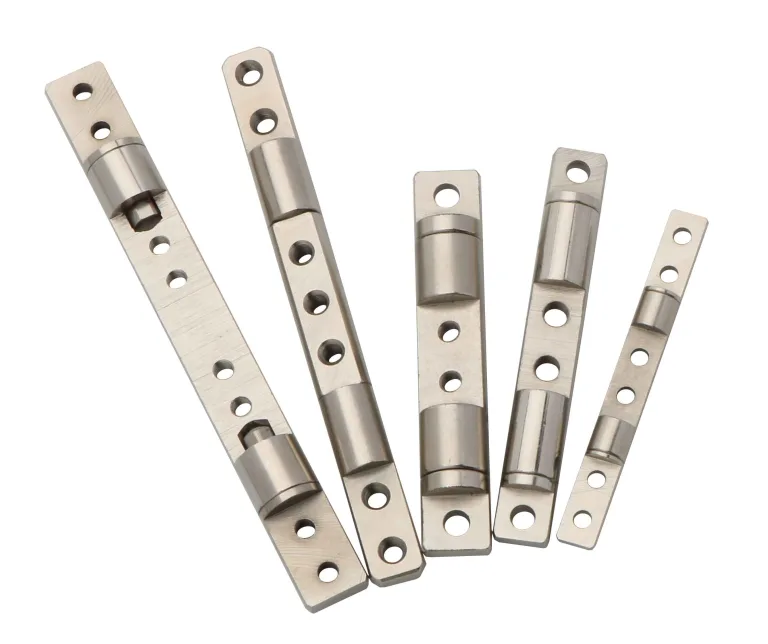
A torque hinge is a mechanical joint that provides controlled rotational resistance, allowing a panel, lid, screen, or door to be held in position at any angle without a separate latch or stay. Unlike a standard hinge that swings freely, a torque hinge incorporates internal friction components that resist rotation throughout the full range of movement.
The term covers several related product types — constant torque hinges, adjustable torque hinges, friction hinges, and positioning hinges — each engineered for different levels of holding force and adjustability. What they share is the ability to hold a load at a set angle, hands-free.
This guide explains the fundamentals of torque hinges for design engineers and procurement teams. For HSP’s full range of torque hinge models and specifications, see our complete torque hinges catalog.
How a Torque Hinge Holds Position
The holding force in a torque hinge comes from friction between internal components, typically spring-loaded friction discs, cam surfaces, or a combination of both. When a panel rotates, these components slide against each other under controlled pressure, generating consistent resistance throughout the range of motion.
The result is a hinge that moves smoothly but does not drift. Set a medical monitor arm to 45°, and it stays at 45°. Adjust an industrial control panel to 90°, and it holds without a prop rod. This free-stop behaviour is the defining characteristic of all torque hinge types.
| Key Principle — Torque (measured in N·m or N·cm) is the rotational force the hinge resists. The higher the torque rating, the heavier the load the hinge can hold in position. Matching torque to load is the core selection challenge — covered step by step in our guide on how to calculate the torque you need. |
The stated N·m value is meaningful only when the measurement direction, angle, speed, dwell, and temperature are defined. See how hinge torque is measured.
Torque Hinge Types: What the Categories Mean
The four main types differ in how their friction mechanism is designed and how much control the user has over the holding force:
| Type | How It Works | Key Characteristic | Typical Applications |
| Constant Torque Hinge | Internal friction discs maintain a consistent factory-set friction throughout rotation | Holding force stays within a tight tolerance across the full range of motion | Medical monitors, telecom panels, industrial displays |
| Adjustable Torque Hinge | Set screw allows manual adjustment of internal friction after installation | Engineer can increase or decrease holding force in the field | Access panels, control units, any application where load may change |
| Detent / Positioning Hinge | Spring-loaded element engages machined recesses at set angles | Distinct click-stop at predefined positions (e.g. 65°, 115°, 225°) | Instrument covers, equipment lids, engineered viewing positions |
| Swivel Torque Hinge | 360° rotation with friction resistance throughout full rotation | Supports continuous single-axis positioning, with cable-routing options | Monitor arms, rotating displays, camera mounts, kiosk screens |
Mini and compact torque hinges follow the same principles as the types above but are sized for small enclosures, electronics, and portable instruments where standard hinge dimensions are impractical — with HSP models as small as Φ6.3 × 12 mm.
Torque Hinge vs. Standard Hinge: The Core Difference
A standard pin-and-barrel hinge has one job: allow rotation. It applies no resistance and holds no position. Torque hinges are specified when a panel or lid must remain at a chosen angle under its own weight, without external support.
| Feature | Standard Hinge | Torque Hinge |
| Position holding | No — swings freely | Yes — holds at any angle |
| Friction | Near zero | Engineered and calibrated |
| Requires latch or prop | Yes, for open positions | No |
| Adjustability | None | Depends on type (see table above) |
| Typical cost | Low | Moderate to high |
| Best for | Doors, gates, lids that close fully | Panels, screens, lids held open at varying angles |
When to Specify a Torque Hinge
A torque hinge is the appropriate choice when one or more of the following conditions apply:
- The panel or lid must be held open at a specific angle without a separate prop or stay
- The application involves frequent repositioning where a latch would slow operation
- Hands-free positioning is needed — for example, during a medical procedure or machine operation
- The load will vary, and a fixed mechanical stop is not flexible enough
- Panel size or weight makes a gas spring impractical due to space constraints
Torque Hinge vs. Gas Spring: A Practical Comparison
Both gas springs and torque hinges hold panels open, but they operate differently and suit different applications. The choice comes down to load weight, available space, cycle life, and environmental conditions.
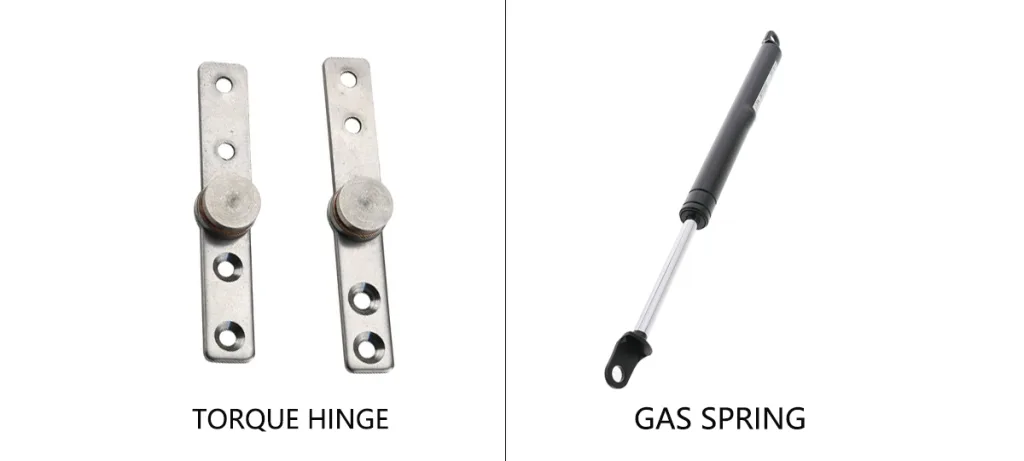
| Factor | Torque Hinge | Gas Spring |
| Load range | Compact holding torque, typically 0.1–25 N·m per hinge | Suited to heavier single-point loads (50N–2000N force) |
| Positioning | Any angle throughout full range | Typically assists opening; limited mid-range holding |
| Space required | Compact, mounts like a standard hinge | Requires mounting points above and below panel |
| Temperature sensitivity | Low to moderate (lubricant viscosity affected) | High (gas pressure changes with temperature) |
| Cycle life | Validated to 20,000 cycles with ≥80% torque retention (HSP constant torque models) | 5,000 – 30,000 cycles typical |
| Failure mode | Gradual torque reduction over time | Sudden gas loss; can drop load without warning |
| Maintenance | Minimal; inspect for torque drift periodically | Inspect seals; replace if gas pressure drops |
For panels under approximately 15 kg that require precise multi-angle positioning in a compact installation, torque hinges are generally the more practical solution. For very heavy hatches or lids where counterbalancing is the priority, gas springs are more appropriate. Many designs also distribute load across two or more torque hinges rather than relying on a single unit.
Material and Construction: What to Look For
Housing Materials
The hinge body material determines corrosion resistance, load capacity, and suitability for specific environments:
- SUS 304 stainless steel — standard choice for most industrial and outdoor applications
- SUS 316 stainless steel — specified for marine, chemical, or food processing environments where chloride exposure is a concern
- Zinc alloy (ZDC) — lower cost, dimensionally precise, suitable for indoor applications with decorative finishes; less suitable for corrosive environments
- SK7 spring steel and free-machining steel — used in mini and compact torque hinges where tight tolerances at small cross-sections are required
Internal Friction Components
The internal mechanism determines torque consistency and cycle life. High-quality torque hinges use precisely machined cam surfaces or stacked friction discs with calibrated spring pressure. The friction surfaces are typically stainless or hardened steel running against a polymer or bronze bushing, lubricated with a grease formulated for the rated temperature range.
The quality of internal components is the primary factor separating long-service-life hinges from those that lose torque after a few thousand cycles. When evaluating suppliers, request documented cycle life test data and the test standard used.
Torque Hinge Applications by Industry
Medical and Laboratory Equipment
Monitor arms, instrument covers, and equipment displays require hinges that hold their position precisely without drift during operation. Constant torque models are common in this sector. Stainless steel construction is specified where the hinge will be exposed to cleaning agents.
Industrial Automation and Control
Access panels on control cabinets, machine guards, and operator displays must open to a set angle and stay there while the operator works. In vibrating environments, the friction mechanism also prevents panels from drifting under vibration — an advantage over gas springs, which can oscillate.
Telecommunications and Electronics
Rack-mounted panels, test equipment covers, and display screens in telecom equipment use constant torque hinges where consistent positioning across temperature cycles is required. The enclosed environments typical in telecom equipment also suit compact torque hinge profiles.
Transportation and Marine
Vehicle storage compartments, marine hatches, and equipment access panels operate in high-vibration and corrosive environments. Stainless steel hinges with sealed mechanisms are specified for these applications. Marine environments require SUS 316 stainless steel throughout, including fasteners.
Common Failure Modes and How to Prevent Them
| Failure Mode | Cause | Prevention |
| Gradual torque loss | Friction surface wear, lubricant breakdown over cycle life | Select a hinge rated for your required cycle count; inspect torque periodically in high-use applications |
| Sudden position drift | Hinge loaded beyond rated torque capacity | Always size with a minimum 1.5× safety factor on calculated load torque |
| Binding or sticking | Installation misalignment; contamination entering the mechanism | Ensure mounting surfaces are parallel; use sealed mechanisms in dusty or dirty environments |
| Corrosion affecting performance | Incorrect material for environment | Match material grade to environment: SUS 316 for marine/chemical, SUS 304 for general outdoor |
| Torque variation at temperature extremes | Lubricant viscosity change in cold or hot conditions | Specify temperature-rated lubricant for applications below -10°C or above 70°C |
Frequently Asked Questions
What is the difference between a torque hinge and a friction hinge?
The terms are often used interchangeably. Technically, ‘friction hinge’ refers to any hinge that uses friction to resist rotation, while ‘torque hinge’ specifically refers to hinges designed to a calibrated torque specification. In practice, when suppliers use either term, they mean the same category of product.
Can torque hinges be used outdoors?
Yes, provided the correct material is specified. Standard zinc-plated steel torque hinges are not suitable for sustained outdoor or wet environments. For outdoor use, specify SUS 304 stainless steel minimum; for marine or chemical exposure, specify SUS 316 stainless steel with sealed internal mechanisms.
How do I know what torque value I need?
The required torque is calculated from the panel weight and the distance from the hinge pivot to the panel’s centre of mass. A detailed step-by-step calculation guide, including safety factor recommendations by application type, is covered in our article on how to calculate the torque you need.
What is the expected service life of a torque hinge?
Service life is rated in cycles (one open-close movement equals one cycle). HSP constant torque hinges are validated to 20,000 cycles with at least 80% torque retention at end of life. Higher-cycle requirements can be discussed during OEM specification. Specifying a hinge with a cycle life rating appropriate for your application’s expected usage frequency is the most reliable way to avoid premature failure.
Is it possible to adjust the torque after installation?
Only adjustable torque hinge models allow post-installation adjustment, typically via an external set screw. Constant torque hinges and most detent hinges are factory-set and not field-adjustable. If your application requires the ability to change holding force after installation, specify an adjustable model from the outset.
| Need a Torque Hinge for Your Application? HSP manufactures constant torque, adjustable torque, swivel, detent, and mini torque hinges from 0.1 to 25 N·m to customer specifications. Send us your torque requirement, panel weight, and environment details for a technical recommendation. Samples in 10 working days, MOQ from 1,000 units. Contact our engineering team → |