-
+86 13720060320
-
lanna@haitangs.com

Detent / Positioning Hinges
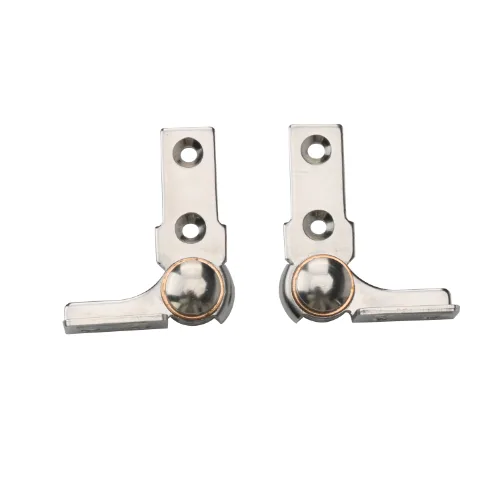
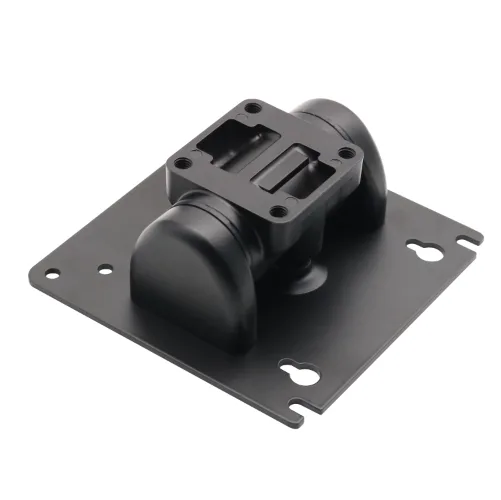
Detent & Positioning Hinges
Preset-position hinges for equipment covers, panels and displays requiring repeatable stop angles or indexed positioning.
MOQ from 1 pc · Free samples available · Custom positioning configurations supported
Positioning behavior
Standard Positioning Hinge Models
Choose by positioning behavior, material and mounting requirement. Open each model page for full dimensions and drawings.
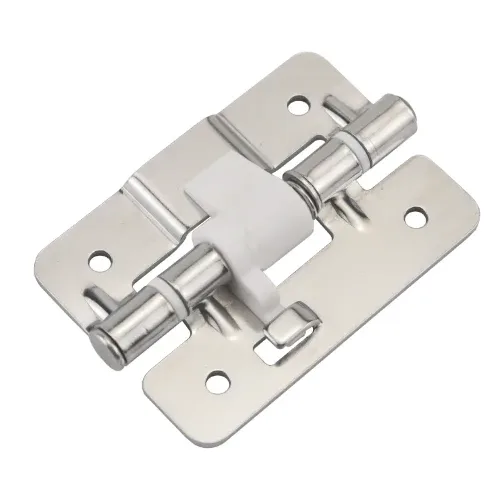
HG11-078
3-Position Stainless Positioning Hinge
- 0° / 75° / 180°
- 0.5 N·m
- SUS304
- Vibratory finish
Best whenThree repeatable fixed positions are required in a stainless-steel application.
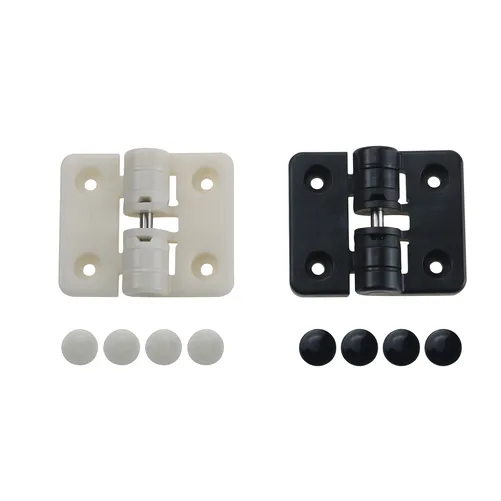
HG11-018
90° Incremental Resin Positioning Hinge
- 0° / 90° / 180°
- 0.5 N·m
- PE resin
- 60 × 50 × 8 mm
- Up to 1.2 kg
- Free-stop between detent positions
Best whenA lightweight indexed hinge is required with friction holding between preset positions.
Need a different positioning angle?
If HG11-078 or HG11-018 does not match the required positions or mounting space, send the target angles, panel load and available envelope for review.
Compare Standard Models
| Model | Positioning | Positions | Torque | Material | Size / Load |
|---|---|---|---|---|---|
| HG11-078 | Three fixed positions | 0° / 75° / 180° | 0.5 N·m | SUS304 | See drawing |
| HG11-018 | 90° incremental + free-stop between positions | 0° / 90° / 180° | 0.5 N·m | PE resin | 60 × 50 × 8 mm / up to 1.2 kg |
Engineering Drawing Reference
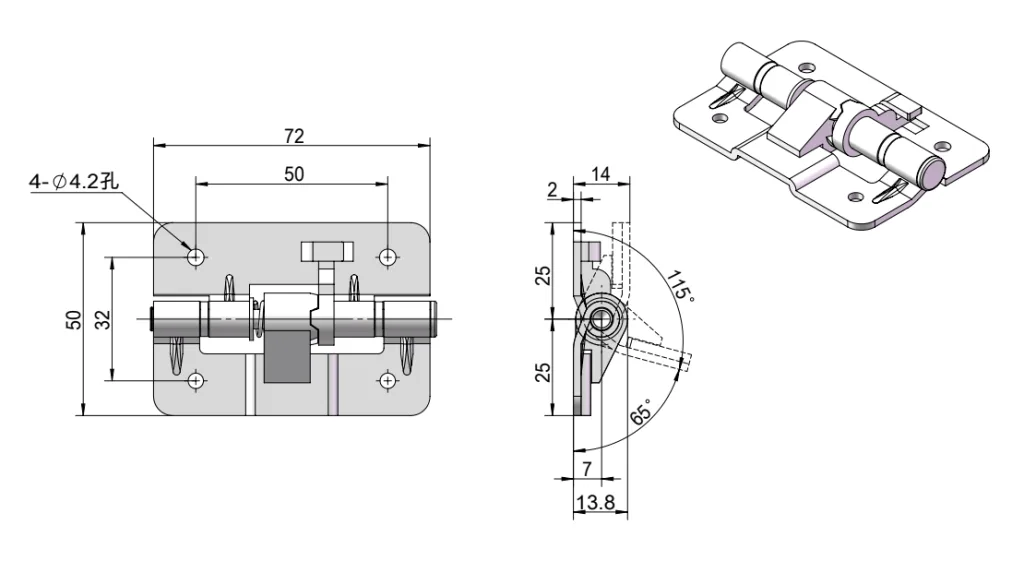
HG11-078 Drawing Reference
- Overall width: 72 mm
- Overall height: 50 mm
- Horizontal mounting-hole spacing: 50 mm
- Vertical mounting-hole spacing: 32 mm
- Mounting holes: 4 × Φ4.2
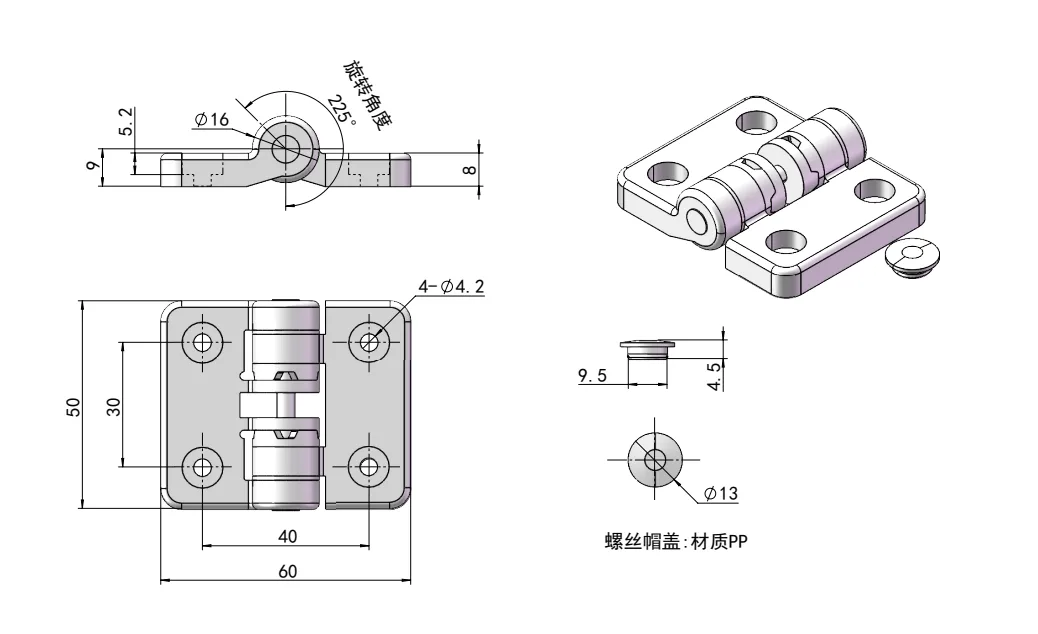
HG11-018 Drawing Reference
- Overall size: 60 × 50 × 8 mm
- Horizontal mounting-hole spacing: 40 mm
- Vertical mounting-hole spacing: 30 mm
- Mounting holes: 4 × Φ4.2
Before You Finalize the Hinge
Confirm the working positions
Do not specify only the maximum opening angle. Confirm every position that must repeat during operation.
Confirm the panel load
Provide the complete panel or lid weight, including attached hardware.
Check hinge axis and center of gravity
Confirm the distance from the hinge axis to the panel center of gravity.
Check the mounting envelope
Verify hinge width, thickness, mounting-hole pattern and surrounding clearance against the selected model drawing.
Also confirm whether the panel should move freely or retain friction between indexed positions.
Custom Positioning Hinge Review
What to Send
- Required positioning angles
- Panel or lid weight
- Available mounting space
- Existing drawing or hinge sample
- Estimated quantity
What We Review
- Detent / indexing feasibility
- Motion between positions
- Mounting envelope and hole pattern
- Material and finish
- Load and operating requirement
Before Production
- Approved drawing
- Confirmed positioning behavior
- Sample when required
- Price and lead time confirmed for the actual specification and quantity
Typical Applications
Machine Guards & Access Doors
Defined working positions for maintenance covers and equipment access panels.
HMI & Operator Panels
Indexed display and operator-interface positioning.
Medical & Laboratory Equipment
Repeatable lid or display positions for equipment access and operation.
Request a Quote
You do not need to know the exact model. Send the required positions, panel weight, mounting space and estimated quantity. If you already know the model, include HG11-078 or HG11-018 in the message.
By submitting this form, you agree that the information provided may be used to review and respond to your inquiry. See our Privacy Policy.
Detent vs Free-Stop Torque Hinges
Choose a detent hinge when the panel must return to defined, repeatable angular positions. Choose a free-stop torque hinge when the panel must hold smoothly anywhere through a continuous range.
| Requirement | Detent / Positioning | Constant Torque Hinges | Adjustable Torque Hinges |
|---|---|---|---|
| Defined preset positions | Yes | No | No |
| Hold throughout a continuous range | Model-dependent | Yes | Yes |
| Tactile indexed feedback | Yes | No | No |
| Field torque adjustment | Usually no | No | Yes |
| Repeatable indexed angle | Yes | No | No |
Frequently Asked Questions
What is a detent hinge?
A detent hinge provides one or more preset or indexed angular positions where the mechanism creates additional resistance or settles into a defined position.
Can a detent hinge also hold between preset positions?
It depends on the mechanism. Some designs combine friction torque and detent positions, while others move more freely between stops.
Can the positioning angles be customized?
Custom angle positions can be developed for suitable OEM applications, subject to mechanism, envelope, load and feasibility review.
What information should I provide for selection?
Provide the required angle positions, panel weight, hinge-axis geometry, mounting space, material, expected cycle requirement and estimated quantity.