-
+86 13720060320
-
lanna@haitangs.com

How to Calculate Torque Hinge Requirements | Formula + Examples
Specifying a torque hinge starts with one number: the holding torque your application needs. Get it right, and the panel stays exactly where the user leaves it for the life of the product. Get it wrong, and the panel either drifts shut under its own weight or feels stiff and awkward to move. This guide shows you how to calculate the required torque in five steps, with three worked examples and the safety factors that experienced engineers apply.
This article is part of our complete torque hinge guide. If you need a refresher on what torque hinges are and how they work, start with our overview of what a torque hinge is.
| The 30-Second Answer Required torque = panel weight (kg) × 9.81 × center-of-gravity distance (m) × safety factor. This gives the holding torque in newton-meters (N·m) needed to hold the panel in its worst-case position, usually horizontal. For a 2 kg panel with its center of gravity 100 mm from the hinge axis: 2 × 9.81 × 0.1 = 1.96 N·m. With a 1.5× safety factor, the required holding torque is roughly 3 N·m. If two hinges share the load, divide the result by two to estimate the required torque per hinge. |
| Prefer to skip the math? Use our free torque hinge calculator. Enter your panel weight, center-of-gravity distance, number of hinges, and safety factor to get the required holding torque per hinge. |
The Physics: Why Torque, Not Just Weight
A common mistake is to size a hinge by panel weight alone. Weight matters, but what the hinge actually resists is torque — the rotational force created by that weight acting at a distance from the pivot. A light panel mounted far from the hinge axis can demand more torque than a heavy panel mounted close to it.
Torque is the product of force and distance. The force is the panel’s weight acting through gravity. The distance — called the moment arm — is measured from the hinge’s rotation axis to the panel’s center of gravity, measured horizontally when the panel is in its worst-case position. The farther the center of gravity sits from the axis, the more torque the hinge must resist to hold position.
Units: N·m and kgf·cm
Torque is most commonly specified in newton-meters (N·m). Some catalogs use kilogram-force centimeters (kgf·cm), particularly in Asia. The conversion is straightforward: 1 N·m equals approximately 10.2 kgf·cm. HSP catalog torque values are specified in N·m, with models available from 0.1 N·m for mini hinges up to 25 N·m for heavy-duty adjustable torque hinges.
The Formula, Step by Step
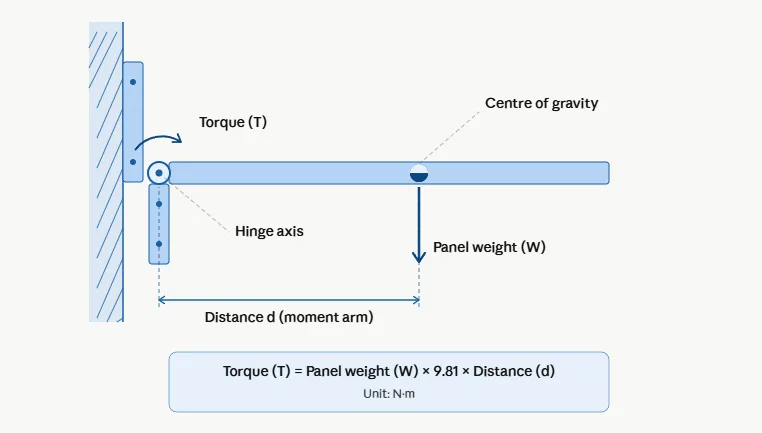
Here is the full calculation process. Work through it once with your own numbers and torque selection becomes a repeatable, defensible engineering decision rather than a guess.
- Measure the panel weight (W). Weigh the panel, lid, or screen the hinge will carry, including anything mounted on it — a display, cables, accessories, or a cover. Use the heaviest realistic configuration. Result in kilograms.
- Find the center-of-gravity distance (d). Measure horizontally from the hinge rotation axis to the panel’s center of gravity, in the position where gravity creates the most torque. For a uniform flat panel, the center of gravity is at its geometric center. Result in meters.
- Calculate the static holding torque (T). Multiply: T = W × 9.81 × d. The 9.81 converts mass to gravitational force. Result in newton-meters.
- Apply a safety factor. Multiply the static torque by 1.5 for normal applications, or by 2 for high-cycle, high-vibration, or safety-critical applications. This accounts for torque retention loss over the hinge’s life and real-world load variation.
- Divide across multiple hinges if used. If the panel uses two hinges, each carries roughly half the load. Divide the total required torque by the number of hinges to estimate the required torque per hinge.
Three Worked Examples
The formula is clearest when applied to real cases. Here are three examples across different load ranges and industries.
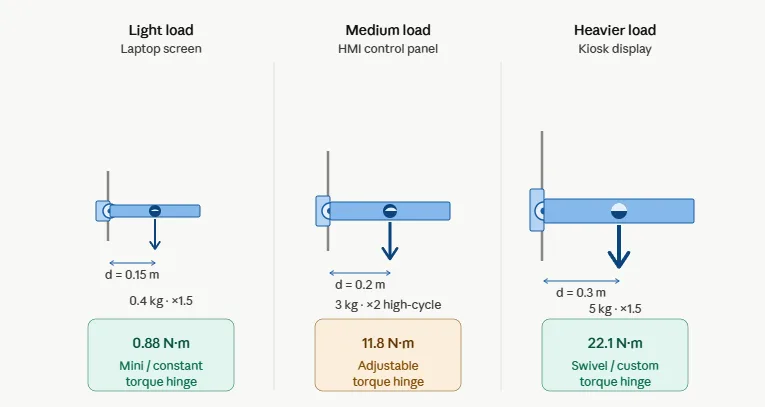
Example 1 — Laptop or Tablet Screen (Light Load)
A foldable display screen weighs 0.4 kg, with its center of gravity 150 mm (0.15 m) from the hinge axis when open.
- Static torque: 0.4 × 9.81 × 0.15 = 0.59 N·m
- With 1.5× safety factor: 0.59 × 1.5 = 0.88 N·m
- Across two hinges: roughly 0.45 N·m per hinge
- Selection: a mini or constant torque hinge in the 0.5–1.0 N·m range per hinge. This sits well within HSP’s mini torque hinge range, which offers resolution as fine as 0.1 N·m.
Example 2 — Industrial HMI Control Panel (Medium Load)
An operator control panel weighs 3 kg, with its center of gravity 200 mm (0.2 m) from the hinge axis. It is opened and closed many times per shift, so it is a high-cycle application.
- Static torque: 3 × 9.81 × 0.2 = 5.89 N·m
- With 2× safety factor for high-cycle use: 5.89 × 2 = 11.8 N·m
- Across two hinges: roughly 5.9 N·m per hinge
- Selection: an adjustable torque hinge rated around 5–6 N·m per hinge. An adjustable torque hinge is the right call here because it lets the operator fine-tune the feel after installation as the panel load or preference changes.
Example 3 — Self-Service Kiosk Rotating Display (Heavier Load)
A kiosk display assembly weighs 5 kg, with its center of gravity 300 mm (0.3 m) from the rotation axis. It rotates for customer and operator viewing and must hold any angle.
- Static torque: 5 × 9.81 × 0.3 = 14.7 N·m
- With 1.5× safety factor: 14.7 × 1.5 = 22.1 N·m
- Across two hinges: roughly 11 N·m per hinge
- Selection: at this level the requirement approaches the top of the standard torque range, so distributing the load across two hinges or specifying a custom high-torque unit is the practical route. A swivel torque hinge suits the rotating motion, and HSP can develop custom torque values up to 25 N·m for applications at this end of the range.
When a self-service kiosk also includes rear service doors, removable access panels or other moving sections, compare the wider hinge routes on our Kiosk & Self-Service Equipment Hinge Solutions page.
Choosing the Right Safety Factor
The safety factor is not padding. It accounts for real engineering effects that erode holding torque over time and operating conditions. Choosing it well is the difference between a hinge that holds for the product’s life and one that drifts after a year.
| Application Type | Suggested Safety Factor | Why |
| Low-use, indoor, stable temperature | 1.5× | Minimal torque drift expected over life |
| High-cycle, many movements per day | 2× | Friction surfaces wear; torque drops gradually |
| Vibrating environment, such as machinery or vehicles | 2× | Vibration can ease a panel out of position |
| Wide temperature swing | 2× | Lubricant viscosity changes affect torque |
| Safety-critical application where the panel must not drop | 2× or higher | Consequences of drift are serious |
Common Mistakes to Avoid
- Sizing by weight while ignoring distance. The moment arm matters as much as the weight. A light panel on a long arm can need more torque than a heavy panel mounted close in.
- Forgetting the safety factor. Sizing to the exact static torque leaves no margin for the torque loss that every friction hinge experiences over its cycle life.
- Ignoring added mass. Cables, a heavier display revision, or accessories added later all increase the load. Size for the heaviest realistic configuration.
- Over-specifying torque. Too much holding torque makes the panel stiff and hard to move, and can stress the mounting points. Aim for the calculated value plus safety factor, not the highest torque available.
- Assuming one hinge carries everything. Most panels use two or more hinges. Divide the load, but also consider uneven opening, alignment, and mounting stiffness.
Torque Hinge Selection Checklist
Before choosing a hinge model, use torque hinge application engineering to confirm the mechanical and environmental requirements below. This checklist helps prevent under-sizing, over-sizing, and mismatched hinge selection.
- Panel weight, including displays, covers, cables, handles, and accessories
- Distance from hinge axis to center of gravity
- Worst-case holding position and required opening angle
- Number of hinges sharing the load
- Required safety factor based on cycle life, vibration, and temperature
- Material and surface treatment for the operating environment
- Mounting space, screw pattern, panel thickness, and bracket stiffness
- Whether the application needs fixed torque, adjustable torque, detent positioning, or 360° swivel motion
- Whether the hinge must support field adjustment, cable routing, concealed mounting, or custom torque values
When to Use Multiple Hinges
Distributing load across multiple hinges is common for panels above roughly 1–2 kg, or panels wider than they are tall. Two hinges share the torque demand and improve alignment stability; three or more may be used for long or heavy doors. When using multiple hinges, divide the total required torque by the number of hinges to estimate the per-hinge rating, but allow margin for uneven load sharing, mounting tolerances, and panel flex.
Frequently Asked Questions
What if my calculated torque falls between two catalog values?
Round up to the next available torque rating, not down. A slightly higher torque means the panel holds securely; rounding down risks drift over the hinge’s life as torque naturally decreases. If the gap is large, an adjustable torque hinge lets you tune the exact holding force after installation.
Can I specify too much torque?
Yes. Excessive holding torque makes the panel stiff and difficult to move, can cause user fatigue in high-use applications, and places extra stress on the mounting points and the panel itself. Aim for your calculated static torque multiplied by the appropriate safety factor, rather than simply choosing the highest torque available.
How does temperature affect the torque I need?
Temperature does not change the torque your panel demands, but it can change the torque a hinge delivers because lubricant viscosity shifts with temperature. For applications below -10°C or above 70°C, specify a temperature-rated lubricant and apply a 2× safety factor to allow for this variation.
What is the difference between static and dynamic torque?
Static torque is the force needed to hold a panel stationary at an angle. This is what the calculation in this guide produces. Dynamic torque is the force felt while moving the panel. For most position-holding applications, sizing to the static holding torque with a safety factor is the correct approach.
Do I divide the torque if I use two hinges?
Yes. Two hinges share the load, so each carries roughly half the total required torque. However, specify each hinge with enough margin for imperfect load sharing, panel flex, and uneven opening. Many panels above 1–2 kg use at least two hinges for stability.
The calculation defines the target holding torque, but the delivered hinge still needs physical verification. Use a controlled method to measure actual hinge torque under the specified direction, angle, speed, dwell, and temperature.
| Need Help Selecting the Right Torque Hinge? Send us your panel weight, center-of-gravity distance, opening angle, and operating environment, and our engineering team will recommend a suitable model — or develop a custom torque value from 0.1 to 25 N·m. Browse our torque hinge catalog or contact our engineers. Samples in 10 working days, MOQ from 1,000 units. |