-
+86 13720060320
-
lanna@haitangs.com

Torque Hinge Cycle Life: Beyond the Cycle Number
Torque hinge cycle life is the number of open/close cycles a hinge completes while still holding its rated torque — and the number is meaningless on its own, because it must be read together with how much holding torque remains after those cycles. A torque hinge rarely fails in one event; it fades. The panel stops staying where you set it, the hold feels weaker, the motion drifts. For procurement and engineering teams, that slow decline is why cycle life should be specified alongside torque loss, test conditions, load, temperature, and environment — not accepted as a catalog headline. This page is about what happens after repeated cycling. For sizing, door weight, and holding moment, use the torque hinge calculator instead, and for the broader decision across hinge types see our industrial hinge selection guide.
The real question: survival vs torque retention
A torque hinge holds a door, lid, or panel at a chosen angle without a gas spring or stay arm. It feels strong on day one — the real test is whether it still holds after thousands of cycles. Buyers see claims like “10,000 cycles,” “30,000 cycles,” or “higher cycle life than before,” but the number alone does not tell the story. A hinge that survives 30,000 cycles but loses too much torque can fail a panel that needs stable positioning, while a hinge with fewer cycles and tighter torque retention may be the better choice. The useful question is not how many cycles does it survive — it is how much holding torque remains after those cycles, under the stated test conditions.
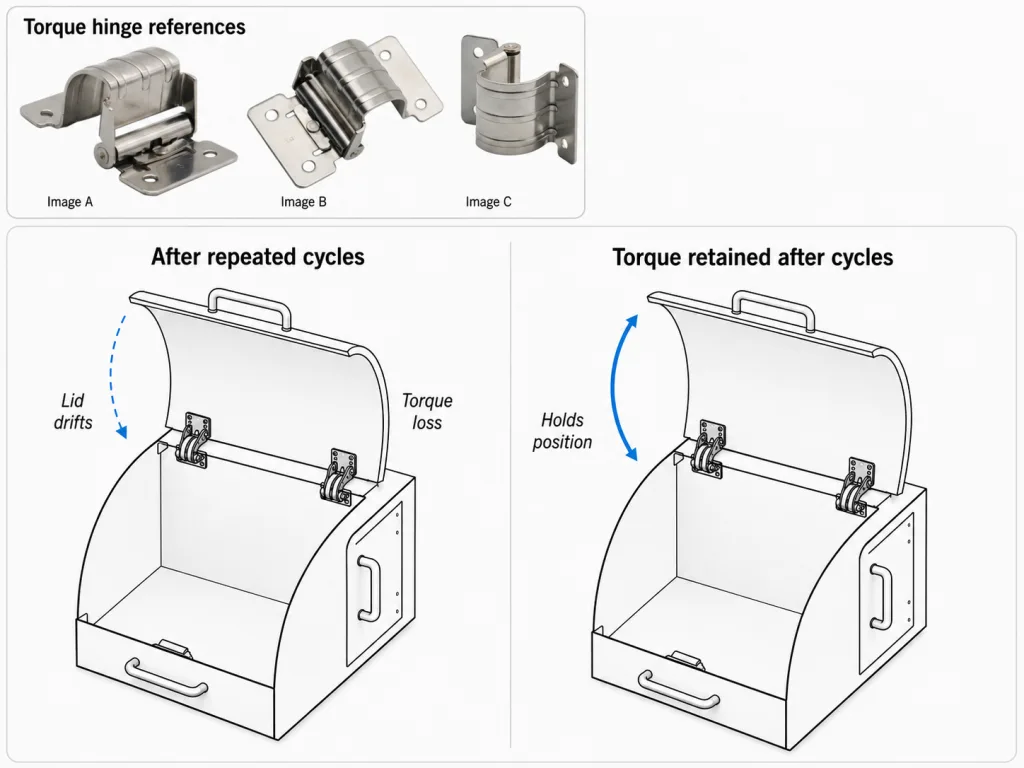
Caption:Cycle life should be judged by remaining holding torque after repeated cycles, not by cycle count alone.
| What buyers see | What it actually means |
|---|---|
| “25,000 / 30,000 cycles” | Cycled to that count under specific conditions — torque retention still must be checked |
| “±20% torque change” | Torque may rise or fall within 20% of the stated value |
| “Up to 25% torque loss” | Holding torque may be meaningfully lower after the test |
| “High cycle life” | Not meaningful unless test conditions and torque retention are defined |
The right hinge is rarely the one with the biggest cycle number. It is the one whose torque stays within the required range for the expected service life. Browse models with stated cycle and torque data in the torque hinges range.
What test conditions to confirm
Reliable cycle-life validation depends on how the test was run, so a catalog figure is not enough. When comparing suppliers, ask them to state each of these — and treat them as an RFQ requirement, not a vague claim.
| Test condition | Why it matters |
|---|---|
| Cycle count | How many open/close cycles were tested |
| Starting & final torque | Baseline before the test and torque remaining after it |
| Torque change rate | How much holding torque shifted after cycling |
| Opening angle & cycle rate | Larger angles wear differently; fast cycling builds heat inside the mechanism |
| Load condition | A no-load test may not match a real loaded panel |
| Temperature & environment | Heat, cold, humidity, salt, or dust change friction and effective life |
| Orientation & hinge count | Vertical vs horizontal loading, and single vs multi-hinge doors, behave differently |
Measure torque before and after cycling with the same fixture, direction, angle range, speed, dwell, temperature, and data-processing rule. See the hinge torque measurement setup and method.
How torque hinges degrade over cycles
Torque hinges decline through gradual change inside the torque-generating mechanism rather than sudden breakage:
- Friction wear: the surfaces that generate holding torque wear over repeated motion, so the hold weakens or feels inconsistent.
- Material fatigue: repeated cycling causes small deformation in the torque components, leading to drift or unstable movement.
- Heat buildup: in fast or high-cycle use, friction generates heat that can change lubrication, spring behavior, or internal fit.
- Contamination: dust, moisture, or particles entering the interface raise friction, cause noise, or accelerate wear.
- Corrosion: in humid, coastal, or washdown service, corrosion can bind or seize the hinge even before the mechanism reaches its mechanical limit — which is why environment must be part of the spec.
Because of corrosion and contamination, a plated hinge that holds torque smoothly indoors may not do so outdoors or under washdown. Material, finish, and internal construction should be validated for the environment — for example with ASTM B117 salt-spray evidence where corrosion is a risk.
How to specify cycle life (and the common mistakes)
Start from the application, not the catalog. Define: expected cycle count; required torque range (min/max); acceptable torque loss after cycling; torque change rate; panel load (weight, width, center of gravity); operating angle; temperature range; environment; cycle rate; and required test evidence. A strong requirement reads: “The torque hinge must maintain the required holding torque after the specified number of cycles under the defined load, angle, temperature, and environment” — far stronger than simply “Cycle life: 30,000 cycles.”
The recurring procurement errors to avoid: assuming a higher cycle number is automatically better; treating cycle life as “it didn’t break” rather than “it kept its torque”; accepting day-one torque instead of post-cycling torque; applying indoor test data to outdoor service; and assuming one-hinge test data represents a full multi-hinge door system. Before approving a hinge, run the sequence: define required torque → confirm panel weight/width/CoG → define expected cycle count → set acceptable torque loss → confirm torque change rate → confirm angle and cycle rate → confirm temperature → confirm environment → request test data → test in the real door system where risk is high.
If your application needs stable positioning over many cycles, do not choose by cycle number alone. Share the expected cycle count, torque-stability requirement, acceptable torque loss, operating temperature, environment, and panel load, and our engineering team can match the hinge to the application rather than the catalog figure.
FAQ
What is torque hinge cycle life?
It is the number of open/close cycles a torque hinge completes while still meeting its performance requirements — holding torque within range, smooth motion, and stable positioning. The cycle number is only meaningful alongside a torque-retention figure.
Does a higher cycle count always mean a better torque hinge?
No. A higher count only helps when torque retention and test conditions are also known. A hinge with more cycles but high torque loss may be worse for stable positioning than one with fewer cycles and tighter torque control.
What does torque change rate mean?
It is how much the hinge’s holding torque changes after cycling, usually stated as a percentage or an acceptable torque loss after a defined number of cycles. It often matters more than the cycle count itself.
What test conditions should I ask a supplier for?
Cycle count, starting and final torque, torque change rate, opening angle, cycle rate, load condition, temperature, environment, and test orientation.