-
+86 13720060320
-
lanna@haitangs.com

Lift-Off Hinges for Industrial Removable Access Panels
Maintenance technicians working on packaging lines, sanitary conveyors, electrical enclosures, and industrial machines often face the same access problem: a door or panel must be opened repeatedly, but the hinge or fastener system slows the work down.
Every screw that must be removed, every pin that requires a punch, and every access door that needs two people to handle adds non-value-added time. In high-uptime environments, these small delays accumulate into longer mean time to repair, slower sanitation cycles, delayed line changeovers, and higher labor cost.
A lift-off hinge solves this problem by allowing the door or panel to swing like a normal hinged door during operation, while still allowing the door to be lifted off when full access is required. For equipment builders and maintenance teams, the value is not only the hinge itself. The value is a faster, cleaner, and more repeatable access workflow.
This guide is part of our complete industrial hinges series. It explains how lift-off hinges support removable access panels, where they create the most operational value, and what engineers should specify before using them in industrial equipment.
Why Fixed Hinges Slow Down Maintenance Access
Conventional fixed-pin hinges, continuous hinges, or screw-mounted access panels can work well when a door only needs to open and close. The problem appears when the panel must be completely removed for cleaning, inspection, repair, line clearance, or component replacement.
A standard hinge may create several access limitations:
- The door remains attached and blocks the working area.
- The technician must work around the open door.
- Pins or screws may require special tools.
- Loose fasteners create foreign object risk.
- The door may require two people to remove safely.
- Gasket surfaces can be damaged during awkward handling.
- Cleaning crews cannot fully expose hidden hinge areas.
In food processing, pharmaceutical, packaging, and electrical enclosure applications, access time is not a small detail. It affects production availability, cleaning validation, maintenance safety, and equipment serviceability.
When equipment must be inspected or cleaned frequently, the hinge becomes part of the maintenance process. If the hinge makes access difficult, the entire process becomes slower.
What Lift-Off Hinges Change in the Access Workflow
A lift-off hinge is a two-piece hinge design. One side usually contains a fixed pin, while the mating side has a socket or receiver. During normal operation, the door functions like a hinged panel. When deeper access is required, the operator lifts the door vertically until the two hinge elements separate.
This creates a simple workflow:
- Open the door.
- Lift the panel upward.
- Remove the panel from the frame.
- Clean, inspect, repair, or replace components.
- Reinstall the door by lowering it back onto the hinge pins.
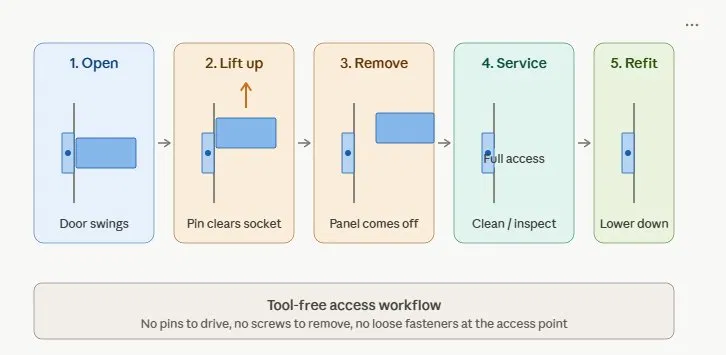
No driven pin needs to be removed. No screw set needs to be taken out. No loose fasteners need to be handled at the access point.
For standard product options, see our industrial lift-off hinges range.
The main benefit is not only speed. Lift-off hinges also make the access procedure more repeatable. This matters when the same door must be removed every shift, every sanitation cycle, or every maintenance interval.
Where Lift-Off Hinges Create the Most Value
Lift-off hinges are most useful where access panels must be opened frequently and occasionally removed completely. They are especially helpful when the cost of slow access is greater than the cost of the hinge.
| Application | Access Problem | Lift-Off Hinge Benefit |
| Food processing covers | Frequent sanitation, washdown, hidden residue, loose fastener risk | Tool-free panel removal and easier cleaning of hinge areas |
| Pharmaceutical equipment | Batch changeover, cleanroom access, particle control | Reduced loose hardware and more repeatable removal procedure |
| Bottling and packaging lines | Jam clearing, guide rail adjustment, frequent line changeover | Faster access during downtime events |
| Electrical enclosures | Door removal during wiring, inspection, or component replacement | Easier service access and reduced gasket handling damage |
| Data center containment panels | Repeated access to service panels or airflow control areas | Faster panel removal with less disruption |
| Machine guarding | Periodic inspection, belt access, or tooling change | Better access without converting the guard into a loose fastener assembly |
The common theme is simple: if the panel must be removed often enough that tools, pins, or screws become a bottleneck, a lift-off hinge deserves consideration.
Food Processing and Washdown Equipment
Food processing equipment often requires repeated cleaning, inspection, and line clearance. Access covers around conveyors, mixing tanks, filling heads, slicers, and packaging machines may need to be removed during sanitation.
Fixed hinges can create hygiene problems when:
- Product residue remains trapped around knuckles or pins.
- Moisture remains inside crevices after washdown.
- Fasteners must be removed and handled during cleaning.
- Panels cannot be fully separated from the machine frame.
- Operators skip difficult removal steps under time pressure.
Lift-off hinges help sanitation teams remove doors and covers more easily, exposing surfaces that would otherwise be difficult to clean. In washdown environments, engineers should also consider stainless steel material, surface finish, crevice control, hinge orientation, and whether a retained lift-off feature is required.
For food or washdown equipment, the hinge should not only be removable. It should also support a cleanable design.
For washdown equipment where removable access, cleaning conditions and hinge material must be considered together, see our Food Processing & Washdown Equipment Hinge Solutions page.
Pharmaceutical and Cleanroom Equipment
In pharmaceutical equipment, access panels are often removed during batch changeover, cleaning, swab sampling, maintenance, and inspection. The hinge system should support clean access without creating unnecessary particle, fastener, or handling risks.
Lift-off hinges can help by reducing the need for repeated screw removal around access panels. They also allow panels to be separated from the equipment body and placed on a clean surface or cart during maintenance.
However, not every lift-off hinge is suitable for cleanroom or pharmaceutical equipment. Engineers should review:
- Material grade
- Surface finish
- Wear behavior
- Particle generation risk
- Cleaning chemical compatibility
- Retention method
- Documentation requirements
The hinge should be evaluated as part of the equipment’s access and cleaning procedure, not as an isolated hardware item.
Electrical Enclosures and Control Cabinets
Electrical control panels, automation cabinets, and outdoor enclosures often require service access for wiring, DIN rail changes, inspection, and component replacement. A large enclosure door can be awkward to support while a technician works inside the cabinet.
Lift-off hinges allow the technician to remove the door when full access is needed. This can reduce stress on the gasket, improve working clearance, and make cable or component changes easier. If the cabinet door needs to hold open at a specific angle without removal, a torque hinge may be a better fit than a lift-off design.
For electrical enclosures, engineers should consider:
- Door weight
- Enclosure gasket compression
- IP or NEMA sealing requirements
- Door alignment after repeated removal
- Corrosion environment
- Grounding or bonding requirements
- Whether the door must be retained during normal operation
The hinge must support both serviceability and enclosure integrity. A removable door should not compromise seal performance or electrical safety.
Design Factors Engineers Should Specify
A lift-off hinge should not be selected only by leaf size. The installed door system determines whether the hinge will function smoothly over time. For a complete custom specification workflow, see our guide on custom hinges for OEM equipment.
| Specification Factor | Why It Matters |
| Lift-off clearance | Determines whether the door can be lifted high enough in the installed space |
| Door weight | Affects pin diameter, socket wear, hinge quantity, and handling safety |
| Door width | Influences sag, moment load, and latch alignment |
| Material grade | Impacts corrosion resistance, washdown suitability, and service life |
| Surface finish | Affects cleanability, appearance, and corrosion behavior |
| Retention feature | Prevents unintended lift-off under vibration, pressure, or accidental upward force |
| Mounting method | Affects alignment, welding distortion, installation repeatability, and maintenance access |
| Pin direction | Determines whether gravity keeps the door seated safely |
| Gasket interaction | Ensures repeated removal does not damage the sealing surface |
| Operating environment | Defines whether stainless steel, coating, or special protection is needed |
A good specification should define the whole access condition, not just the hinge dimensions.
Lift-Off Clearance: The Detail Many Designs Miss
Lift-off hinges require vertical movement before the door separates from the frame. This space is called lift-off clearance. If the cabinet, guard, or machine frame does not have enough clearance above the door, the hinge may be technically correct but impossible to use in the installed equipment.
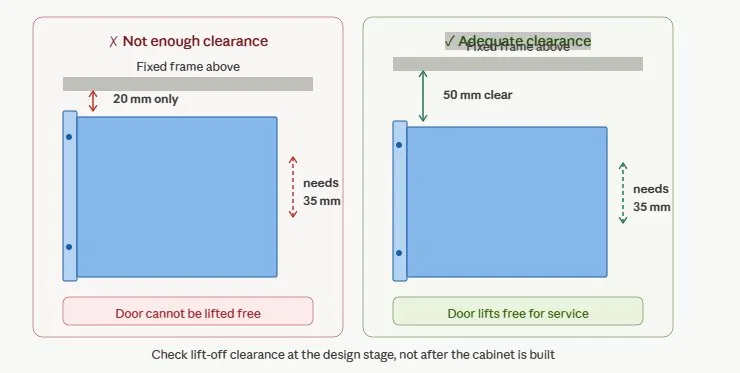
For example, if a hinge requires 35 mm of vertical lift but the panel is installed below a fixed frame with only 20 mm of available space, the door cannot be removed. The solution may be:
- A reduced-lift hinge design
- A different hinge orientation
- A revised panel layout
- A removable top stop
- A retained lift-off variant
- A different access hardware concept
Lift-off clearance should be checked during the design stage, not after the cabinet is built.
Retention and Anti-Lift Features
A pure lift-off hinge allows the door to separate whenever it is lifted upward. In many vertical door applications, gravity keeps the door seated. However, some equipment environments create upward or vibrating forces that can make unintended lift-off possible.
Retention may be needed when the panel is exposed to:
- Vibration
- Forklift impact risk
- Pneumatic pressure pulsation
- Inclined installation
- Mobile equipment movement
- Operator contact from below
- Safety guarding requirements
A retained lift-off hinge can use a locking tab, captive screw, spring feature, cam retainer, or secondary stop to prevent unintended separation while still allowing intentional removal during maintenance.
This is an important distinction. Engineers should not specify “lift-off” without also defining whether the panel must be retained during operation.
Lift-Off Hinges vs Other Quick-Access Hardware
Lift-off hinges are not always the best solution. They should be compared with other access hardware based on how the panel is used.
| Access Solution | Best For | Limitation |
| Lift-off hinges | Doors that must swing normally but occasionally remove completely | Requires lift clearance and correct orientation |
| Quarter-turn fasteners | Small inspection covers and lightweight panels | Panel becomes loose once fasteners are opened |
| Sliding panels | Linear access where space allows side movement | Tracks can collect debris or require alignment |
| Captive screws | Panels that must remain attached to hardware | Slower than lift-off removal for frequent access |
| Gas springs with fixed hinges | Heavy doors needing assisted opening | Door remains attached and may block access |
| Clamp doors | Pressure or sealing applications | Usually more specialized and cost-sensitive |
A lift-off hinge is strongest when the access panel must behave like a normal hinged door during operation, but also remove quickly for cleaning, inspection, or deep maintenance.
Total Cost of Ownership: Why Access Time Matters
Procurement teams often compare hinge cost only by unit price. For removable access panels, that approach can miss the larger operational cost.
A lift-off hinge may cost more than a basic fixed hinge, but it can reduce:
- Time spent removing panels
- Tool handling during maintenance
- Lost screws or damaged fasteners
- Two-person handling events
- Cleaning delays
- Door alignment problems after reassembly
- Risk of skipped cleaning or inspection steps
The higher hardware cost can often be justified when panels are removed frequently for sanitation, inspection, repair, or line changeover. This is why access hardware should be evaluated as part of total cost of ownership, not only as a small purchased component.
Common Specification Mistakes
Engineers and buyers should avoid these common errors when selecting lift-off hinges.
Selecting by Leaf Size Only
Leaf dimensions matter, but they do not define the full load path. Pin diameter, material thickness, socket geometry, and door width also affect performance.
Ignoring Lift-Off Clearance
If the installed equipment does not provide enough vertical space, the door cannot be removed even if the hinge itself is correct.
Using the Wrong Orientation
A lift-off hinge installed in the wrong direction can create a safety or security problem. Gravity should keep the panel seated unless a positive retention feature is used.
Overlooking Dynamic Load
A door may carry more than its own weight. Operators may lean on it, hang tools from it, or open it quickly. These loads can accelerate socket wear.
Ignoring Weld Distortion
For weld-on lift-off hinges, heat input can distort the pin or socket alignment. Fabrication procedures should control tack sequence, cooling, and final alignment.
Treating All Stainless Steel as Equal
304 and 316 stainless steel behave differently in corrosive environments. Material grade should be specified clearly for washdown, outdoor, or chemical exposure.
When to Choose Lift-Off Hinges
Lift-off hinges are a strong choice when the application requires:
- Frequent panel removal
- Tool-free access
- Faster maintenance
- Easier sanitation
- Reduced loose fastener risk
- Full access to internal components
- Repeatable removal and reinstallation
- Better serviceability across the equipment lifecycle
They may not be ideal when:
- There is not enough lift clearance.
- The door must never be removable.
- The panel opens upward and could disengage accidentally.
- A pressure-rated or safety-interlocked access system is required.
- The panel is too heavy for safe manual removal without additional handling support.
The best decision comes from reviewing the access workflow, not only the hinge drawing.
Frequently Asked Questions
What is a lift-off hinge?
A lift-off hinge is a two-piece hinge where one side has a fixed pin and the other has a socket. The door swings normally during operation, but can be lifted off the frame vertically when full access is needed, without removing any pins or screws.
How much lift-off clearance does a lift-off hinge need?
The vertical clearance must be greater than the pin engagement length, typically 25 to 50 mm depending on the hinge size. Always check the specific hinge specification and confirm at the design stage, before the cabinet or frame is built.
Do lift-off hinges need a retention feature?
Retention is recommended when the door may experience vibration, upward forces, pressure pulsation, inclined installation, or safety-critical conditions. A retained lift-off hinge uses a locking tab, captive screw, or cam retainer to prevent unintended separation while still allowing intentional removal.
Can lift-off hinges be used in food processing equipment?
Yes, and they are often preferred because they allow tool-free panel removal during sanitation. For food processing, specify stainless steel material, a cleanable surface finish, and review crevice control and hinge orientation as part of the cleaning procedure.
What is the difference between SUS304 and SUS316 lift-off hinges?
SUS304 is the standard choice for most industrial and indoor applications. SUS316 contains added molybdenum and is specified for marine, chemical, or food processing environments where chloride or aggressive cleaning exposure is a concern. Material grade should be matched to the operating environment.
Lift-Off Hinges Improve the Human Side of Maintenance
A lift-off hinge is a simple mechanical design, but its operational impact can be significant. By allowing an access panel to swing normally and remove quickly when needed, it changes how technicians, sanitation teams, and operators interact with equipment.
For OEMs, this can improve maintainability, reduce downtime, simplify cleaning procedures, and support better long-term equipment reliability. For end users, it can make everyday access faster, safer, and more predictable.
The key is proper specification. Engineers should define lift-off clearance, door weight, material grade, retention needs, mounting method, operating environment, and access frequency before selecting a hinge.
| Request Lift-Off Hinge Selection Support Send your door size, panel weight, mounting method, operating environment, and access requirements. Our engineering team can help review suitable lift-off hinge options for your equipment. Contact our engineers → |