-
+86 13720060320
-
lanna@haitangs.com

How to RFQ a Torque Hinge | 5-Step Sourcing Guide
A good torque hinge RFQ gives the supplier enough to quote the right part the first time: the load and geometry, the motion and hold requirement, the environment, and the production and documentation needs. The reason quotes come back wrong — or come back as a list of questions instead of a price — is almost always missing information, not supplier capability. In our experience handling torque hinge inquiries, the three things buyers most often leave undefined are the same three every time: the required torque, the actual panel or door weight, and how many hinges the design will use. Those three are linked — torque depends on the weight, the number of hinges, and the geometry — so when all three are blank, the supplier is quoting a guess. The five steps below close those gaps so the first quote is usable.
This guide is written for procurement specialists, project managers, and OEM buyers who have decided a torque hinge is the right component and now need to source it well. If you are still choosing the hinge type, start with how to choose an industrial hinge first, then come back to run the RFQ.
Quick answer — a torque hinge RFQ should include: the moving panel weight, the center-of-gravity distance from the hinge line, the opening angle, the number of hinges, the required torque if known, the cycle-life and torque-retention target, the operating environment, the material and finish, the annual volume and MOQ, the sample plan, the documentation needs (RoHS, REACH, material and test reports), and the target production date.
Step 1 — Define the application before you ask for a price
The most common reason an RFQ stalls is that it asks “what does a torque hinge cost?” before defining what the hinge has to do. A torque hinge is not a catalog commodity with one price — the same physical size can be built to very different torque values, materials, and finishes. So the first step is not a question to the supplier; it is a description of the application: what panel, lid, or display the hinge carries, what it must do (hold a viewing angle, stay open for service, close softly), and where the product is used. A supplier who understands the application can propose the right part; a supplier handed only a size can only quote a size.
Step 2 — Provide the load and geometry data
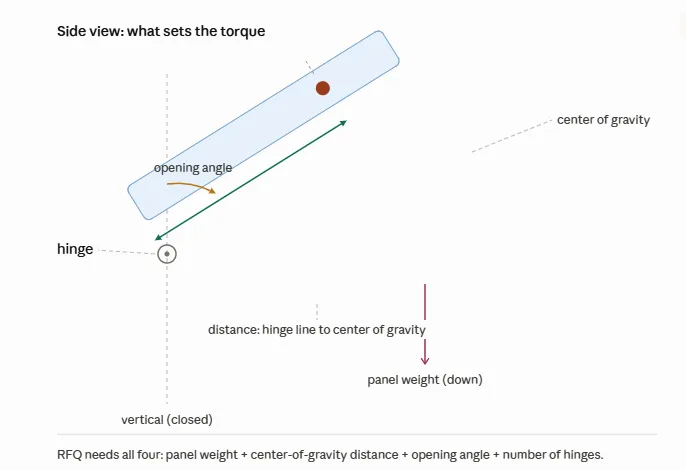
This is where the three most common gaps live. Give the supplier the real numbers: the weight of the moving panel (including the display, enclosure, cables, gasket, and any cover — not just the bare panel), the distance from the hinge line to the center of gravity, the opening angle, and how many hinges will share the load. These four values are what actually determine the torque, because the holding requirement is the moment — weight multiplied by the center-of-gravity offset — divided across the hinges used.
If you do not yet know the required torque, that is normal — but supply the load and geometry so it can be calculated rather than leaving the torque field blank. The torque hinge calculator turns panel weight, center-of-gravity distance, and angle into a target torque, so you can either provide the torque or provide the inputs that produce it. What slows an RFQ down is providing neither.
Step 3 — Specify performance, life, and environment
Torque alone does not define a hinge for an OEM program. State the performance the part has to hold over its life: the acceptable torque tolerance, the expected cycle count, and how much torque loss is acceptable after those cycles. A hinge that meets the torque on day one but fades after the panel is adjusted a few thousand times has failed functionally — so cycle life and torque retention belong in the RFQ, not in a complaint later. The distinction between surviving cycles and still holding after them is covered in the torque hinge cycle life guide.
Environment belongs here too. Tell the supplier where the product lives — indoor, outdoor, washdown, humid, coastal, or exposed to oils and cleaning chemicals — because it sets the material and finish, and a hinge that is right mechanically can still corrode and seize if the material is wrong. State whether the torque should be fixed at the factory or adjustable in the field, since that changes the part and the process; the trade-off is in the constant vs adjustable torque hinge guide.
Step 4 — State production, volume, and documentation needs
An RFQ is a production document, not just a technical one. State whether the OEM & ODM manufacturing route uses a customer-controlled drawing or an existing platform. Include the commercial and compliance requirements that determine whether a quote is real: the expected annual volume and order pattern, the target or required MOQ, whether you need samples before a production commitment, and what documentation the program requires — RoHS and REACH declarations, material certificates, test reports, or specific certifications. For OEM programs, also state the timeline: when you need samples and when production must start. These are not afterthoughts; a price quoted without a volume, a sample plan, or the required documents is not a quote you can act on, and clarifying them up front avoids a second and third round of back-and-forth. Browse the relevant models in the torque hinge range so the part numbers in your RFQ match what the supplier actually builds.
Step 5 — Ask the supplier the right questions back
A strong RFQ is two-directional: you provide the application data, and you ask the supplier to prove the part fits. Ask for the recommended torque range and tolerance for your load, the cycle-life and torque-retention behavior, the material and finish options for your environment, the mounting hole pattern and a CAD or 2D drawing, sample availability and lead time, the MOQ, and whether custom torque or dimensions are possible. The answers tell you as much about the supplier as the part — a supplier who can explain torque range, cycle life, and environmental suitability for your specific application is matching the hinge to your program, while one who simply restates a catalog number is not. If the part is critical, request a sample and validate it on the real assembly before committing to production.
Torque hinge RFQ template
Copy the block below into your inquiry and fill in what you know. Leaving the torque blank is fine as long as the weight, geometry, and hinge count are filled in — the supplier can calculate the torque from those.
TORQUE HINGE RFQ
----------------
Application (what the hinge carries / must do):
Moving panel weight (incl. display, enclosure, cables, cover):
Center-of-gravity distance from hinge line:
Opening angle:
Number of hinges:
Required torque (if known):
Constant or adjustable:
Cycle-life target:
Acceptable torque loss after cycling:
Operating environment (indoor / outdoor / washdown / coastal / chemical):
Material / finish preference:
Mounting method / hole pattern (attach drawing if available):
Annual volume / order pattern:
Target or required MOQ:
Sample quantity needed:
Required documents (RoHS / REACH / material cert / test report):
Target sample date / production start date:
Run these five steps and the supplier has what they need to quote the right hinge once, instead of trading questions for a week. If you are ready to source a torque hinge, share the panel weight, center-of-gravity distance, opening angle, hinge count, cycle target, and environment, and our engineering team can quote against the real application rather than a guess.
FAQ
What information does a torque hinge RFQ need?
At minimum: the moving panel weight, the distance from the hinge line to the center of gravity, the opening angle, the number of hinges, the cycle and torque-retention requirement, the operating environment, and the production volume and documentation needs. The most commonly missing items are the torque, the real panel weight, and the number of hinges.
What if I do not know the required torque?
That is normal at the RFQ stage. Provide the load and geometry instead – panel weight, center-of-gravity distance, opening angle, and hinge count – so the torque can be calculated rather than left blank. A torque calculator turns those inputs into a target value, and the supplier can confirm it.
How many torque hinges does an application need?
It depends on the panel weight, width, and the moment from the center of gravity. Heavier or wider panels often use two or more hinges to share the load, which also lowers the torque required from each. State your panel data in the RFQ and let the supplier confirm the count rather than guessing.
Should I request a sample before ordering torque hinges?
For any critical or high-volume application, yes. Request a sample and validate it on the real assembly – with the actual panel, frame, and cabling – before committing to production. A hinge that fits on paper can still drift or feel wrong in the finished product.
Can a supplier quote a torque hinge without the required torque?
Yes, but only if the RFQ includes enough load and geometry data. Provide the moving panel weight, center-of-gravity distance, opening angle, and hinge count so the supplier can calculate or recommend the torque range. A torque value alone, with no load behind it, is harder to quote against than the load data itself.