-
+86 13720060320
-
lanna@haitangs.com

Flag Hinge vs Lift-Off Hinge | Face-Mount vs Edge-Mount
A flag hinge and a lift-off hinge both let a door be removed without tools, but they mount differently: a lift-off hinge fits on the edge of the door and frame, while a flag hinge mounts on the face — which is why flag hinges win on frameless enclosures and retrofits where there is no edge to mount to. Both share the same core mechanism: an upper leaf that slides vertically off a fixed pin, so the door lifts away for service and drops back on. The decision between them is almost always about where you can put the hinge, not whether the door needs to come off. This guide covers when each one is the right call.
If you have already decided you need a removable door and just want products, the flag hinge range and the lift-off range both cover that — this page is about choosing between the two formats first.
Quick answer: which one fits
| Choose a flag hinge when… | Choose a lift-off hinge when… |
|---|---|
| The enclosure is frameless (no edge to mount on) | There is a door edge and frame edge to mount to |
| You need face-mount installation | Standard edge-mounting works for the cabinet |
| You are retrofitting onto an existing panel | The hinge is designed in from the start |
| The mounting surface is flat and accessible from the front | The door and frame edges are accessible |
| A clean offset-leaf look is acceptable or wanted | A conventional in-line hinge profile is preferred |
In short: both give you a tool-free removable door. Pick the lift-off when you have edges to mount to, and the flag when you only have a face — frameless cabinets, retrofits, and panels where edge-mounting is not possible.
What they share: the lift-off mechanism
It helps to start with what is the same, because it is most of the part. Both hinges are two-leaf designs built around a fixed vertical pin on one leaf and a matching curl or knuckle on the other. The door leaf simply slides up and off the pin, so the door can be removed by lifting it — no tools, no unscrewing, no removing the hinge from the door or frame. Drop the door back onto the pins and it is reinstalled. That tool-free removal is the whole reason to choose either format: it makes service access, cleaning, and panel replacement fast, which matters in electrical cabinets, food machinery, and any equipment where a technician opens things up regularly. A flag hinge is, in effect, a lift-off hinge with the leaves arranged for face-mounting instead of edge-mounting. So the question is never “do I want lift-off behavior” — both give it — but “how does the hinge attach to my cabinet.”
What sets them apart: where the leaves mount
A standard lift-off hinge mounts on the edges — one leaf on the edge of the door, the other on the edge of the frame, the way most hinges do. That is the natural choice when the cabinet has a proper frame with accessible edges, which most purpose-built enclosures do. The hinge sits in the gap between door and frame and keeps a conventional profile.
A flag hinge mounts on the face. Its leaves are offset — the name comes from the shape, one leaf carrying a vertical pin like a flagpole and the other curling over it like a flag — so both leaves can bolt flat onto the front surfaces of the door and frame rather than into the edges. That offset-leaf, face-mount design is what makes a flag hinge the standard answer for frameless enclosures, where there is no edge to put a normal hinge on, and for retrofit installations, where you are adding a removable door to an existing panel and can only reach the face. It is the same removability as a lift-off hinge, solved for a different mounting reality.
From the field: a flag hinge on an aluminum-extrusion cabinet
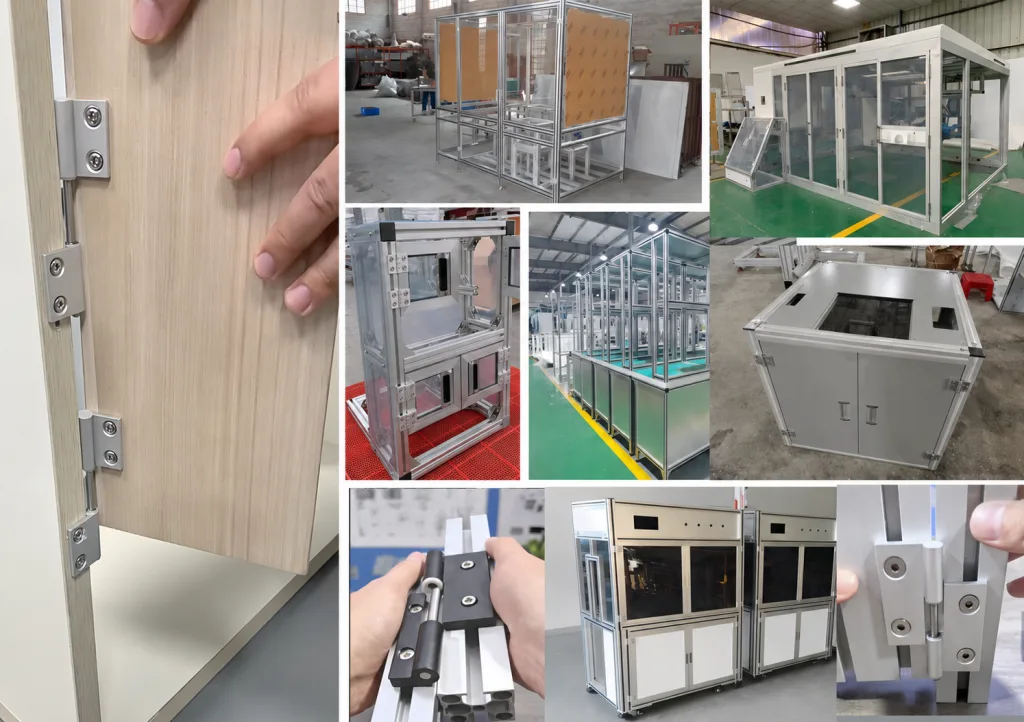
The cabinets shown here are a real example of where the flag format wins. They are built on aluminum-extrusion (T-slot) framing — the kind of profile-built equipment enclosure used for machine cells, test rigs, and instrument cabinets — with glazed or panel doors. On a frame like this there is no conventional door edge and frame edge to seat an edge-mounted hinge into; the natural mounting surface is the flat face of the extrusion. That is exactly the case a flag hinge is built for: its offset leaves bolt onto the face of the profile and the door, and the door still lifts off its pin for tool-free service access. The hinge in this build is a flag lift-off type, 80 × 50 mm in A6063-T5 aluminum with a sandblasted anodized finish — an aluminum hinge on an aluminum frame, which keeps the materials matched and avoids the galvanic corrosion you can get when dissimilar metals share a damp joint. Anodized aluminum handles both indoor equipment cabinets and outdoor-capable enclosures, while stainless remains the choice for the harshest washdown or coastal duty.
How to decide for your cabinet
The decision comes down to a short sequence. First, confirm the door actually needs tool-free removal — if it does not, a fixed bolt-on or concealed hinge may be simpler, and the broader trade-offs are in how to choose an industrial hinge.
If it does need to come off, the next question decides the format: do you have accessible door and frame edges to mount to? If yes, a standard lift-off hinge is the conventional, clean choice. If the enclosure is frameless, or you are retrofitting and can only reach the face, a flag hinge is the answer.
Beyond the format, a few engineering checks apply to both, and they decide whether the removable door behaves over its life rather than just on day one.
Mounting surface
This is the deciding check. An edge-mount lift-off hinge needs an accessible door edge and frame edge to seat into. A face-mount flag hinge needs a flat, accessible front surface — which is why it suits aluminum-extrusion frames, frameless panels, and retrofits where only the face is reachable. Confirm which surface your cabinet actually offers before choosing the format, because it settles the decision more often than any other factor.
Door load and alignment
Size by the moment from the door’s center of gravity, not the raw weight, and use enough hinges to share it — flag hinges include multi-leaf heavy-duty variants for long-span doors. Because both formats are removable, the detail that matters most over time is keeping alignment after repeated lift-off and reinstallation, where pin wear and door sag eventually show up; how to manage that is covered in the lift-off hinge guide.
Handing, material, and environment
Confirm the handing — these hinges are directional, so left-hand and right-hand versions must match the door swing. Match the material to the cabinet and its environment: anodized aluminum pairs cleanly with aluminum-extrusion frames and handles indoor and general outdoor use; zinc-plated or zinc-alloy suits dry indoor cabinets; and stainless steel is the choice for washdown, humid, or coastal duty. Watch for galvanic corrosion where dissimilar metals meet in a damp joint — matching the hinge metal to the frame, as with an aluminum hinge on an aluminum frame, avoids it.
RFQ checklist for removable-door hinges
To get an accurate quote for a flag or lift-off hinge the first time, give the supplier the application, not just a size. Copy and fill in:
REMOVABLE-DOOR HINGE RFQ
------------------------
Mounting surface available (edge / face):
Cabinet type (framed / frameless / aluminum extrusion / retrofit):
Door size (width x height):
Door weight:
Number of hinges:
Handing (left / right):
Removal direction (lift up):
Material / finish (aluminum anodized / stainless 304 / 316 / zinc):
Operating environment (indoor / outdoor / washdown / coastal):
Sample quantity needed:
With those defined, share them and our engineering team can confirm whether a flag or lift-off format fits and which model to use.
FAQ
What is the difference between a flag hinge and a lift-off hinge?
Both let a door lift off a fixed pin for tool-free removal. The difference is mounting: a lift-off hinge mounts on the door and frame edges, while a flag hinge has offset leaves that mount on the face. Flag hinges suit frameless enclosures and retrofits where there is no edge to mount to.
When should I use a flag hinge instead of a lift-off hinge?
Use a flag hinge when the enclosure is frameless, when you are retrofitting a removable door onto an existing panel, or when you can only reach the front face to mount the hinge. Use a standard lift-off hinge when the cabinet has accessible door and frame edges to mount to.
Why is it called a flag hinge?
The name comes from its shape: one leaf carries a fixed vertical pin like a flagpole, and the matching leaf curls over the pin like a flag wrapping around it. The offset-leaf form is what allows face-mounting instead of edge-mounting.
Can flag hinges support heavy industrial doors?
Yes, within the right model and count. Flag hinges include multi-leaf heavy-duty variants for long-span industrial doors. As with any hinge, size by the moment from the door’s center of gravity, not just the weight, and use enough hinges to share the load.
Is a flag hinge the same as a lift-off hinge?
A flag hinge uses the same lift-off, removable-door principle, but its leaves are arranged for face mounting. A standard lift-off hinge usually mounts on the door and frame edges, while a flag hinge mounts on the front face of the cabinet or panel – which is why it suits frameless and aluminum-extrusion frames.
What information should I provide before ordering flag or lift-off hinges?
Provide the mounting surface (edge or face), cabinet type, door size and weight, hinge count, handing, removal direction, material and finish, and operating environment. These let the supplier confirm whether a face-mount flag hinge or an edge-mount lift-off hinge is the better fit.