-
+86 13720060320
-
lanna@haitangs.com

How to Compare Torque Hinge Quotes
The lowest torque hinge quote is not necessarily the lowest-cost approved option.
One supplier may include a controlled drawing, production tooling, sample inspection, packaging, and the requested documents. Another may quote only a catalog hinge at a lower unit price, with testing, tooling, freight, and revision work excluded. The two prices are not yet comparable.
To compare torque hinge quotes, first remove any option that does not meet the mandatory technical baseline. Then normalize the commercial scope: part identity, quantity, one-time charges, samples, evidence, lead time, freight responsibility, payment terms, and change control.
This page starts after quotations have arrived. For the information needed before suppliers quote, use the torque hinge RFQ guide.
Technical EligibilityA low price cannot compensate for an unresolved torque, geometry, material, or retention gap.
Normalized ScopeCompare the same part revision, quantity basis, included evidence, packaging, and delivery responsibility.
Program CostSeparate recurring piece price from tooling, samples, testing, freight, and later change cost.
Price Comparison Starts After Technical Eligibility
A quotation is not commercially comparable until the quoted hinge has passed the mandatory engineering requirements. The supplier may offer a lower price because the part uses a different torque definition, a wider tolerance, another material, an obsolete drawing, a lighter mounting structure, or no retention evidence.
Do not convert those differences into a weighted price score. A hinge that cannot support the required panel behavior should be placed on hold, not rewarded for being inexpensive.
| Technical Gate | Required Comparison | Quote Status When Unresolved |
|---|---|---|
| Part identity | Exact model, configuration, drawing number, and revision | Hold |
| Torque requirement | Same torque term, range, direction, angle, and tolerance | Hold |
| Mechanical interface | Hole pattern, axis location, envelope, fasteners, and installation orientation | Hold |
| Material and finish | Same construction and environmental requirement | Hold |
| Retention or life evidence | Equivalent project target and evidence condition | Hold or clarification required |
The detailed method for comparing torque definitions, curves, sample variation, and cycle evidence belongs in the constant torque hinge supplier-specification comparison. For adjustable models, define usable range, access, locking, and post-lock shift using the adjustable torque hinge specification guide.
Commercial rule: Only quotes that pass the mandatory technical baseline should enter the price comparison. Missing technical information is not a small commercial disadvantage; it prevents a defensible comparison.
Build One Quote Normalization Sheet
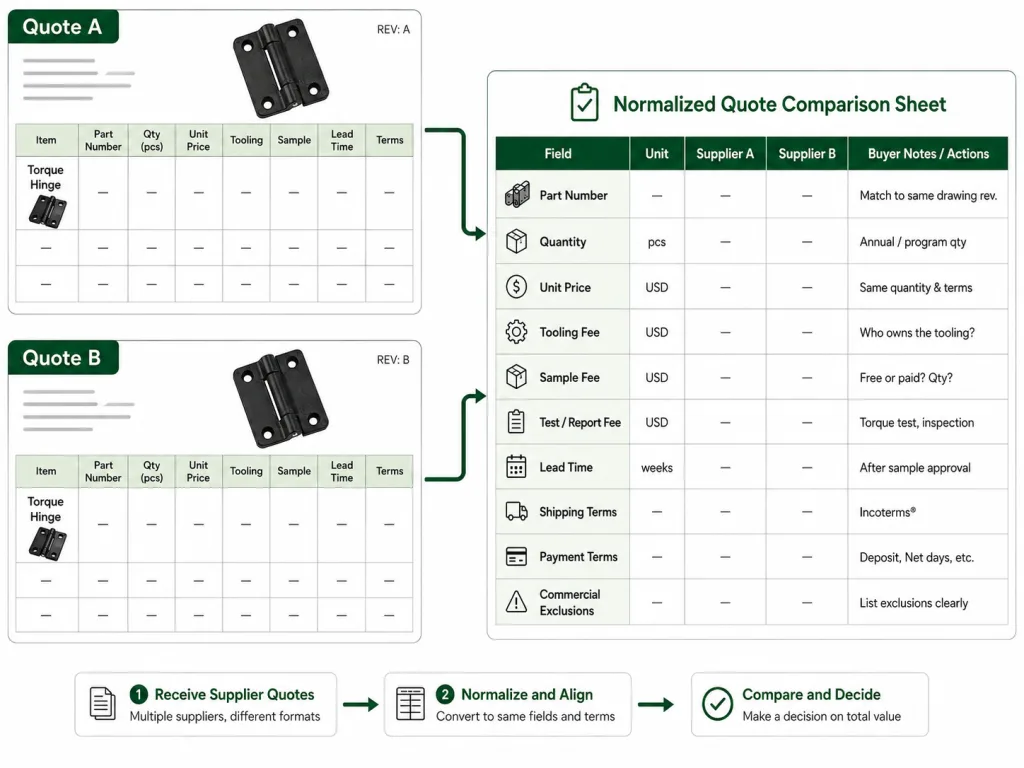
Supplier quotations rarely use the same structure. One quote may show an EXW piece price and separate tooling. Another may include export packaging and list a price break at a different quantity. A third may bundle sample inspection and documentation into the unit price.
Move every quote into one buyer-controlled sheet. Keep the supplier’s original wording in a source column, then record the normalized interpretation and any open question. Do not silently assume that a blank field is included.
| Normalization Field | Supplier A | Supplier B | Buyer-Controlled Comparison |
|---|---|---|---|
| Quoted part and revision | Record exact wording | Record exact wording | Must match the approved baseline |
| Quantity basis | Order quantity or annual volume? | Order quantity or annual volume? | Convert to the same purchase scenario |
| Unit price | Currency and price break | Currency and price break | Compare at the same quantity and scope |
| One-time charges | Tooling, setup, fixtures, reports | Tooling, setup, fixtures, reports | Separate recurring and nonrecurring cost |
| Sample scope | Quantity, configuration, inspection | Quantity, configuration, inspection | Confirm samples match production intent |
| Delivery basis | Incoterm, named place, freight scope | Incoterm, named place, freight scope | Normalize landed-cost responsibility |
| Lead time | Starting event and dependencies | Starting event and dependencies | Separate sample and production timing |
| Documents included | Drawing, material record, test report | Drawing, material record, test report | List included, optional, and unavailable items |
| Commercial exclusions | Record every exclusion | Record every exclusion | Convert hidden scope into an open action or cost |
Quote Gaps That Need Immediate Clarification
A supplier-side review exposes the biggest comparison problem: one quotation may include the controlled drawing, sample inspection, tooling, packaging, and required documents, while another lists only a unit price. The buyer is not comparing two suppliers yet. The buyer is comparing two different scopes.
- No exact part number or drawing revision: the price cannot be tied to one controlled configuration.
- An undefined quantity basis: annual volume, order quantity, and shipment quantity may produce different prices.
- “Testing included” without a named report: the quote does not identify the test condition, data, or document to be delivered.
- A tooling charge without ownership or tool identification: payment alone does not define control, transfer rights, or maintenance responsibility.
- A lead time without a starting event: the clock may begin after deposit, drawing approval, tooling completion, or sample approval.
- Required approval evidence listed as optional or excluded: the lower price may not support sample or production approval.
Hold the quote when scope is missing. A blank field is not evidence that the item is included. Send the same clarification list to every supplier and compare only the revised, written responses.
Separate Piece Price From Program Cost
The piece price is only the recurring cost of the quoted item under a stated quantity and scope. It does not automatically include tooling, sample preparation, dimensional reports, torque testing, special packaging, export documentation, or later drawing changes.
Keep recurring and nonrecurring charges separate. This makes it possible to compare both the first purchase and the expected program volume without hiding a large setup charge inside a low piece price—or the reverse.
Unit price, routine packaging, normal inspection, and recurring documentation explicitly included in each shipment.
Tooling, engineering setup, fixtures, first-article work, qualification testing, or document preparation.
Charges triggered by small orders, expedited delivery, design changes, special reports, requalification, or unusual packaging.
A useful comparison calculates the cost for at least two realistic scenarios: the first approved order and the expected annual purchasing pattern. Do not divide tooling over an unrealistic lifetime volume only to make one quote look inexpensive.
Generic cost structure: First-order program cost = recurring part cost + one-time charges + sample and qualification cost + packaging and delivery cost + any known project-specific fees. The inputs are project-specific; this is a comparison structure, not a universal costing formula.
MOQ and Price Breaks Need the Same Demand Scenario
A supplier can quote against minimum order quantity, shipment quantity, annual demand, blanket-order volume, or an assumed production forecast. These are not interchangeable.
Suppose Supplier A offers a lower price at 10,000 pieces but requires one shipment and full payment against that order. Supplier B quotes a higher unit price for four scheduled releases of 2,500 pieces. The lower nominal price may create more inventory, cash exposure, storage, and obsolescence risk.
| Quantity Term | What Must Be Defined | Comparison Risk |
|---|---|---|
| MOQ | Minimum per part, revision, finish, order, or shipment | A low price may require excessive inventory. |
| Price break | Quantity per order, release, month, or year | Suppliers may be pricing different demand assumptions. |
| Blanket order | Commitment, release schedule, storage, and cancellation terms | The buyer may carry liability even when shipments are delayed. |
| Mixed models | Whether related hinge models or finishes can share the MOQ | Product families may not receive the same price treatment. |
| Forecast basis | Nonbinding forecast or committed volume | A forecast price may be revised when actual demand is lower. |
Compare the quotation against a realistic purchasing pattern, not only the largest theoretical annual volume. A buyer should know the cost at prototype, launch, normal production, and lower-than-forecast demand.
Tooling Price Is Only One Part of Tooling Control
Custom leaves, hole patterns, shafts, friction components, fixtures, gauges, or assembly tools can create nonrecurring charges. The quotation should identify what the charge creates, who controls it, and the supplier manufacturing capabilities behind the proposed production route.
| Tooling Field | Required Quote Detail | Buyer Risk When Missing |
|---|---|---|
| Tool description | Production tool, prototype fixture, gauge, die, mold, or assembly aid | The buyer cannot tell what has been purchased. |
| Ownership | Supplier-owned, buyer-owned, or dedicated-use arrangement | Transfer or reuse rights remain unclear. |
| Location and identification | Site, tool number, and configuration | The tool may not be traceable to the project. |
| Useful life | Expected output or maintenance basis, when available | Replacement charges may appear later. |
| Maintenance | Routine care, repair responsibility, and approval for major work | The piece price may exclude predictable maintenance. |
| Change impact | Effect of drawing changes on the existing tool | A minor design revision may require new tooling. |
Do not assume a tooling payment automatically gives the buyer unrestricted ownership or transfer rights. The commercial agreement and supplier confirmation must define those points for the actual project.
Free Samples and Paid Evidence Are Not the Same Offer
A free catalog sample may help with early fit and feel. It may not represent the quoted production revision, material, finish, torque setting, inspection condition, or manufacturing process.
Compare sample scope and evidence scope separately:
Part number, drawing revision, configuration, lot, torque setting, and any prototype deviation.
Dimensions, material or finish records, torque data, and the acceptance method supplied with the sample.
Fixtures, cycle work, environmental exposure, report format, third-party charges, and retest conditions.
A supplier may include a basic inspection report but charge separately for a torque-angle curve, cycle-retention report, material certificate, special dimensional layout, or third-party test. Another may include those documents in a higher initial price. To compare inspection and validation capabilities, the buyer needs the delivered evidence list, not only the words “testing included.”
The Lower Quote Excluded the Approval Evidence
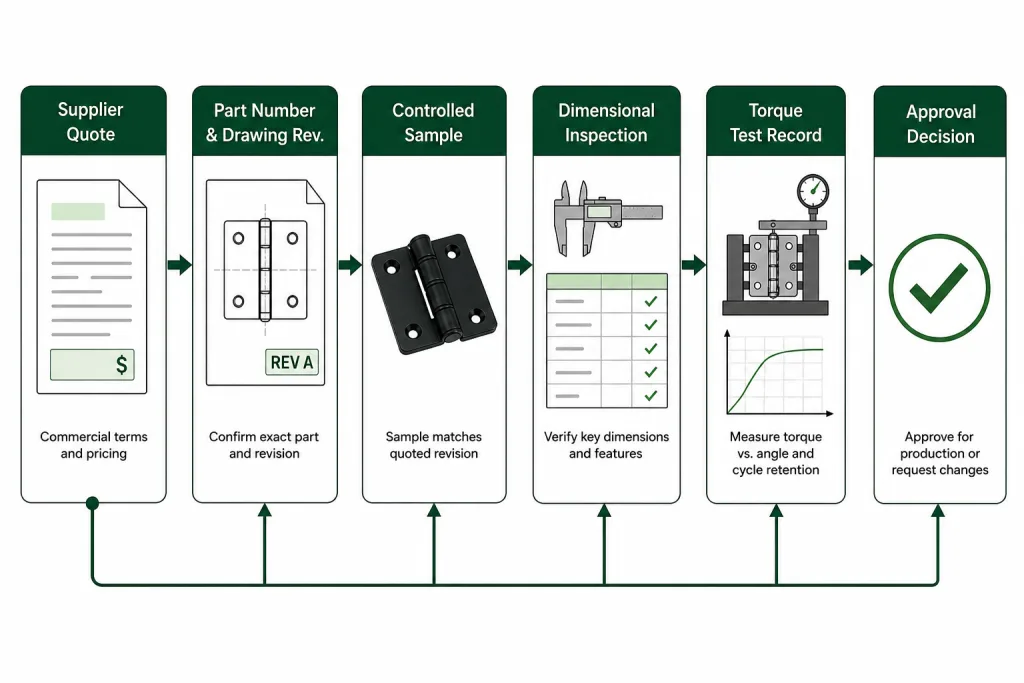
Supplier A quotes a lower unit price and free samples. The samples are catalog stock with no link to the proposed production drawing. Torque testing, a controlled report, and a custom inspection fixture are excluded. Supplier B quotes a higher unit price but includes samples from the intended configuration, a revision-linked drawing, and the requested measurement report. Supplier A may still become competitive, but only after the missing evidence and setup cost are added.
This is an illustrative engineering scenario, not a customer project record or product test claim.
Claims That Need Written Evidence
- “Production sample” should identify the part number, drawing revision, material or finish, lot, and any approved prototype deviation.
- “Torque tested” should identify the torque term, direction, angle, speed or method, sample quantity, and report reference.
- “Tooling included” should identify the tool or fixture, ownership, location, and work covered by the quoted charge.
- “Lead time confirmed” should identify the starting event, dependencies, quantity, and whether the timing applies to samples or production.
Lead Time Must Have a Defined Starting Event
“Four weeks” is incomplete unless the quote states what starts the clock. The supplier may count from purchase order, deposit, drawing approval, sample approval, material arrival, or tooling completion.
| Timing Field | Required Definition | Why It Changes the Decision |
|---|---|---|
| Engineering response | Time to return drawing, questions, or technical proposal | A fast production promise can still begin after a long technical delay. |
| Sample lead time | Starting event, sample quantity, and configuration | Catalog samples and production-intent samples have different timing. |
| Tooling lead time | Design, manufacture, tryout, correction, and approval dependencies | “Tool complete” may not mean approved parts are available. |
| Production lead time | Order quantity, material status, and starting event | Lead time may reset after drawing or payment changes. |
| Capacity | Normal output, peak output, and notice required | A supplier may meet launch volume but not the later ramp. |
| Recovery plan | Response to failed samples, material delay, or rejected lot | The lowest quote may create the longest schedule exposure. |
Do not convert an undefined lead-time statement into a precise schedule date. Record dependencies and request a milestone sequence when timing affects launch or qualification.
Delivery Terms Change the Landed Comparison
A quotation may include or exclude export packing, freight, insurance, duties, brokerage, taxes, and delivery to the buyer’s facility. Record the named Incoterm and named place exactly as quoted, then have the responsible commercial or logistics team confirm the actual obligation for the shipment route.
| Commercial Field | What to Normalize | Open Question |
|---|---|---|
| Currency | Quoted currency and comparison date | Who carries exchange-rate exposure? |
| Delivery term | Incoterm and named place | Where does cost and responsibility change? |
| Packaging | Standard, export, individual protection, returnable, or custom | Is packaging included in the piece price? |
| Freight | Mode, consolidation assumption, and charge responsibility | Is freight quoted, estimated, prepaid, or excluded? |
| Payment | Deposit, balance timing, credit terms, and tooling payment | How does cash timing differ between suppliers? |
| Quote validity | Expiration date and revision conditions | Which fields may change after validity expires? |
| Taxes and duties | Included, excluded, or buyer-responsible | Which team will confirm the actual obligation? |
Keep stable engineering conclusions separate from variable commercial inputs. Currency, freight, duty, tax, and price validity should sit in a clearly dated section of the comparison sheet so they can be updated without rewriting the technical review.
Revision Control Protects the Quote After Selection
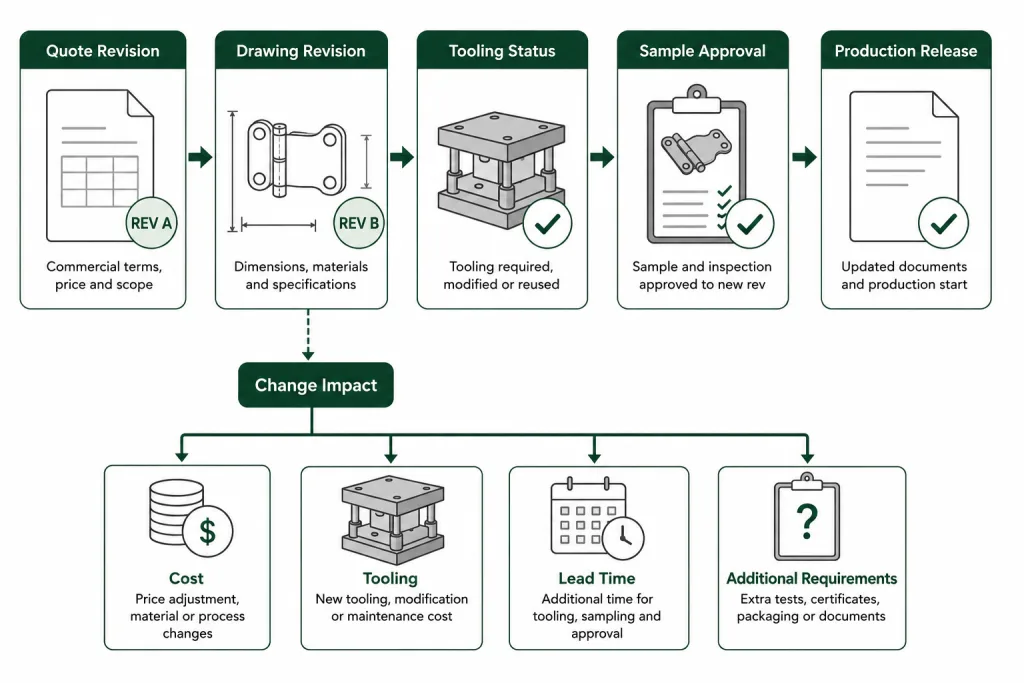
A quotation is tied to a technical and commercial baseline. If the drawing, torque setting, material, finish, inspection method, packaging, volume, or delivery schedule changes, the original price and lead time may no longer apply.
The quote should identify the controlled documents and the process used to review cost, tooling, evidence, and timing after a revision.
| Change-Control Field | Required Clarification | Decision Impact |
|---|---|---|
| Quoted revision | Drawing, specification, and quote revision | Prevents price from being compared against different technical scopes. |
| Supplier substitution | Approval required for material, lubricant, finish, or process change | Protects performance and traceability. |
| Buyer revision | Method for reviewing cost, timing, tooling, and requalification impact | Reveals how flexible the commercial model is. |
| Price review | Defined triggers, notice, and supporting basis | Separates a fixed quote from a temporary estimate. |
| Discontinuation notice | Notice period and last-time-buy process, when applicable | Reduces late program supply risk. |
| Record retention | Drawing, inspection, and report traceability period | Supports later investigation and repeat orders. |
Use Pass, Compare, or Hold
A single weighted supplier score can hide a disqualifying omission. Separate mandatory gates from commercial advantages.
| Review Area | Pass | Compare | Hold |
|---|---|---|---|
| Technical baseline | Quoted part meets all mandatory requirements | Minor documented difference remains acceptable | Torque, geometry, material, or retention gap is unresolved |
| Scope identity | Part, revision, quantity, and included work are explicit | Small wording difference is clarified | Quote cannot be tied to one controlled scope |
| Recurring price | Same quantity and included scope | Price breaks differ but can be normalized | Unit price is based on an incompatible volume or scope |
| One-time charges | Tooling, samples, testing, and reports are identified | Optional work can be added transparently | Required approval work is excluded or unpriced |
| Lead time | Starting event and dependencies are defined | Timing differs but supports the project | Promise has no controlled start or approval basis |
| Delivery and payment | Commercial responsibility is clear | Terms differ but can be priced | Material landed-cost responsibility is unresolved |
| Change control | Revision and change process are defined | Additional agreement is manageable | Supplier may change critical scope without an approval path |
Only suppliers with every mandatory field in Pass or an accepted Compare condition should reach the final commercial shortlist. A Hold result is not a rejection when information can still be supplied. It means the buyer cannot yet make a controlled decision.
Close the Quote Gaps Before Award
Send each supplier the same clarification list. Do not rewrite the requirement differently for every supplier, or the revised quotes will remain incomparable.
- Part number and configuration
- Drawing and revision
- Torque setting or range
- Material and finish
- All technical deviations
- Currency and validity
- MOQ and price breaks
- Recurring unit price
- One-time charges
- Conditional charges
- Sample quantity and identity
- Included inspection records
- Included test reports
- Optional evidence charges
- Retest and correction terms
- Lead-time starting event
- Packaging and delivery basis
- Payment terms
- Tool ownership and maintenance
- Revision and change-control process
Request a Comparable HSP Quote
Send the application drawing, required torque behavior, quantity scenario, material and finish requirement, sample scope, document list, and target timing. HSP can quote against the same baseline you use for the other suppliers.
Torque Hinge Quote Questions
Can I compare torque hinge quotes by unit price alone?
No. Unit price is comparable only after the quoted hinge, drawing revision, torque requirement, quantity basis, tooling, testing, packaging, freight scope, and commercial terms are aligned. A lower unit price can still produce a higher approved-program cost when required items are excluded.
What should I do when two suppliers quote different hinge models?
First decide whether both models meet the same mandatory technical baseline. Do not average technical differences into a commercial score. Place any quote with an unresolved torque, geometry, material, or retention gap on hold before comparing price.
Should tooling be included in the piece price?
Either structure can be acceptable, but the quote must state the amount, ownership, maintenance responsibility, expected life, replacement conditions, and whether the tool is dedicated to the buyer. Normalize the total cost over the expected program volume instead of comparing only the visible unit price.
How should sample and testing charges be compared?
Separate sample parts, custom setup, fixtures, reports, third-party testing, and shipping. Confirm what evidence will be delivered and whether the sample configuration matches the production drawing. A paid sample with traceable data may be more useful than a free sample with no controlled identity.
Does the shortest quoted lead time always make the supplier better?
No. Lead time is useful only when its starting event, material status, tooling status, approval dependencies, and order quantity are defined. Compare sample lead time, production lead time, and recovery capacity separately.
What information should be requested when a quote is incomplete?
Request the exact part number and drawing revision, quantity basis, price breaks, tooling and sample charges, included documents, lead-time definition, packaging, freight scope, payment terms, quote validity, change-control process, and all technical or commercial exclusions.
Technical and commercial limitation: This article provides a comparison framework, not project-specific engineering approval, legal advice, tax advice, customs advice, or a binding cost calculation. Technical eligibility must be confirmed against the controlled hinge specification and complete assembly. Commercial responsibilities, tooling ownership, payment obligations, delivery terms, and change conditions must be confirmed in the actual quotation and purchase agreement.