-
+86 13720060320
-
lanna@haitangs.com

Bushed vs Non-Bushed Industrial Hinges: Wear, Fit and Serviceability
Adding a bushing to an industrial hinge is easy to describe as an upgrade. It adds a separate bearing surface, can move wear away from the hinge body and may create a replaceable component. But it also adds another fit, another retained part and another assembly condition that has to remain correct after installation.
That is why the useful comparison between bushed vs non-bushed industrial hinges is not “which one is better?” The practical question is whether controlling the wear surface is valuable enough to justify the extra interface.
For some access doors, a large pin running directly in a substantial barrel is the simpler and more economical design. For other equipment, allowing an expensive welded hinge body to become the wearing surface makes little sense when a serviceable bushing could take most of that wear instead.
Quick decision: a direct pivot is a strong candidate when the duty is moderate, the bearing area is generous and replacing the complete hinge is straightforward. A bushed pivot becomes more attractive when repeated movement, controlled wear location or future service of an expensive hinge assembly matters.
What Actually Changes When You Add a Bushing?
Start with the sliding interface.
In a non-bushed pivot, the pin runs directly against a structural bore, barrel or knuckle. The same component that locates and supports the pin also participates in the bearing surface. Wear therefore occurs directly in the hinge structure, on the pin, or on both.
A bushed pivot inserts another component between those two parts. The pin runs against the bushing ID, while the bushing OD is retained by the surrounding hinge housing or knuckle.
This does not remove wear. It changes where the designer expects wear to occur.
| Pivot Question | Non-Bushed Direct Pivot | Bushed Pivot |
|---|---|---|
| Primary sliding interface | Pin against structural bore or knuckle | Pin against separate bushing |
| Structural part participates in wear? | Yes | Normally reduced if the intended pin/bushing interface remains controlled |
| Separate wear component | No | Yes |
| Additional retained fit | No bushing-to-housing fit | Yes |
| Potential field replacement | Pin or complete hinge, depending on wear | Pin and/or bushing if the housing and access remain serviceable |
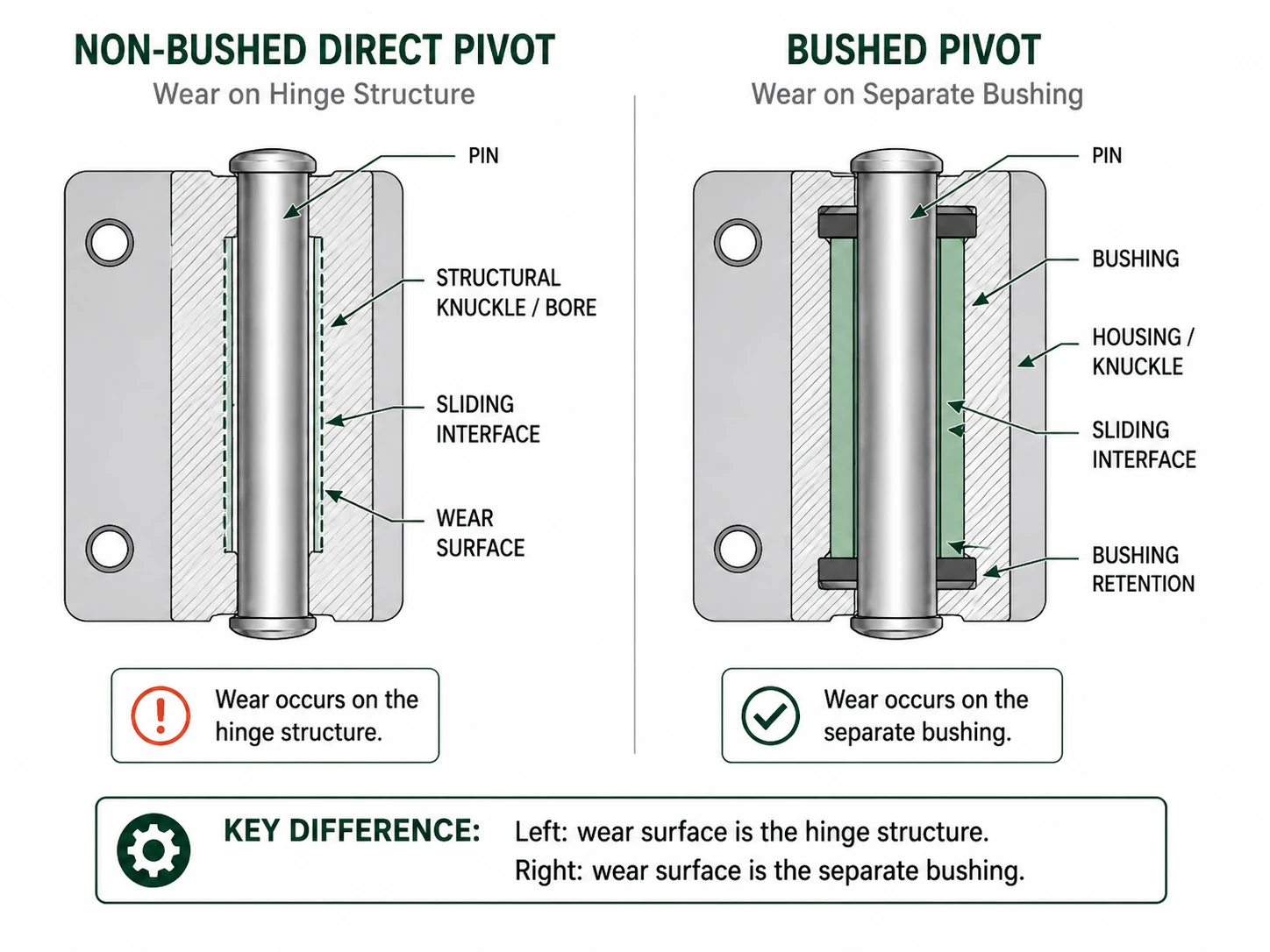
The distinction matters most after wear begins. A new direct pivot and a new bushed pivot can both feel smooth on the bench. Their real difference may not become important until the joint develops clearance and somebody has to decide what can actually be restored.
When a Direct Pivot Is the Better Design
A separate bushing should solve a real problem. If it does not, the simpler pivot may be the better engineering choice.
Consider a fabricated equipment door that opens occasionally during inspection. The hinge has a substantial pin, enough bearing length, good alignment and a mounting position where the complete hinge can be replaced without dismantling the machine. In that situation, adding a bushing may increase manufacturing control without reducing a meaningful service risk.
Bearing length matters because the same pivot reaction can be concentrated over a short contact zone or distributed across a longer one. A large nominal pin diameter does not automatically make a direct pivot forgiving if only a small portion of the bore is actually carrying the load.
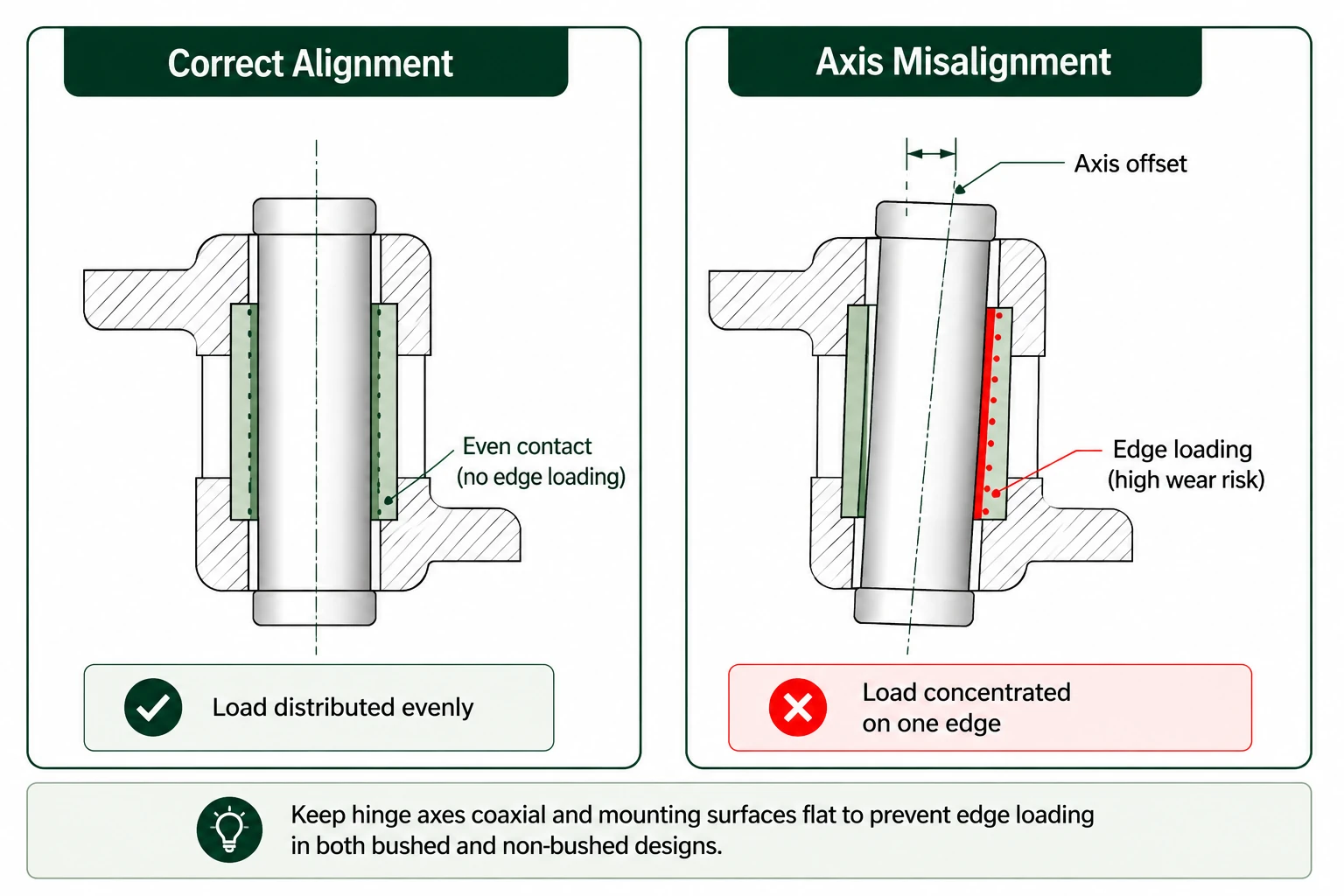
For a direct pivot, look at usable bearing length together with axis alignment and housing stiffness. When contact remains reasonably distributed through the intended bearing region, direct pin-to-bore wear may be acceptable. If fabrication error or deflection drives the pin against one narrow edge, local pressure and wear can rise even though the pin itself appears generously sized.
The direct design also has fewer interfaces. There is no bushing outside diameter to retain and no thin sleeve whose installed bore can change when pressed into the housing. Fewer parts can be useful where fabrication tolerances are relatively coarse or where the joint needs to remain straightforward to inspect and manufacture.
Direct metal contact does not automatically mean poor friction or short service life. The result still depends on pin material, mating surface, bearing area, alignment, contamination and lubrication. The important limitation is that once significant wear reaches the structural bore, replacing only the pin may not restore the original geometry.
Direct-pivot advantage: fewer parts and fewer controlled fits. Direct-pivot cost: the hinge structure itself may become part of the wear repair.
When a Bushing Earns Its Cost
A bushing becomes easier to justify when the cost of wearing the structural hinge is higher than the cost of managing the additional bearing component.
This often happens when the hinge body is welded into an equipment frame, difficult to access or expensive to realign after replacement. If the design allows the bushing to carry the intended sliding contact, wear can be concentrated in a component that is cheaper to replace than the surrounding hinge structure.
Repeated operating duty can strengthen the case as well. The reason is not that every bushing automatically wears less. The value is that the designer can choose the bearing interface separately from the structural hinge material.
Operating duty is more than a cycle count. A small access door moving through a limited angle hundreds of times during a shift creates a different bearing condition from a service cover that swings through a large angle only a few times each month. Starts from rest, dwell time, bearing pressure, contamination and the expected equipment life can all change what matters at the sliding interface.
For that reason, “high cycle” is a reason to examine the bearing interface more closely, not an automatic instruction to add a bushing. A bushed pivot still has to suit the real motion, load, environment and maintenance strategy.
A steel hinge body may be selected for strength and weldability, while the sliding interface may need different friction, lubrication or contamination behavior. Separating those functions can be useful when one material would otherwise have to satisfy conflicting requirements.
The exact bushing material should be selected only after the architecture is justified. Polymer, composite and metallic bushings do not have interchangeable temperature, lubrication or load limits. Those decisions belong in the industrial hinge bushing material and lubrication guide.
The Trade-Off: Controlled Wear Creates Another Fit
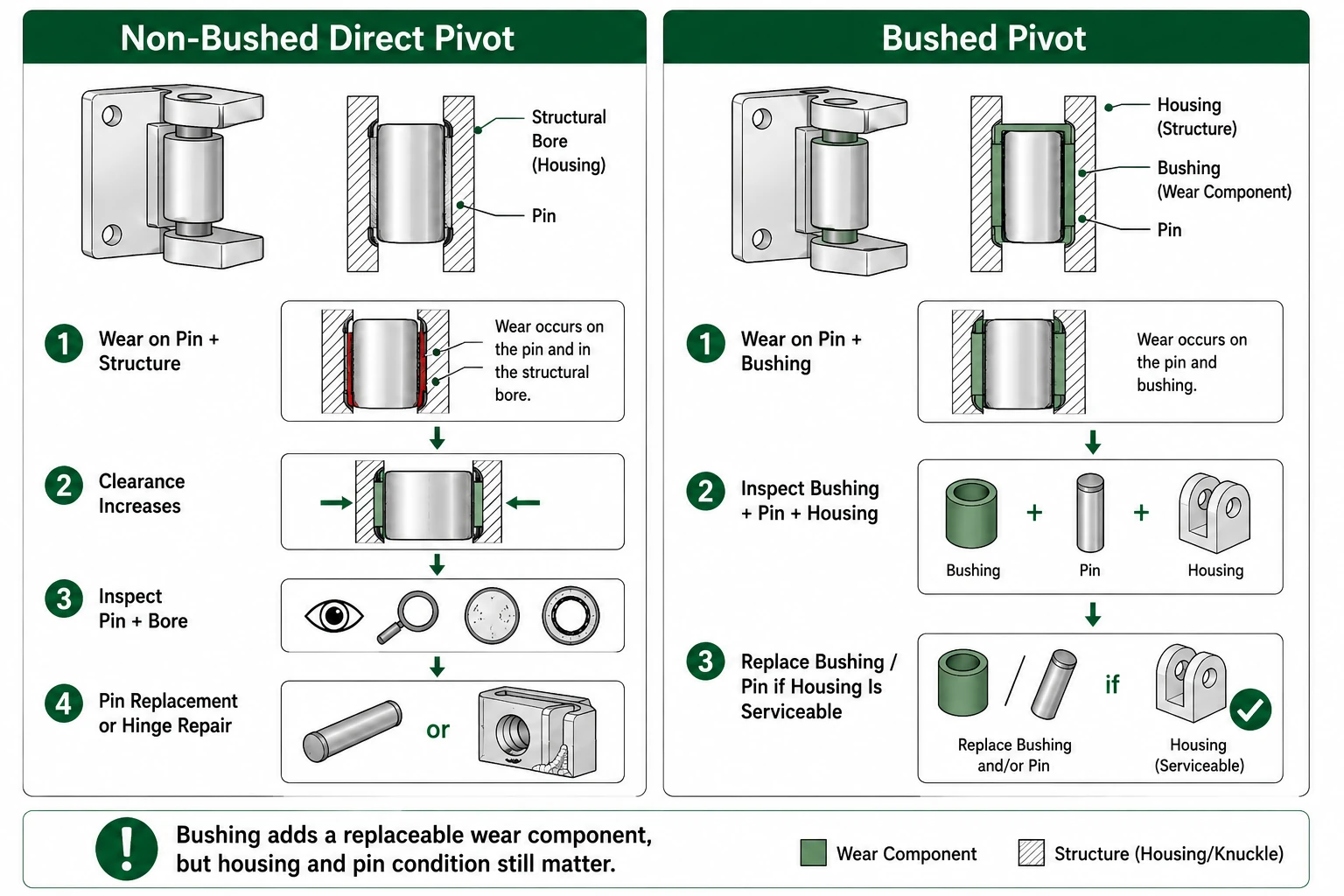
Adding a bushing creates a controlled wear surface, but the hinge now has at least two interfaces that matter: the running fit between the pin and bushing, and the retention fit between the bushing and housing.
If the pin-to-bushing fit becomes too tight, opening resistance can increase. If the bushing is not retained correctly, it can move or rotate in the housing and transfer wear to an interface that was not supposed to move.
Once the bushing begins rotating in the housing, replacing the bushing alone may no longer restore the pivot. The housing bore has become part of the wear path, so its diameter, shape and ability to retain a replacement component also have to be checked.
Assembly can change the final running condition as well. A thin bushing that looks correct as a loose component may not have the same inside diameter after installation. Housing stiffness, interference fit and local distortion can all influence the finished pin-to-bushing condition.
Multi-hinge alignment adds another constraint. A bushing cannot correct two hinge axes that are not coaxial. When one pin centerline is displaced, contact can concentrate at one end of the bearing instead of remaining distributed over its intended length.
Also separate radial bearing duty from axial restraint. A cylindrical bushing can control the sliding interface around the pin without controlling end play along the hinge axis. If the door creates meaningful axial thrust, or if its vertical position must remain controlled, the flange, washer, shoulder or other thrust surface still needs to be defined separately.
This is the main engineering trade-off in a bushed hinge: better control of the wear surface in exchange for more control of fit and assembly.
If installed clearance becomes the problem, check the actual pin, bushing and finished bore condition rather than expanding this architecture decision into a tolerance calculation. The hinge pin clearance guide covers that specification in detail.
A bushing changes the bearing interface; it does not create structural hinge capacity. Leaf thickness, pin support, hinge spacing, welds, fasteners and the mounting structure still have to carry the door reactions. Use the industrial hinge load rating guide when structural capacity is the unresolved question.
Replaceable Does Not Mean Serviceable
A drawing can show a separate bushing and still create a hinge that is frustrating to service in the finished machine.
For example, if the pin has to move upward 80 mm before it clears the bearing stack but the installed enclosure leaves only 25 mm above the hinge, the bushing may be technically replaceable on a workbench and practically trapped in the equipment.
The same problem occurs when a permanent cover blocks the extraction direction, a nearby frame member prevents tool access or the bushing requires a removal method that cannot be used without taking the entire door off the machine.
Housing condition matters too. A replacement bushing only restores the intended joint when the surrounding bore still retains it correctly. If the bushing has been rotating in the housing, or if the housing has become enlarged or distorted, replacing the bushing alone may not recover the original fit.
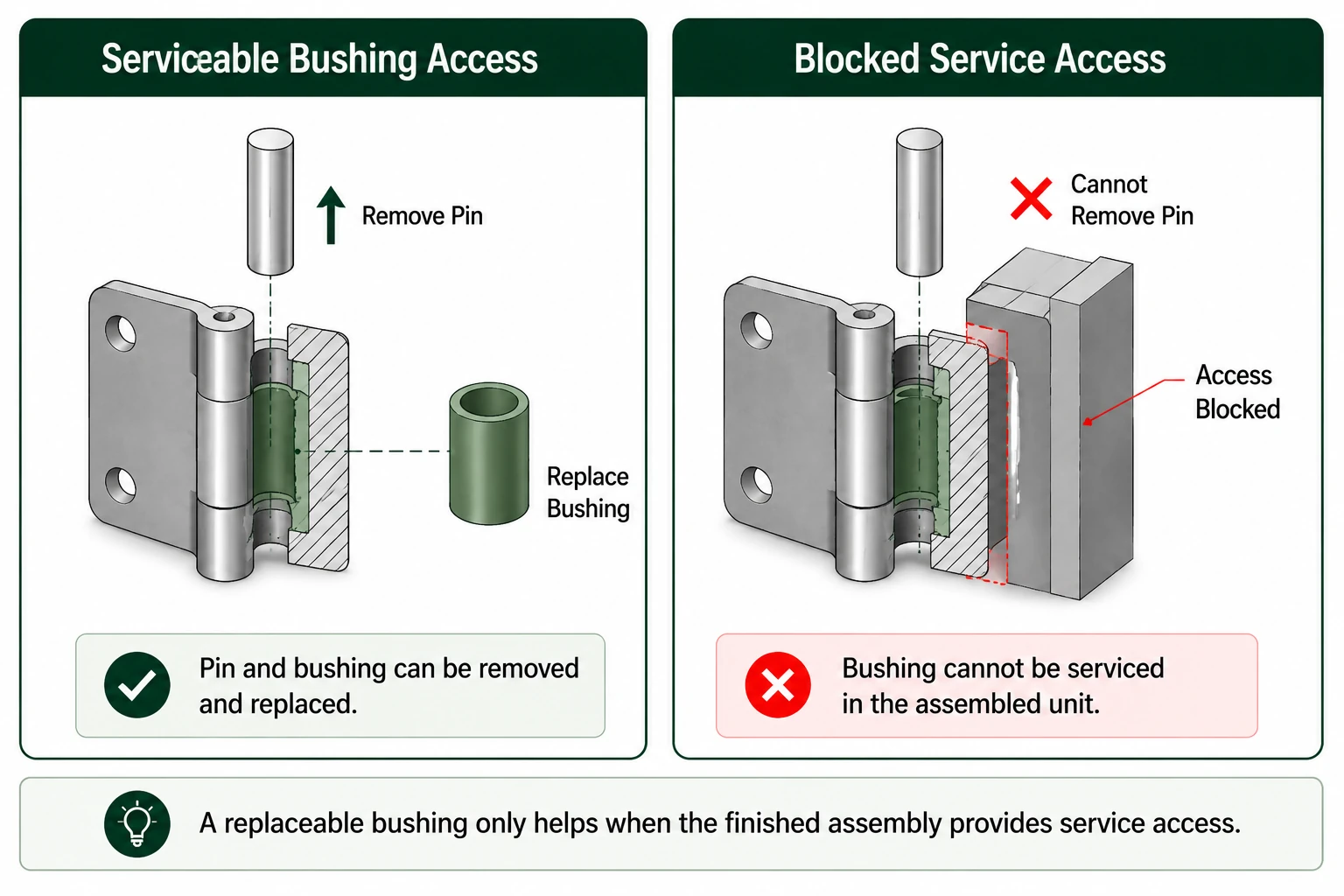
For an OEM, this changes the cost comparison. The important question is not simply whether the catalog says “bushed.” It is what has to be removed, replaced and realigned when the pivot eventually needs service.
A Practical OEM Selection Check
The architecture can usually be narrowed before the exact hinge model or bushing material is selected.
| Application Condition | Direct Pivot | Bushed Pivot |
|---|---|---|
| Low or moderate operating frequency and easy whole-hinge replacement | Strong candidate. Simplicity may have more value than a separate wear component. | May add cost and fit control without solving a major service problem. |
| Repeated operation where wear location matters | Can work, but structural bore wear must be acceptable. | Worth evaluating. A separate bearing surface gives more control over the wearing interface. |
| Hinge body is welded into expensive equipment | Structural bore wear can make future repair larger. | Strong reason to evaluate a serviceable bushing. |
| Fabrication or assembly has limited tolerance control | Fewer interfaces can make production more forgiving. | Added fit and retention must remain controlled after installation. |
| External lubrication is undesirable | Depends on the direct-running material pair. | May allow a suitable dry-running bearing system, subject to material selection. |
| Field maintenance is an important requirement | Good when pin or complete hinge replacement is straightforward. | Useful only when the pin and bushing can actually be removed in the assembled equipment. |
No single row decides the architecture by itself. The useful comparison is where the wear will occur, how difficult that worn component is to restore and what manufacturing control the alternative requires.
A high-cycle machine door with a welded hinge body may provide a strong reason to evaluate the extra bearing component. A lightly used inspection cover with a large pin and a bolt-on hinge may not.
What to Send the Hinge Supplier
Once the pivot architecture has been narrowed, the supplier can compare actual hinge models much more effectively.
Provide the door orientation, approximate mass, center-of-gravity distance when relevant, hinge quantity and spacing, expected operating frequency, mounting structure and operating environment. Also state how the equipment is expected to be maintained.
If a bushed hinge is being considered, ask the supplier to identify the bushing construction, pin material and finish, bushing retention method and intended lubrication condition. If field replacement matters, confirm the actual pin-removal direction and service access rather than assuming the bushing can be replaced because it is a separate component.
For a direct pivot, identify which interface is intended to rotate and what happens when wear reaches the structural bore. A lower-cost hinge is not necessarily the lower-cost choice if restoring the pivot later requires replacing or realigning a permanently mounted assembly.
After those conditions are defined, compare suitable industrial hinge models against the actual installation instead of selecting from the word “bushed” alone.
Bushed vs Non-Bushed Industrial Hinge FAQ
What is the main difference between a bushed and non-bushed industrial hinge?
A non-bushed hinge uses the pin and structural bore or knuckle as the primary sliding interface. A bushed hinge adds a separate bearing component between the pin and hinge structure. The main design difference is therefore where the intended wear surface is located and what may be replaceable later.
When is a bushing worth adding to an industrial hinge?
A bushing is worth evaluating when controlling the wear location, protecting an expensive hinge body, repeated operation or planned service has enough value to justify the additional fit, retention and assembly requirements.
When is a non-bushed direct pivot a better choice?
A direct pivot can be the better choice when operating frequency is moderate, the pin and usable bearing area are sufficient, alignment is controlled, and replacing the pin or complete hinge is easier than maintaining a separate bushing system.
Does adding a bushing increase hinge load capacity?
Not automatically. A bushing changes the local bearing interface, but the leaves, pin support, knuckles, welds or fasteners, hinge spacing and mounting structure still determine the structural load path.
Does a bushed hinge always have lower friction?
No. Friction depends on the actual material pair, running fit, alignment, bearing pressure, lubrication, contamination and installed condition. A poorly fitted or misaligned bushed pivot can have more operating resistance than a well-designed direct pivot.
Can a worn hinge bushing always be replaced without replacing the hinge?
No. The pin and bushing must be accessible and removable, and the surrounding housing must still be suitable for retaining the replacement bushing. A trapped pin or worn housing can turn a nominally replaceable bushing into a larger repair.
Compare the Pivot Before Choosing the Model
Send the door layout, hinge spacing, expected operating frequency, mounting structure and maintenance requirement. HSP can use those conditions to narrow suitable direct-pivot or bushed hinge options before sample review.
Send Your Hinge Requirements