-
+86 13720060320
-
lanna@haitangs.com

Mini Torque Hinges: Balancing Holding Torque and Opening Force
A small lid can stay open perfectly and still be awkward to use. The operator pulls at a narrow finger recess, the housing lifts off the bench, and the lid barely moves. Reducing hinge resistance may make opening easier but leave the cover drifting closed at its working angle.
Mini torque hinge opening force depends on the complete assembly: the lid load, the hinge’s starting resistance, and where the hand can actually act. The useful choice holds the lid while leaving enough leverage for the intended opening action.
The Pull Point on a Compact Housing
Mark the lid’s center of gravity and its usable pull point on the assembly drawing. The center of gravity determines the moment that tends to close the lid. The pull point determines the leverage available to the operator. They are rarely the same location.
For motion in the plane perpendicular to the hinge axis, the hand’s effective lever arm is the perpendicular distance from that axis to the force’s line of action. It is not necessarily the distance measured along the lid. A pull directed nearly toward the pivot produces little opening moment, even if the finger is some distance from it.
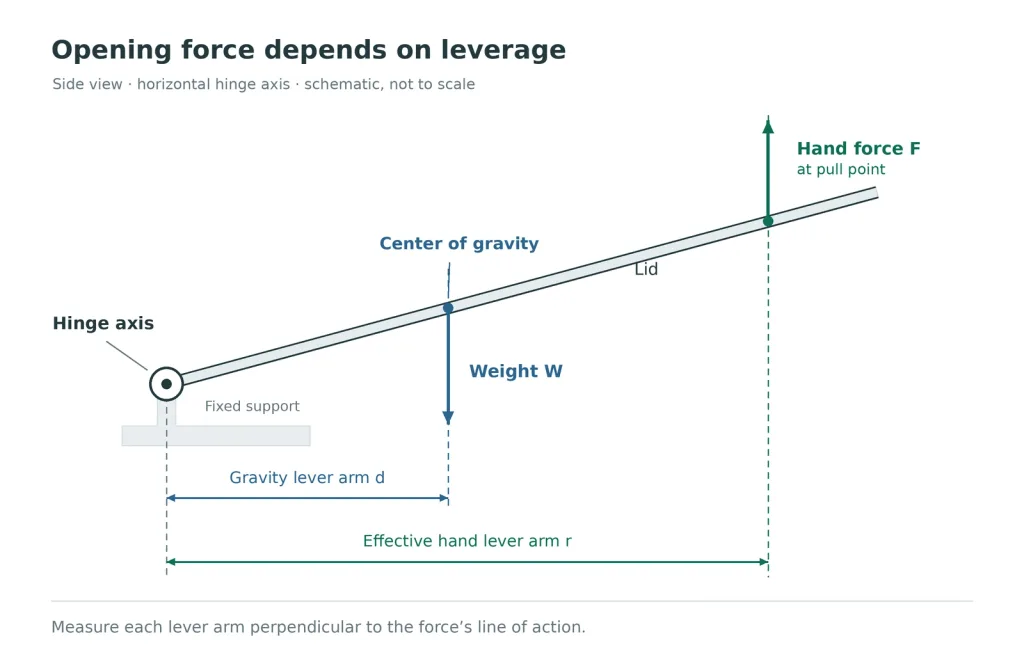
On a compact enclosure, a bezel or recessed lip may prevent the user from reaching the pull point shown in CAD. A fingertip, a gloved hand, and a pinch grip can also produce different force directions. Check the accessible contact point in the intended grip before choosing the torque value.
Calculate the closing moment with the complete lid, including its display, window, handle, and moving attachments. Use the torque hinge requirement calculation for the gravity contribution, then add relevant cable or other external moments at the working positions.
Separate Holding From Starting Resistance
Holding torque describes the resistance available to keep the lid stationary under stated conditions. Specify the working angles, allowable angular movement, and time for which the lid must remain there. A cover resting against an end stop has not demonstrated the same function as a cover holding an intermediate angle.
Breakaway torque is the resistance to starting movement after rest. It affects the initial pull. Running torque governs resistance once movement is underway. Keep these values separate when reading a datasheet; a smooth running feel does not establish an acceptable starting force.
For slow upward opening of a rigid lid about a horizontal axis, with the latch released and negligible acceleration:
Starting hand force = (combined hinge opening breakaway torque + opposing gravity moment + other opposing moments) ÷ effective hand lever arm.
Use N·m for moments and meters for the lever arm to obtain force in newtons. Assisting moments enter with the opposite sign. Cable reaction and seal release belong in the calculation when present. Resolve all moments about the actual hinge axis; a vertical-axis panel does not have the same gravity contribution as a horizontal-axis lid.
Set the acceptable starting and moving forces for the intended user, grip, posture, and frequency of use. If the product is meant to open with one hand while sitting on a bench, holding the base down with the other hand changes the task.
Work Back From the Allowed Hand Force
Once the hand-force limit is known, turn it into an opening-resistance limit for the hinge set. Under the same slow-opening conditions:
Maximum allowed opening breakaway torque = allowed hand force × effective hand lever arm − opposing gravity moment − other opposing moments.
This is the allowance for all torque hinges acting on the lid together. If the result is zero or negative, the opposing loads already consume the available hand input before hinge resistance is added. Changing the leverage, load, or assistance becomes necessary.
Calculated example using assumed values. A rigid lid has a mass of 0.20 kg and a center of gravity 40 mm from a horizontal hinge axis. At its horizontal starting position, the gravity moment is approximately 0.0785 N·m, using g = 9.81 m/s². Assume the installed hinge set provides 0.10 N·m of stationary resistance against closing and requires 0.12 N·m to start opening. The example project limits starting hand force to 5 N. The latch is released, the hand pulls perpendicular to the lid, and cable, seal, and assist moments are excluded.
| Effective hand lever arm | Predicted starting force with this hinge set | Allowed opening breakaway torque, total |
|---|---|---|
| 25 mm | Approximately 7.9 N | Approximately 0.0465 N·m |
| 60 mm | Approximately 3.3 N | Approximately 0.2215 N·m |
At 25 mm, the assumed 0.12 N·m starting resistance exceeds the available 0.0465 N·m allowance. At 60 mm, the same set is within the calculated limit. Moving the pull point changes the opening effort without reducing the assumed holding resistance.
If the shorter pull point is fixed, ask whether a candidate can meet the lower opening-resistance limit while providing enough stationary resistance against the closing moment. Do not assume its opening breakaway torque and closing-direction holding capability are equal. A direction-dependent design may behave differently, but the selected model must support both requirements.
Repeat the check at angles where gravity, hand leverage, or cable reaction is less favorable. The 5 N limit belongs to this example; it is not a universal comfort threshold.
Torque Variation Across Samples
The preferred nominal value must leave room for actual part variation. Check the lowest supported holding capability against the greatest required external moment, and the highest supported breakaway and running resistance against the hand-force limits.
Use the lid configuration that produces the largest external moment, not simply the greatest mass. A lighter display located farther from the axis can demand more holding torque than a heavier, closely balanced cover. The worst configuration for holding may also differ from the one that produces the highest opening force.
Ask what the supplier’s limits cover: new parts, the relevant temperature range, and the intended service condition. Do not assume a fixed percentage of torque loss or a fixed relationship between holding and starting resistance. Where supplier values use different definitions, use the constant torque specification comparison to establish a common basis.
A Light Housing Can Move First
An acceptable pull force can still lift, slide, or tip a lightweight instrument. Device mass, support footprint, feet, surface friction, and the pull direction determine whether the housing stays put. A longer pull tab may reduce the required force, but it also changes where that force acts on the complete product.
Check one-handed opening on the intended support. A clamped base makes hinge comparisons easier, but it cannot demonstrate how an unclamped instrument behaves on its normal feet. Use the intended surface or supporting grip.
Before changing the hinge, separate its resistance from an engaged latch, an adhering gasket, or a lid edge rubbing the bezel. An unwanted contact needs a clearance correction. A seal-release force that remains in normal operation must still fit within the user’s opening-force limit.
If No Candidate Meets Both Requirements
When lower resistance allows drift and higher resistance makes opening unacceptable, an intermediate catalog value may still leave too little room for production variation. Use the calculated opening allowance to identify whether the constraint comes from hinge resistance or from the lid and pull geometry.
Where packaging allows, improve finger access, move the pull point, or bring the lid’s center of gravity closer to the axis. A direction-dependent hinge can be considered if its low-resistance opening direction and closing-direction holding capability match the application. If those changes cannot meet the task, an assist or support mechanism may be needed.
Two torque hinges contribute to the total resisting moment. Specify the intended set; choosing two parts as though each must provide the full holding requirement can make opening unnecessarily stiff. Adding a hinge is not a substitute for checking the combined resistance.
Check the Shortlisted Configuration on the Lid
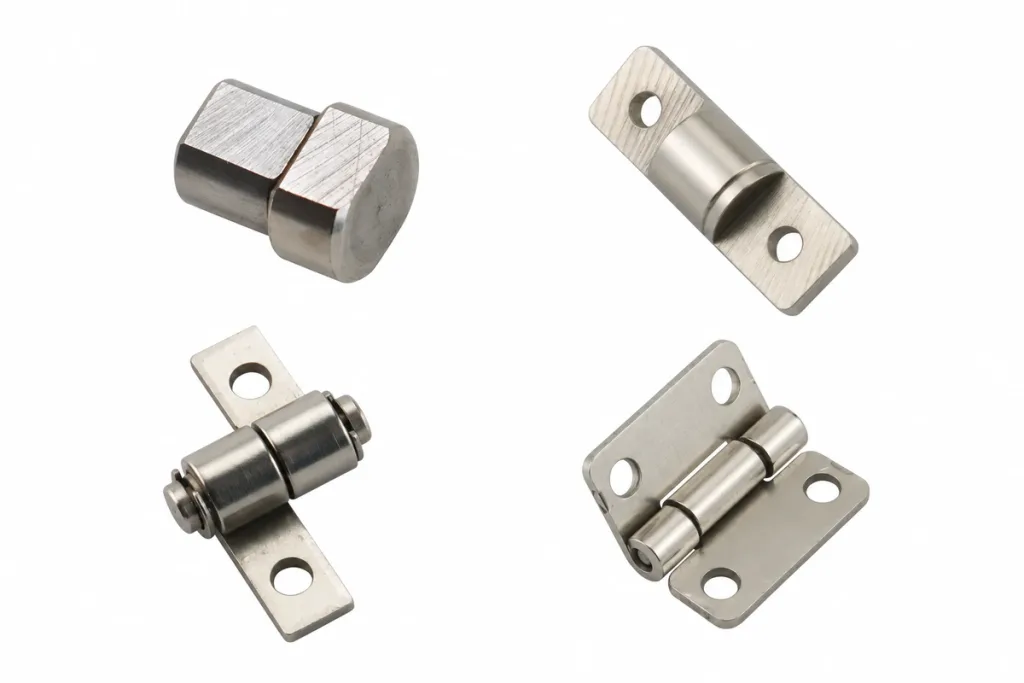
Shortlist mini and compact torque hinge options against the mounting space, closing-direction holding requirement, and opening-resistance allowance. Compare them on the same representative lid with the same pull point, attachments, cable route, and mounting condition.
| Requirement | Condition to identify | Result to record |
|---|---|---|
| Hold at working angles | Angle, external load, and dwell | Angular movement |
| Start and continue opening | Pull point, direction, rest period, and opening arc | Starting peak and moving force |
| Keep the device controllable | Normal feet, surface, or supporting grip | Lifting, sliding, or tipping |
Identify the part numbers, hinge quantity, assembly revision, and sample condition with each result. Use a consistent hinge torque measurement method. If controlled closing is also required, check it separately; an acceptable opening result does not establish closing behavior.
Select the configuration that meets all three requirements under the stated conditions. Confirm that the supplier’s variation and service-life evidence covers that configuration before treating one successful sample as representative.
Mini Torque Hinge Opening Force FAQ
Does a higher torque rating make a mini hinge better?
Only when the extra resistance is needed for holding and the lid remains usable. Check the rating’s definition and the complete assembly’s opening force before choosing a higher value.
Can I divide catalog torque by the pull distance?
Only to estimate the hinge contribution, using the appropriate opening torque and perpendicular lever arm. Gravity, cables, seals, and other loads must be included to estimate the complete lid’s opening force.
Can I move the pull tab instead of changing the hinge?
Yes, if the new position provides more effective leverage and remains accessible. Recheck the complete opening path and device stability; the hand-force direction may change as the lid rises.
Will two mini torque hinges make opening easier?
Not automatically. Their resisting moments combine. Two lower-rated parts may provide a suitable total, but their installed behavior and mounting alignment must be checked together.
Is there a standard comfortable force for every small lid?
No single value fits every user, grip, posture, and operating task. Define the requirement at the intended pull point and include whether the product is supported or free-standing.
What if the lid holds only at the fully open stop?
The stop may be carrying the load. Check intermediate positions if they are required; an endpoint-only requirement should be specified separately from continuous position holding.
For help narrowing down a mini torque hinge, send HSP the lid drawing and opening-force limits. Mark the center of gravity, accessible pull point, force direction, working angles, and mounting space. Include the lid mass and any sample readings so the discussion starts with the installed requirements.