-
+86 13720060320
-
lanna@haitangs.com

Flag Hinge Handing: How to Specify Left and Right
A purchase order that says “left-hand flag hinge” can still leave the supplier guessing. Left when viewed from outside the cabinet, or from inside? Does the name describe the door arrangement or the supplier’s hinge design? For flag hinge handing, start with a marked assembly view that can be matched to an orderable part.
Start with the viewing side, identify the mating leaves and pin, and then have the supplier map that configuration to its own designation. The result should be a complete part number tied to the intended installation.
A Fixed Viewing Side
Choose a reference view and label it on the drawing. For an equipment cabinet, “viewed from outside with the door closed” is a useful project convention. It does not automatically define the supplier’s left-hand or right-hand part. That designation must come from the selected model’s documentation.
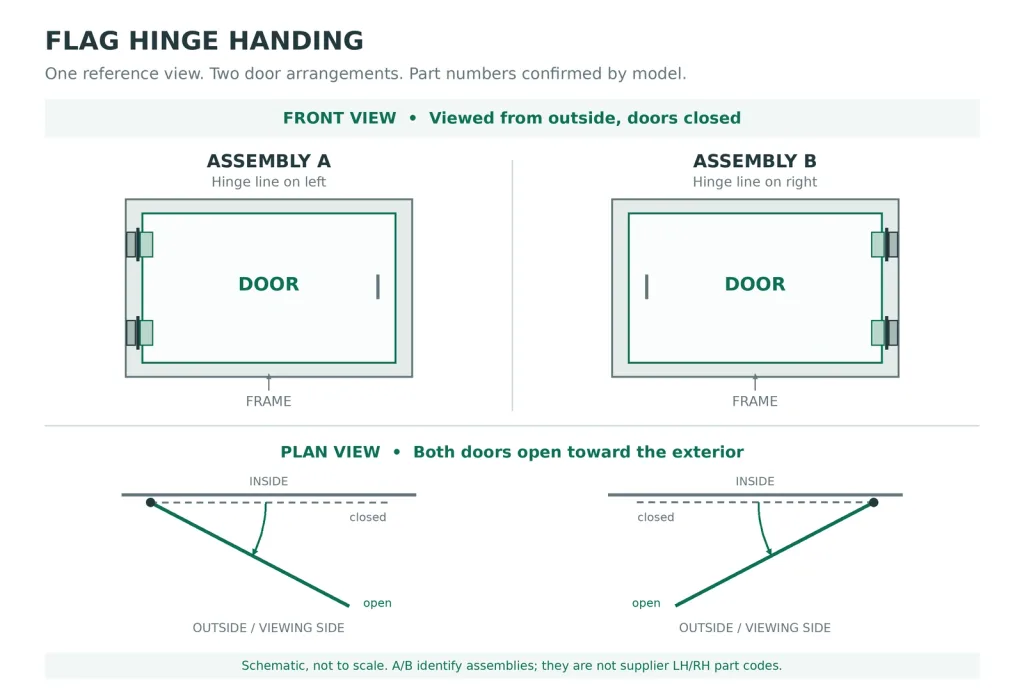
Show the hinge line and add a plan view or opening arrow. A hinge on the left side of the front view could serve a door opening toward or away from the observer. If you start with a photograph, identify the cabinet exterior and door edge.
Keep three items separate: the hinge-line location in the stated view, the door’s opening direction, and the manufacturer’s handed part designation. A rear view can put the same hinge on the opposite side of the page. Nothing has changed on the machine.
For example, Assembly A may have its hinge line on the left and Assembly B on the right, with both doors opening toward the observer. These descriptions distinguish the layouts. The supplier then uses the leaf and pin arrangement to assign the appropriate part number to each one.
Door Leaf, Frame Leaf, and Pin
On an enlarged assembly detail, identify the leaf attached to the moving door and the leaf attached to the fixed frame. Then mark the pin-bearing member and the member that receives it. Do not assume the pin belongs on the frame for every design. The selected product drawing must establish the permitted arrangement.
A catalog photograph may be rotated for presentation. An isolated CAD model may have no relationship to the installed top of the cabinet. Carry the door/frame labels into the assembly view instead of inferring leaf positions from either image.
For a separable model, also mark the direction in which the door-side member disengages. The required travel and retention arrangement are covered separately in the guide to lift-off clearance and pin retention.
Mirrored Doors and Reversible Designs
Depending on the model, mirrored doors may need opposite-hand parts, a reversible configuration, or the same part in a permitted orientation. The installed leaf positions determine which arrangements are usable.
| What changed? | What it establishes | Action before ordering |
|---|---|---|
| Viewing side only | The same hardware can appear on the opposite side. | Return to the labeled reference view. |
| Mirrored door assembly | The mounting arrangement changes. | Match each assembly to a supplier part. |
| Hinge rotated to fit | Matching holes do not confirm a usable installation. | Review leaf roles and permitted orientation. |
| Model described as reversible | One model may serve more than one arrangement. | Follow its documented reconfiguration method. |
“Reversible” may involve a specified reconfiguration rather than turning the complete hinge over. Ask the supplier to show how its model serves both arrangements.
The Same Hole Pattern, the Wrong Leaf Position
Consider two mirrored cabinet doors with equal panel sizes. Purchasing copies the hinge code from Assembly A to Assembly B because the nominal size and hole spacing match. In this assumed design, the offset between the hinge leaves is handed. With the frame leaf held on Assembly B’s specified mounting face, the door leaf does not meet the door’s attachment face. Turning the hinge may align some holes, but changes the leaf positions from those shown on the installation drawing. The review must therefore match Assembly B’s installed geometry to a permitted hinge configuration and its complete order code. This is an illustrative engineering scenario, not a customer project record or product test claim.
Flag Hinge Handing on the Drawing
Use an overall view for the reference side and an enlarged detail for the mating parts. Add a local view if the pin or mounting faces are hidden.
- Reference view: identify outside/inside and the illustrated door position.
- Leaf assignment: label the moving door leaf and fixed frame leaf.
- Pin and motion: show pin orientation, opening direction, and the separation direction where applicable.
- Configuration identity: give each distinct door arrangement a drawing identifier and link it to the supplier’s part number after confirmation.
Keep “Door Assembly A” and “Door Assembly B” as neutral drawing identifiers until the supplier’s part numbers are assigned. A and B do not mean left-hand and right-hand.
Example note for a handing detail
“Door assemblies A and B are identified in the labeled exterior views. Match the door leaf, frame leaf, pin orientation, and motion arrows shown. Return the complete supplier part number for each assembly and identify any required reconfiguration. Do not substitute a mirrored or inverted installation without confirmation.”
This is sample wording for a project drawing, not a specification for an HSP model.
Hole spacing, offsets, and tolerances still need their own review. Use the broader hinge drawing review for those dimensional checks; a correct handed designation does not prove that the mounting interface fits.
From Assembly View to Order Code
Once the arrangement is clear, review the available industrial flag hinge options against it. Ask for a complete part number tied to each marked assembly view, including any required reconfiguration. That gives purchasing a specific item to order.
Keep the manufacturer’s exact designation in the bill of materials. An unfamiliar numeric suffix may identify size, finish, or another variation; do not turn it into an assumed L or R.
The order line should reference the complete hinge assembly, the door assembly identifier, and the drawing revision used to confirm the match. If the supplier sells leaves separately, list the required mating members explicitly.
Also define what “pair” means. Two complete hinges for one door are different from one hinge for each of two opposing doors. State the quantity of complete hinge assemblies per door and of each confirmed part number. Do not let packaging language decide the arrangement.
The Sample Must Match the Marked View
Place the sample in the intended door/frame orientation beside the marked detail. Match its complete part designation to the supplier response, then compare the leaf assignments and pin orientation. A loose hinge can be turned until it looks correct. The installed reference removes that ambiguity.
For mirrored doors, compare the proposed parts against both assembly views. A successful fit on Assembly A does not establish that the same part fits Assembly B. Where one door uses multiple hinges, include every location in the orientation check.
Resolve any undocumented change to leaf positions or installation orientation before accepting the part. A handing match does not establish load capacity, service life, or overall cabinet approval; those need separate evidence.
Flag Hinge Handing FAQ
Is a “left-opening door” enough to specify a left-hand flag hinge?
No. State the viewing side and opening direction, then use the handed designation associated with the supplier’s matching model drawing.
Do all flag hinges use L and R part-number suffixes?
No. Manufacturers may use letters, words, numeric variants, or one code for a reversible model. Use the designation documented for the selected product.
Can a right-hand flag hinge replace a left-hand one?
Only if the model permits that installation and it matches the door/frame arrangement. Similar dimensions alone are insufficient.
Does one door need one left-hand and one right-hand flag hinge?
Not simply because it has two hinge locations. Specify the parts required at each location; do not interpret “a pair” as automatically meaning one of each hand.
Can I determine handing from a photo of a detached flag hinge?
A detached photo may identify the product, but often leaves its installed orientation unclear. Include an installed view showing the door, frame, and pin.
What if the old hinge has no readable part number?
Photograph the hinge before removal, then document both mating members. Match the replacement to that installed arrangement as well as the dimensions and required function.
To resolve flag hinge handing for a specific cabinet, share your marked hinge layout with HSP. Include the viewing side, door/frame leaf labels, motion arrows, and any existing part reference, and ask which complete part number corresponds to each arrangement.