-
+86 13720060320
-
lanna@haitangs.com

Detent Hinge Not Holding Position? Causes & Checks
The cover clicks into position, then starts to move as soon as the operator lets go. The sound is easy to notice. The cause is less obvious: the detent may be only partly engaged, the panel may be overcoming its holding resistance, or the mounting joint may be moving around an otherwise engaged hinge.
For a detent hinge not holding position, locate the movement before ordering a stronger replacement. Establish whether the panel reaches the intended detent, what force pulls it away, and whether the behavior changed after assembly or service.
Independently support the cover during inspection and follow the equipment’s isolation procedure. A positioning detent should not be treated as a maintenance support or positive lock unless the equipment design explicitly provides that function.
Detent Hinge Not Holding Position: Locate the Movement
Identify the exact hinge and its specified detent positions. Use the drawing’s angle reference; the angle of the outer cover relative to the floor may not be the angle defined between the hinge leaves.
A panel that stays at the intended detents but moves between them may be operating normally. Intermediate holding depends on the mechanism. If that is the only concern, use the detent vs free-stop motion comparison to establish whether the installed hinge provides the required behavior.
For movement at an intended detent, watch the hinge leaves against the frame and panel while controlling the cover. The location of the movement matters more than how strong the click sounds.
| Observed movement | What it suggests | Next check |
|---|---|---|
| The panel stops before the specified position. | Travel may be obstructed before full engagement. | Find the first point of contact or cable tension. |
| The panel reaches the position, then rotates out of it. | The detent may be incompletely engaged or unable to resist the applied moment. | Confirm engagement, then compare load and holding capability. |
| A hinge leaf shifts against its mounting surface. | The attachment is moving, regardless of internal detent behavior. | Inspect fastening, seating, and the supporting material. |
| The panel settles slightly but remains within the indexed position. | Clearance or structural deflection may be contributing. | Locate the movement and compare it with the permitted assembled-position variation. |
Several effects can occur together; use the observations to direct the inspection.
A Stop Can Prevent Full Engagement
A cover can reach its intended service opening without the hinge reaching its intended detent. A bracket, gasket, panel edge, or separate stop may take the load first. The operator feels resistance and assumes the hinge has engaged.
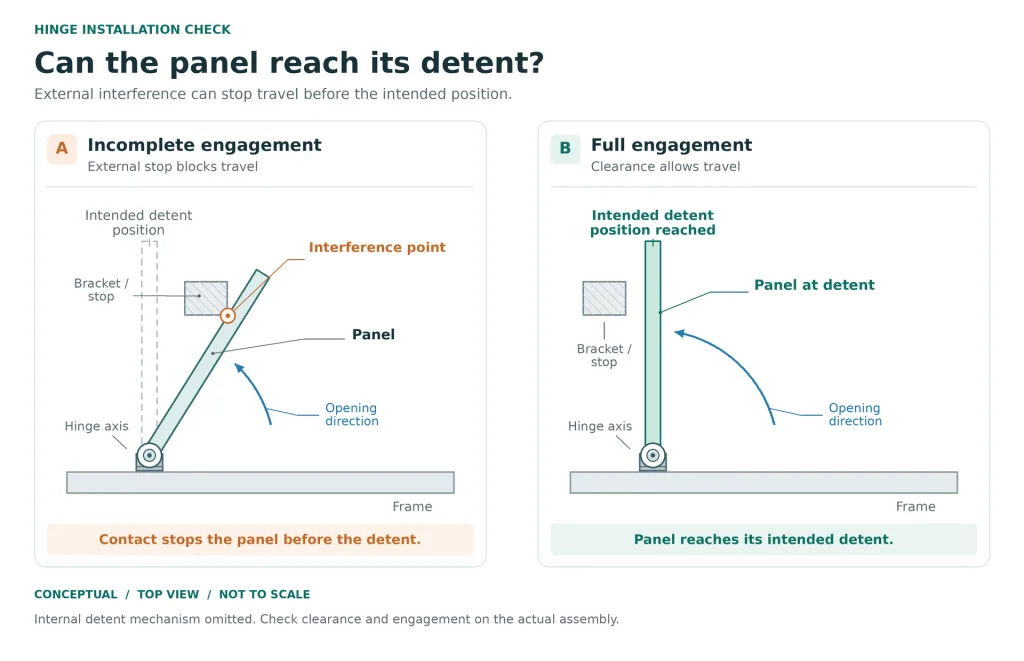
Move the supported panel slowly through the problem area, within the model’s permitted travel. Look for contact marks and watch when a harness becomes taut. Compare the actual leaf position with the drawing rather than pushing harder against the obstruction.
Inspect behind the cover and hinge leaf as well. Photograph contact marks that are hidden from the handle side.
- Early contact: correct the interfering geometry using the approved assembly design; retain any required opening-stop function.
- Incorrect configuration: check the specified orientation and any documented angle setting. An adjustable angle does not necessarily mean adjustable holding resistance.
- Inconsistent engagement: compare opening and closing approaches where the hinge is designed to engage in both directions.
The Click Changes After Tightening
If the problem appeared during installation or reassembly, inspect the mounting before treating the hinge as worn. The holes can line up while the hinge pin centerlines remain misaligned.
Look for a leaf that rocks on its mounting face, a flange that bends as fasteners seat, or a panel that twists near the detent. With two positioning hinges, verify compatible part numbers, orientations, and settings. One hinge engaging before the other can change the feel and the effective holding behavior.
If the same hinge behaved differently before reassembly, compare flange seating, coating buildup, and fastening sequence.
The Correct Parts, but a Strained Cover
Consider a cover fitted with two matching detent hinges. Each hinge has a distinct engagement when operated separately. On the equipment, however, one mounting flange sits at a slight angle. Tightening the fasteners pulls the assembly into place, and the cover twists as it approaches the working position. The operator feels a click from one hinge, but the second has not reached a compatible engaged position. Stored strain in the cover can then contribute to movement when the handle is released. Increasing the nominal hinge resistance leaves that mounting conflict unresolved.
This is an illustrative engineering scenario, not a customer project record or product test claim.
Use the hinge axis alignment diagnostic when final tightening changes the motion. Any controlled comparison involving mounting adjustments requires independent panel support. Complete the corrective work and secure the fasteners before evaluating normal operation under load.
Holding Against the Complete Panel Load
A loose hinge does not carry the assembled cover. Include its glazing, displays, handles, and brackets. An accessory near the outer edge can increase the hinge-axis moment substantially.
For a lifting lid, the gravity moment depends on mass, center-of-gravity location, and opening angle. Use the hinge torque calculation guide for that calculation. A door rotating about a truly vertical axis needs a different assessment: its weight alone does not create a gravity moment about that axis, although weight still loads the hinge and mounting structure.
At the failing position, inspect forces from the harness, seals, springs, or other attached mechanisms. Their direction matters. A harness can assist opening over part of the travel and pull the panel away from a detent elsewhere.
After an equipment change, record what moved outward from the axis as well as what became heavier.
Compare the demand with the supplier’s holding data for the exact model, direction, and conditions. A catalog torque value may describe release resistance rather than sustained holding capability. If its measurement conditions are unspecified, the calculation alone cannot establish suitability.
Dividing the total demand equally between two hinges remains an initial estimate until their installed behavior is verified.
If correct engagement and installation still leave the assembly outside the model’s stated capability, review alternative detent and positioning hinges. Match the required position, holding behavior, and mounting envelope before choosing a higher torque value.
A Hinge That Held Before
For an assembly that previously held, establish when behavior changed: after an impact, reinstallation, cleaning, a temperature change, or extended use.
Start outside the mechanism. Loose fasteners, a cracked bracket, an elongated mounting hole, or a shifting leaf can create loss of position without proving that the internal detent has worn out.
Then look for changes in the hinge itself: deformation, unusual play, rough movement, corrosion, or inconsistent engagement. Depending on the design, damage or wear at the locating surfaces or retaining element can change the detent’s resistance. The symptom does not reveal which internal component is responsible.
Photograph evidence before cleaning. Use the manufacturer’s permitted method; do not add lubricant as a holding-force remedy. Cleaning cannot repair worn or damaged components.
Where an approved procedure permits, substitute a known-good hinge of the same specification in the supported assembly. If the problem follows the hinge, investigate the component. If it remains with the equipment, revisit the installation and load. Account for any specification differences.
Correction, Replacement, and the Retest
Correct interference or mounting movement where it occurs. Verified hinge damage or loss of required holding capability calls for a manufacturer-guided replacement assessment.
A stronger detent can increase operating effort and bracket loads. It does not correct a strained assembly. If the required angle or intermediate holding behavior is absent, change the model or mechanism.
After rework, evaluate the assembled panel under controlled conditions:
- Restore the operating configuration. Fit the normal attachments, route the cables, and secure fasteners to the specified assembly requirements.
- Approach every required detent. Use the intended operating directions and observe whether engagement is repeatable without forcing the panel.
- Observe holding and release. Use the actual operating load, required dwell, and relevant environment. Record any movement and the effort needed to leave the position.
- Apply the project’s acceptance limits. Compare position variation, holding, and operating effort with the agreed requirements. A few successful movements do not establish service life.
Retain the original configuration and test conditions in the record so the before-and-after results can be compared.
Share Photos and Failure Details
Still tracing a detent hinge not holding position? Send HSP the hinge part number, mounting photos, and failure details, including when it moves and the panel load. These details support a discussion of relevant positioning models or configuration requirements; suitability still needs confirmation in the complete assembly.
Questions About Detent Hinges That Will Not Stay Open
Can I increase detent holding force by tightening a screw?
Only use an adjustment identified in the model’s instructions. A mounting screw, angle selector, and torque adjuster perform different jobs. Overtightening a mounting screw can distort the joint without increasing the intended detent resistance. If no holding-force adjustment is documented, ask for a suitable model or service assessment.
Why does a detent hinge hold while opening but slip while closing?
First establish whether the model is intended to engage from both directions. Approach-dependent engagement, assembly strain, and external forces can change the result. Compare the same position, load, and operating conditions from each permitted direction before attributing the difference to wear.
Is slight movement inside the detent a failure?
Not automatically. Movement within the engaged region differs from leaving it. Acceptance depends on where the movement occurs and the assembly’s permitted position variation; there is no universal acceptable amount for all detent hinges.
Should both detent hinges be replaced if only one seems weak?
That depends on the manufacturer’s pairing and service instructions. Check whether a replacement will have compatible engagement positions and operating behavior alongside the retained hinge. Replacing only one without checking the pair can leave an installation or engagement mismatch unresolved.
Can vibration release a detent that holds when stationary?
It can, depending on the mechanism, load, and vibration conditions. A stationary holding check does not establish performance on moving or vibrating equipment. Investigate the actual operating condition and any required independent restraint rather than assigning a vibration capability from the detent’s static torque value.
Can a matching hole pattern confirm a detent hinge replacement?
No. The hinge axis location, leaf geometry, detent positions, holding behavior, and operating travel must also suit the assembly. A part can bolt into the existing holes while changing the cover’s clearance or leaving it unable to reach the working position.