-
+86 13720060320
-
lanna@haitangs.com

How to Choose Industrial Hinge Bushings by Material and Lubrication
A dry polymer bushing can make an industrial hinge quiet and easy to service. The same bushing can tighten after installation if a thin housing closes around the press fit or the mounted leaves place the pin on an angle. Replacing it with bronze may improve one part of the problem while introducing grease access, lubricant migration, corrosion, or noise that the equipment cannot accept.
Industrial hinge bushings should be chosen as part of a sliding system: bushing construction, pin surface, housing fit, thrust support, motion, temperature, contamination, and maintenance policy. The material name alone does not predict opening force, wear, or service life.
This guide begins after the design team has decided to use a plain bushing rather than a rolling-element bearing. It compares dry-running polymer and composite bushings, oil-impregnated sintered bronze, and solid or layered metal bushings that require initial or periodic lubrication. Detailed pin-clearance calculation, bearing architecture, door-load distribution, and application-specific certification remain separate engineering tasks.
If the hinge architecture has not yet been fixed, compare the available industrial hinge families before specifying the pivot interface.
Define the Bushing Construction First
Searches often use “plastic bushings vs bronze bushings,” but those labels are not enough for an engineering release. A polymer part may contain fibers or solid lubricants. A bronze part may be porous and oil-impregnated, solid and grease-lubricated, or fitted with lubricant plugs. A layered metal-polymer bushing combines a metal backing with a sliding layer. Every proposal needs a construction and a lubrication regime, not only a broad material family.
| Useful Working Category | What Must Be Identified | Question the Label Does Not Answer |
|---|---|---|
| Dry-running engineered polymer or composite | Exact resin or composite grade, fillers, geometry, molding or machining condition, mating-surface requirement | Does the grade tolerate the installed pressure, temperature, chemicals, moisture, and dwell? |
| Oil-impregnated sintered bronze | Alloy, density or porosity, impregnation oil, storage condition, finishing process, supplier operating method | Will oscillation, temperature, washout, or long idle periods maintain the intended lubrication? |
| Solid bronze, steel, or bimetal with grease or oil | Substrate and lining, lubricant, grooves or feed path, relubrication interval and access, pin specification | Can lubricant reach the loaded interface without contaminating nearby equipment? |
| Metal-backed polymer sliding layer | Backing, interlayer, sliding-layer formulation, edge condition, installation direction | Is it being evaluated as a system-specific composite rather than as generic plastic or metal? |
The drawing should eventually state the exact supplier material or an approved technical equivalence. At the concept stage, however, it is reasonable to compare families. The comparison stays valid only if each row includes its intended lubricant condition, mating pin, housing, and installed geometry.
Start with the constraint that cannot be compromised: If external lubricant is prohibited, begin with a verified dry-running polymer or composite, or an application-compatible impregnated construction. If sustained pressure, component temperature, or edge loading is more demanding, evaluate metal-supported candidates. If maintenance access is limited, reject any design whose lubrication path cannot be inspected or controlled. These are screening directions; the installed hinge still requires validation.
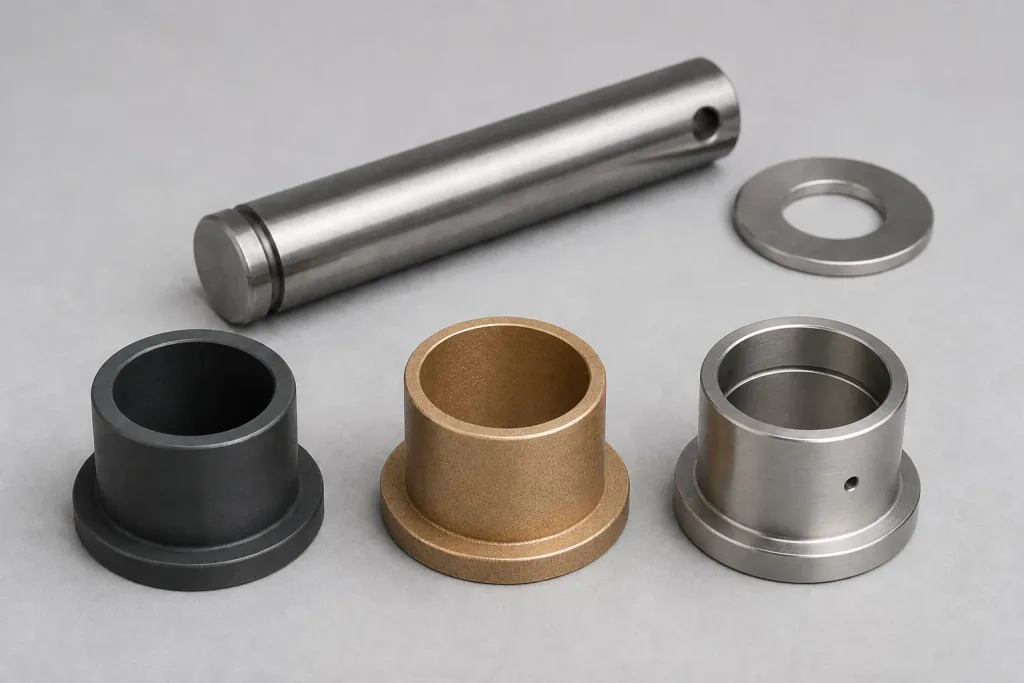
Illustrative comparison of polymer, oil-impregnated sintered bronze, and lubricated metal bushing constructions.
Hinge Motion Is Reversing Oscillation
Most industrial doors start from rest, move through a limited angle, stop, dwell, and reverse over the same arc. Some are opened a few times per shift. Others are operated repeatedly by an actuator. Neither case is represented well by a continuous-rotation value copied from a motor or wheel application.
At start-up, the sliding surfaces must break away after a period of static contact. A short stroke may repeatedly load the same sector of the bushing instead of distributing wear around the full circumference. Reversal can disturb a lubricant film before stable motion develops. Long dwell may allow grease to move away from the contact zone, oil to drain, corrosion to form, or a polymer to continue deforming under load.
Describe the real motion with opening angle, angular speed or opening time, starts per period, dwell in each position, manual or powered actuation, and expected shock at the stop. If the door can rest partly open, include that position. If a powered actuator continues pushing after a jam, treat its available force as a fault load rather than normal operating friction.
Supplier-data check: Confirm that the exact bushing data applies to oscillating service, the proposed lubricant condition, the actual mating surface, and the component temperature. A catalog limit from another motion or test method is not an automatic hinge life rating.
Screen Pressure, Speed, and Edge Loading
A material comparison needs the reaction at each bushing, not only total door mass. Door center of gravity, hinge spacing, number of hinges, latch and stop reactions, actuator location, handling loads, and frame deflection influence that reaction. A separate heavy-door analysis should establish the load distribution before the bushing calculation begins.
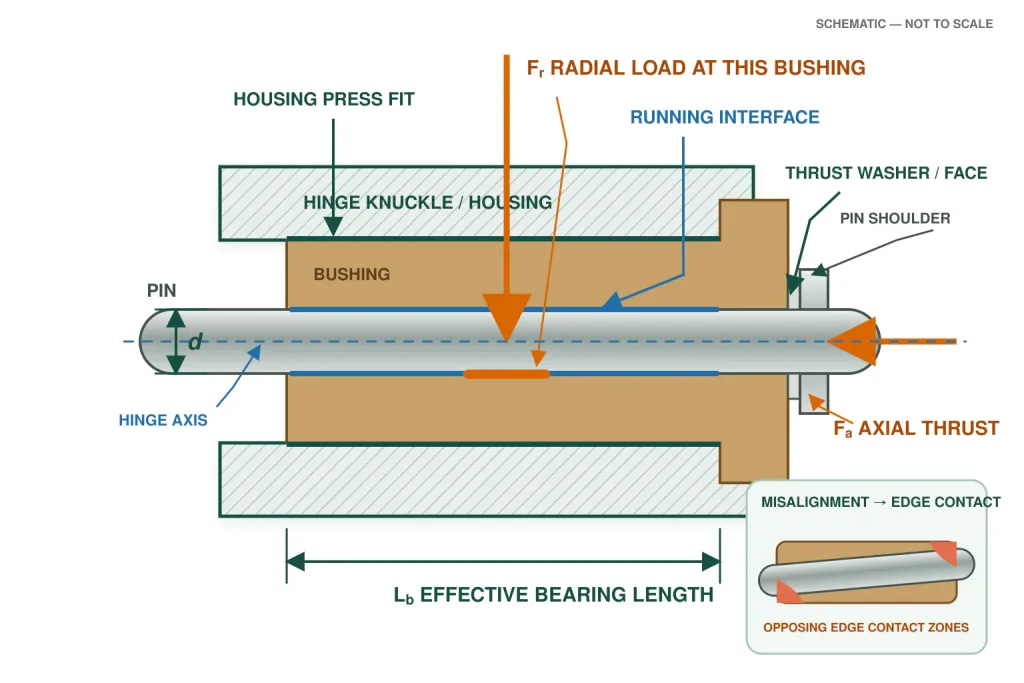
For a first screening pass, projected bearing pressure can be written as:
p = Fr ÷ (d × Lb)p = projected pressure; Fr = radial reaction at one bushing; d = pin diameter; Lb = effective loaded bushing length
This average pressure assumes a useful projected area and reasonably distributed contact. It can hide the condition that often damages hinge bushings: a short high-pressure band at one edge caused by leaf distortion, non-collinear axes, housing taper, pin bending, or inadequate support. Increasing nominal bushing length may add little useful area if alignment prevents the load from reaching it.
Surface speed may be screened from the pin diameter and angular velocity:
v = ωd ÷ 2 and PV = p × vv = sliding speed at the interface; ω = angular velocity in radians per unit time; PV = pressure–velocity screening value
PV helps reject an obviously unsuitable candidate when the supplier publishes a compatible method. It does not predict service life by itself. Oscillation angle, dwell, heat removal, lubrication, contamination, pin roughness, edge loading, and test definition can change the result even when two designs have the same calculated PV.
Axial load needs a separate path. A sleeve bushing should not be assumed to carry door weight on its end face unless the geometry and material are intended for thrust. A flange, thrust washer, shoulder, or separate support may control vertical movement and opening force.
Dry-Running Polymer and Composite Bushings
An engineered polymer or polymer-composite bushing is often considered when external grease is undesirable, quiet motion matters, electrical isolation is useful, corrosion is a concern, or maintenance access is poor. Low mass and a conformable sliding surface can also make the bushing tolerant of small surface irregularities. Those are possible design advantages, not properties shared equally by every polymer grade.
The exact formulation controls temperature response, moisture uptake, chemical resistance, wear, creep, thermal expansion, and compatibility with the pin. Reinforcement or solid-lubricant fillers may change these behaviors. A resin name without grade and supplier data is therefore incomplete.
Creep and Installed Fit
Door hinges can hold load for long periods without moving. That static dwell can matter as much as the opening stroke. A polymer may change shape under sustained pressure, especially as component temperature rises. The effect may appear as increased free play, a shifted thrust position, or local material flow at an edge-loaded zone.
Installation also changes geometry. A press-fit bushing normally reduces in internal diameter after insertion, but the amount depends on bushing construction, interference, housing stiffness, roundness, wall thickness, and insertion process. Do not approve the running fit from the loose bushing dimensions alone.
The Pin Is Part of the Material Choice
A pin that is too rough can abrade a polymer sliding layer. A surface that is extremely smooth is not automatically correct for every formulation. Plating, coating thickness, hardness, corrosion pits, burrs, lead-in chamfers, and the direction of machining marks can all influence start-up and wear. Use the supplier’s mating-surface range for the exact material, then verify the production pin after finishing.
Use precise wording: “Dry-running” describes the intended interface condition. It does not mean zero wear, unlimited life, zero friction, or suitability for every temperature. “No scheduled external relubrication” is usually clearer than a universal maintenance-free claim.
Oil-Impregnated Sintered Bronze Bushings
Sintered bronze is a porous metal structure that can hold an impregnation oil. It is different from a machined sleeve made from solid bronze. When the material, lubricant, counterface, motion, and temperature are compatible, it can provide a compact metal bushing without an external grease fitting.
The phrase “self-lubricating bronze” still needs qualification. The oil type, impregnation state, porosity, storage, finishing, temperature history, and operating motion affect how the interface is supplied. A bushing cannot be assumed to replenish oil in every slow, short-stroke hinge merely because the catalog family is porous.
Machining and Cleaning Can Change the Part
Post-machining, aggressive cleaning, heating, or long storage can affect the lubricant inventory or close surface pores. If sizing, reaming, washing, or thermal processing is proposed after receipt, the bushing supplier should confirm the process and any re-impregnation requirement. A visually acceptable part may no longer behave like the specified catalog construction.
Press-fit and alignment remain important. Sintered bronze offers metal stiffness, yet it can still be damaged by a poor insertion lead, excessive interference, a tapered bore, or hammering through the sliding surface. The installation method should support the bushing end squarely and prevent raised edges that scrape the pin.
Temperature and Environment Include the Oil
A bronze structure may tolerate an environment that its impregnation oil does not. Heat can change viscosity or accelerate loss. Water or cleaning chemistry may displace or degrade the lubricant. Dust may combine with oil at an exposed edge. Review the complete bushing as supplied, including lubricant compatibility and permitted storage, rather than approving only the bronze alloy.
Grease-Lubricated Solid Metal Bushings
A solid bronze, steel-backed, or bimetal bushing with grease or oil can be a strong candidate when the pivot has a controlled lubrication path, maintenance is accessible, and the environment permits the lubricant. The metal construction may suit high local pressure or temperature conditions that rule out a particular polymer grade, but the exact alloy and lining still require verification.
Lubrication must be engineered into the assembly. A fitting on the hinge does not prove that grease reaches the loaded zone. Feed holes, grooves, seals, relief space, orientation, purge direction, and the position of the maximum contact band determine where lubricant travels. A groove that interrupts the most heavily loaded area can also reduce supporting surface.
Specify the Lubricant and Service Condition
“Grease as required” is not a release specification. Define the lubricant, initial fill or assembly method, permitted substitutes, relubrication access, intended interval or condition trigger, cleaning compatibility, and acceptable purge. Where excess lubricant could reach optics, electronics, product zones, coatings, or operators, include migration and containment in validation.
Long idle periods deserve attention. A metal interface that moved freely after greasing may show different breakaway force after storage, washdown, condensation, or lubricant separation. Corrosion protection for the pin and bushing is part of the tribological system, particularly at an exposed hinge edge.
Serviceability can favor a lubricated metal design when technicians can inspect and replenish it. The same feature is a liability when the hinge is concealed, the grease point becomes inaccessible after assembly, the wrong lubricant is likely to be used, or maintenance records cannot be controlled.
Review the Pin, Housing, and Thrust Path
The bushing does not correct a weak or distorted hinge structure. The pin must remain supported and sufficiently straight under the real reaction. The knuckle or cartridge must hold the bushing without collapsing its bore. The thrust feature must carry axial load without rubbing an unintended edge. All hinge axes must remain collinear through fabrication and mounting.
Running clearance is determined from the installed bushing internal diameter and the finished pin outside diameter at the relevant temperature and alignment state. Coating buildup, press-fit closure, thermal expansion, debris allowance, wear, and permissible free play belong in that analysis. Use the hinge pin clearance guide for the detailed fit review; this article treats clearance as an input to material selection.
The Polymer Passed; the Installed Hinge Bound
Consider an illustrative development case. A polymer bushing and finished pin run smoothly in a rigid bench coupon. In the production-intent hinge, the bushing is pressed into a thinner rolled knuckle. The installed internal diameter becomes smaller than the coupon condition. After the leaves are fastened to the equipment, local panel distortion shifts one hinge axis. The door still opens, but breakaway force rises and witness marks appear on one end of the bushing.
Changing to a harder bushing might delay visible deformation while leaving the root causes intact. The useful corrective work is to measure the installed bore, verify housing interference and support, map axis position, check pin straightness, and identify the thrust path. If the mounting surface is thin sheet, transfer the reinforcement and local panel review to the thin sheet-metal hinge mounting guide.
Illustrative case: This scenario explains a failure mechanism; it is not a reported customer event or company test record. Actual root cause requires measurement of the production-intent hinge and mounting structure.
Add Temperature, Contamination, and Chemicals
Use the temperature at the bushing, pin, and lubricant—not only the air temperature inside the machine. Nearby heaters, cold surfaces, washdown, outdoor solar load, hot cleaning, or a door-open plume can create short exposures that differ from the normal closed condition. Measure or justify each controlling state.
| Service Condition | Material-System Question | Evidence to Request |
|---|---|---|
| Elevated or cycling component temperature | Will the bushing, lubricant, pin finish, press fit, and running fit remain functional together? | Supplier limits for the exact construction plus installed hot/cold force, free-play, and inspection results |
| Water, humidity, or washdown | Will moisture change polymer dimensions, remove oil, promote corrosion, or carry debris into the interface? | Fluid compatibility, drainage and shielding review, post-exposure operation, corrosion and wear inspection |
| Dust, fibers, powder, or abrasive particles | Will the interface exclude, embed, purge, or trap the contaminant? | Representative contamination test and inspection of pin scoring, debris, seals, and exposed edges |
| Cleaning agents, process chemicals, or vapors | Are the bushing, lubricant, bonding layers, pin coating, and housing compatible at concentration and temperature? | Current supplier compatibility data followed by project exposure and functional verification |
| Particle- or lubricant-sensitive equipment | Can wear debris, lubricant migration, or material shedding reach the controlled zone? | Defined cleanliness method, witness collection locations, inspection threshold, and configuration-specific test |
A statement such as “chemical resistant” is too broad for release. Record chemical identity, concentration, temperature, exposure time, rinse or dry sequence, and whether the interface is moving or stationary during exposure. When the hinge serves contamination-sensitive equipment, particle generation, lubricant migration, and controlled-zone placement require a separate application-specific cleanliness review.
Electrical behavior may also matter. A polymer bushing can interrupt an intended bonding path. A metal bushing does not by itself guarantee reliable electrical continuity through lubricant, oxide, coatings, or intermittent contact. Treat protective bonding or signal grounding as a separate, verified path.
Industrial Hinge Bushings: Selection Matrix
This matrix is a concept filter, not an approval table. Read each favorable condition together with its limitation. The final choice remains an exact material, lubricant, pin, housing, thrust arrangement, installation process, and acceptance test.
| Candidate Family | Often Worth Evaluating When | Investigate Carefully When | Release Evidence |
|---|---|---|---|
| Dry-running engineered polymer or composite | External grease is restricted; quiet motion, corrosion resistance, isolation, or low service access matters | Component temperature, sustained static pressure, moisture change, chemical exposure, edge loading, or press-fit closure is significant | Exact grade; installed dimensions; pin requirement; thermal and chemical basis; breakaway force, wear, free play, and debris after representative duty |
| Oil-impregnated sintered bronze | A compact metal bushing with retained oil is attractive and the motion, temperature, storage, and environment suit the impregnation system | Short oscillation, long idle, washout, contamination, post-machining, heating, or lubricant loss may change oil supply | Alloy and impregnation oil; approved finishing and installation; counterface specification; duty and environmental validation |
| Grease- or oil-lubricated solid bronze, steel, or bimetal | Lubrication can be controlled; service access exists; higher local pressure or a demanding metal-supported interface must be assessed | Lubricant migration is unacceptable; feed paths are uncertain; maintenance is inaccessible; corrosion, washdown, or wrong-grease risk is high | Exact material and lining; lubricant and feed path; pin and housing specification; service instruction; functional and wear results before and after the service interval |
| Metal-backed polymer sliding layer | A thin section, controlled dry sliding layer, and metal support are useful within the supplier’s defined application range | Assembly direction, edge damage, misalignment, temperature, press fit, or incompatible pin finish can affect the thin sliding layer | Exact composite construction; orientation; installation tooling; mating surface; installed inspection and representative oscillation test |
If more than one family remains plausible, compare them in the production-intent hinge with the same pin, housing, alignment, temperature sequence, contamination, and measurement method. A coupon test can screen material compatibility; it cannot close installation and structural risks that the coupon does not contain.
Validate the Installed Hinge Assembly
Validation should answer whether the selected bushing system works in the real assembly and whether production can reproduce it. A loose bushing on a pin proves very little about housing closure, multi-hinge alignment, door deflection, thrust, stop impact, or mounting distortion.
Record the Baseline Before Cycling
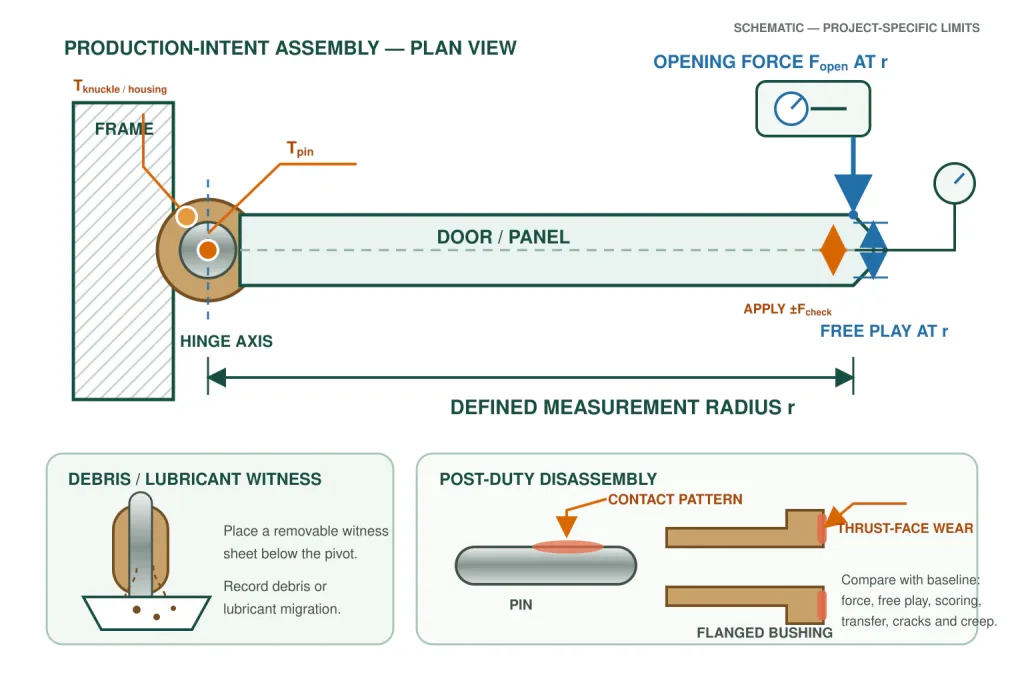
Record bushing and housing traceability, loose dimensions where useful, installed internal diameter, finished pin diameter and surface condition, axial position, free play at a defined measurement radius, and opening or breakaway force with a defined method. Note assembly torque, lubrication quantity or dry condition, hinge alignment, door position, temperature, and any conditioning time.
Run the Representative Duty
The cycle should reproduce opening angle, speed, dwell, direction reversal, temperature states, loads, actuator behavior, stop contact, and relevant contamination or cleaning. There is no responsible universal cycle count for every industrial hinge. Set duration and acceptance criteria from the intended service, risk, inspection strategy, and project evidence.
Trend opening force or actuator current at defined intervals instead of checking only whether the door still moves. Measure free play at the same position and radius. Monitor component temperatures where they affect the selected bushing or lubricant. Observe noise, stick-slip, lubricant purge or migration, debris, axial walk, retainer movement, and interference with nearby seals or guards.
Disassemble and Inspect the Evidence
Post-test movement alone cannot show how close the design is to failure. Disassemble a controlled sample and map contact marks around the bushing length and circumference. Inspect the pin for scoring, coating loss, transfer film, corrosion, and a step at the stroke boundary. Check bushing cracks, creep, glazing, embedded debris, blocked lubricant paths, oil loss, flange wear, and thrust-surface distress.
Compare final free play and force with the baseline and the project limits. Retain photographs, measurement locations, sample identity, drawing revision, material lots, lubricant lot, assembly process, test sequence, deviations, and disposition. An acceptable result applies to that tested configuration; uncontrolled substitutions need review.
Release the Complete Bushing Requirement
A purchasing description such as “bronze bushing” leaves several functional decisions open. The released definition should identify the bushing construction, dimensions and tolerances, approved supplier part or equivalence rules, lubricant condition, mating pin, housing, thrust arrangement, installation process, inspection points, and functional acceptance method.
BushingConstruction, grade, backing or lining, flange, length, wall, split orientation where relevant, supplier identity, prohibited substitutions.
Pin and ThrustMaterial, hardness, finish, surface range, coating, lead-in, diameter limits, retention, shoulder or thrust-washer details.
Housing and InstallationBore limits, wall and support, interference, insertion tooling and direction, post-install internal-diameter inspection, alignment datums.
LubricationDry condition or exact lubricant, initial quantity and method, feed and purge path, substitute control, access, service trigger, cleaning restriction.
Operating EnvelopeRadial and axial reactions, oscillation, dwell, component temperature, chemicals, water, debris, stop or actuator loads, permitted maintenance.
Acceptance EvidenceInstalled dimensions, force and free-play method, representative duty, inspection criteria, traceability, drawing revision, deviation approval.
Place the requirements at the level where production and purchasing will see them. The general assembly may control alignment and functional test; the component drawing may control material and dimensions; the work instruction may control press tooling and lubrication. The hinge spec sheet and engineering drawing guide covers broader drawing, tolerance, material, finish, and revision review.
When data are incomplete, mark the decision correctly. “Preliminary—supplier confirmation required” is more useful than silently converting an assumed grade, temperature, surface finish, or service interval into a released fact. Industrial hinge bushings are ready for release only when the material construction and the installed system are controlled together.
Prepare the Hinge Pivot for Engineering Review
Send the door assembly drawing, hinge count and spacing, reaction loads, pin and housing details, installed clearances, motion and dwell, component temperatures, contamination or cleaning exposure, lubricant restrictions, maintenance access, and required validation method. These inputs allow candidate constructions to be compared against the production-intent assembly instead of a material name alone.
Industrial Hinge Bushing Questions
Which bushing material is best for an industrial hinge?
There is no universal best material. Select the exact bushing construction with its pin, housing, thrust support, lubrication regime, radial and axial loads, oscillation, dwell, component temperature, environment, maintenance access, and installed validation.
Are polymer hinge bushings suitable for heavy doors?
Some engineered polymer and composite grades may be suitable, but the decision cannot come from door mass alone. Calculate the reaction and projected pressure at each bushing, then review dwell, edge loading, temperature, creep, installed fit, pin surface, thrust load, and the exact supplier data.
Is every bronze bushing self-lubricating?
No. Oil-impregnated sintered bronze, solid bronze used with grease or oil, and other bronze constructions have different lubrication requirements. Specify the alloy and construction, lubricant condition, finishing process, pin, motion, temperature, and environment.
Can PV alone be used to choose a hinge bushing?
No. PV is a screening value whose limit depends on material and test method. Hinge oscillation angle, starts, reversals, dwell, temperature, lubrication, pin finish, contamination, alignment, thrust, and housing fit also affect performance.
What should be measured during hinge bushing validation?
Measure the installed fit, opening or breakaway force, free play at a defined radius, component temperatures, lubricant migration or debris, axial position, and retainer condition. After representative duty, disassemble a controlled sample and inspect the bushing, pin, thrust surfaces, housing, and contact pattern.
Technical limitation: This article is a selection and validation framework for plain bushings in industrial hinge pivots. It does not certify a material, lubricant, hinge, door, or complete machine for load, temperature, chemical exposure, cleanliness, corrosion, cycle life, or safety function. Exact limits and acceptance criteria remain project-specific and require supplier confirmation where noted.