-
+86 13720060320
-
lanna@haitangs.com

Industrial Oven Door Hinges: High-Temperature Selection Guide
An oven drawing states the process setpoint. A hinge quotation says “high temperature.” Neither statement identifies what the pin, bushing, lubricant, retainer, fasteners, or mounting brackets actually experience. During closed dwell, insulation may keep an external hinge relatively cool. When the door opens, radiation and escaping process air can create a different, short-duration exposure at the pivot.
Industrial oven door hinges should therefore be selected from the hardware temperature and heat path—not from chamber temperature alone. The review also needs the complete door load, thermal movement between controlled datums, pivot materials, mounting-joint behavior, opening sequence, and evidence from the production-intent assembly.
This guide is limited to side-hinged swing doors on industrial process ovens, drying ovens, curing ovens, and comparable heated equipment. It does not cover household range doors, downward-opening appliance mechanisms, sliding doors, pressure-retaining closures, burner controls, or the oven’s combustion-safety system.
The Oven Setpoint Is Not the Hinge Temperature
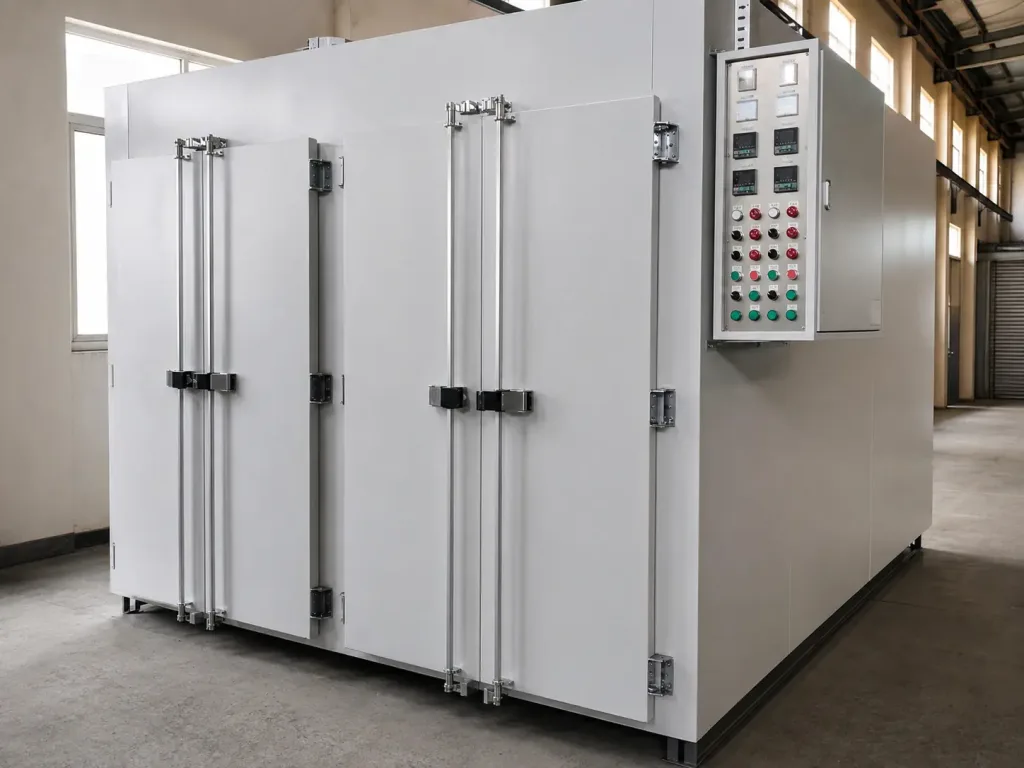
A chamber setpoint describes the process space. It does not define the temperature at every hinge component. Location outside the insulation, bracket stand-off, frame construction, door thickness, shielding, airflow, opening duration, and nearby equipment all change the hardware exposure.
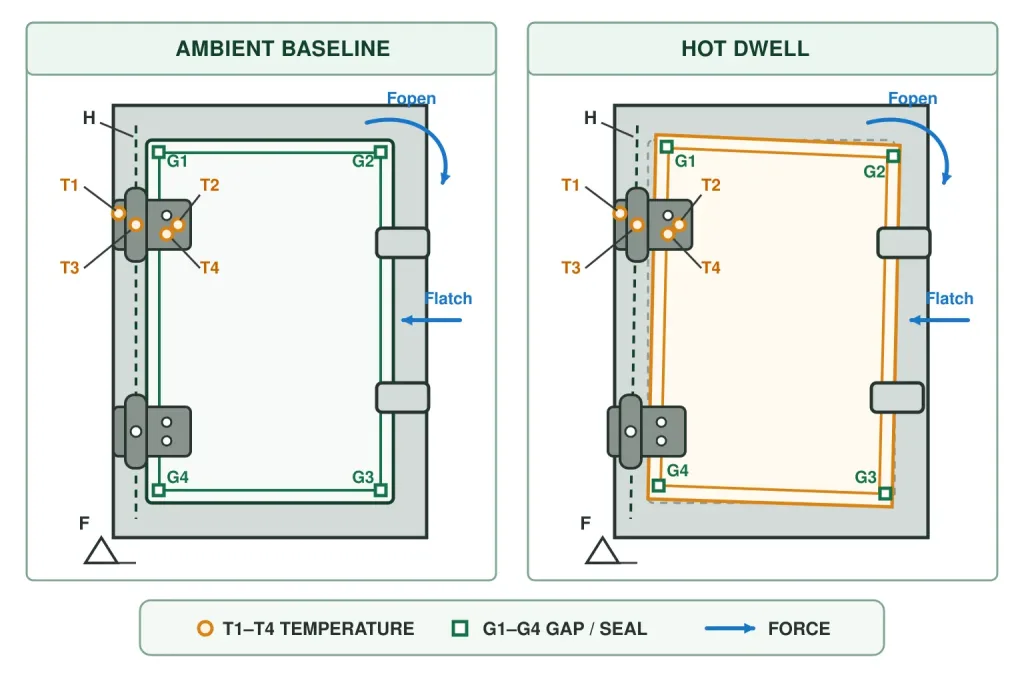
Define measurement locations before asking for a temperature rating. Useful points include the frame-side bracket, door-side leaf, pin region, bearing or bushing housing, thrust surface, retainer, fastener group, and any polymer isolator. The upper and lower hinges may also require separate points because hot air, cooling flow, and frame geometry are not always symmetric.
Each value needs a state and time reference. “Maximum hinge temperature” is incomplete unless the record says whether it occurred during heat-up, steady dwell, the first hot opening, repeated openings, shutdown, or cleaning. A short exposure may control a lubricant or polymer decision even when the long-dwell bracket temperature is lower.
Measurement Location and Method
A temperature record should identify the sensor or imaging method, attachment, surface condition, sampling interval, and uncertainty relevant to the decision. A contact sensor can be influenced by attachment quality, sensor mass, shielding, and lead routing. Infrared measurement depends on line of sight, surface emissivity, reflections, and whether the door position exposes the target. The project should use a method appropriate to the component and document its limitations.
A reading on the outer leaf does not automatically prove the pin, bushing, lubricant, or hidden bracket temperature. When the controlling component cannot be measured directly, use a justified model or correlated location and mark the result as Preliminary until representative hardware testing confirms it. Synchronize temperature with door position and time so a door-open peak is not averaged into a closed-dwell record.
Specification boundary: Do not approve a hinge for an oven temperature unless that temperature is tied to a component location, door position, exposure duration, measurement or modeling method, surrounding structure, and acceptance decision. Supplier Confirmation Required applies when only the chamber setpoint is available.
Closed Dwell, Hot Opening, and Repeated Exposure
One temperature value cannot represent the complete production cycle. The closed oven, the newly opened door, and a door operated repeatedly between batches create different combinations of conduction, radiation, convection, and thermal gradient. Record the states that the real process uses.
| Operating State | Possible Hinge Exposure | Evidence to Record | Selection Question |
|---|---|---|---|
| Heat-up | Door, frame, and hinge warm at different rates | Time-based temperatures and operating force | Does changing gradient create temporary friction or joint movement? |
| Steady closed dwell | Conduction through door edge, frame rail, brackets, and fasteners | Stabilized component temperatures and local gradients | Which component carries the highest sustained exposure? |
| First hot opening | Radiation and escaping process air reach previously shielded surfaces | Peak and recovery at the pin, bushing, retainer, and door-side leaf | Does transient exposure set the lubricant, polymer, or clearance limit? |
| Repeated production openings | Components may not return to the closed-dwell baseline | Temperature accumulation, opening force, and recovery time | Does the real batch sequence create a higher working condition? |
| Shutdown and cooldown | Door and frame contract through different paths | Residual shift, joint witness marks, and return force | Does the assembly return without permanent movement? |
| Cleaning or maintenance | Cool liquid, vapor, chemicals, or debris may reach hot or warm hardware | Permitted cleaning state, material compatibility, and post-cleaning motion | Is the hinge suitable for the actual service procedure? |
The test sequence should match the equipment’s intended use. A sample held at one uniform temperature cannot represent a bracket with one side connected to a hot frame, another side exposed to room air, and a pivot that receives a brief door-open plume.
Peak and Dwell Answer Different Questions
A short temperature peak may control lubricant migration, a polymer insert, a seal near the bracket, or an operator-accessible surface. Sustained dwell may control bracket movement, joint preload, bearing support, and the clearance that remains after the complete structure has warmed. Neither the maximum reading nor the time average is automatically sufficient.
Repeated openings add another variable: recovery time. If the pivot does not cool to its earlier state before the next opening, the relevant condition is the accumulated production sequence. Record the number and spacing of events used in the test without converting one project’s schedule into a universal cycle requirement.
Map the Heat Paths Before Choosing Materials
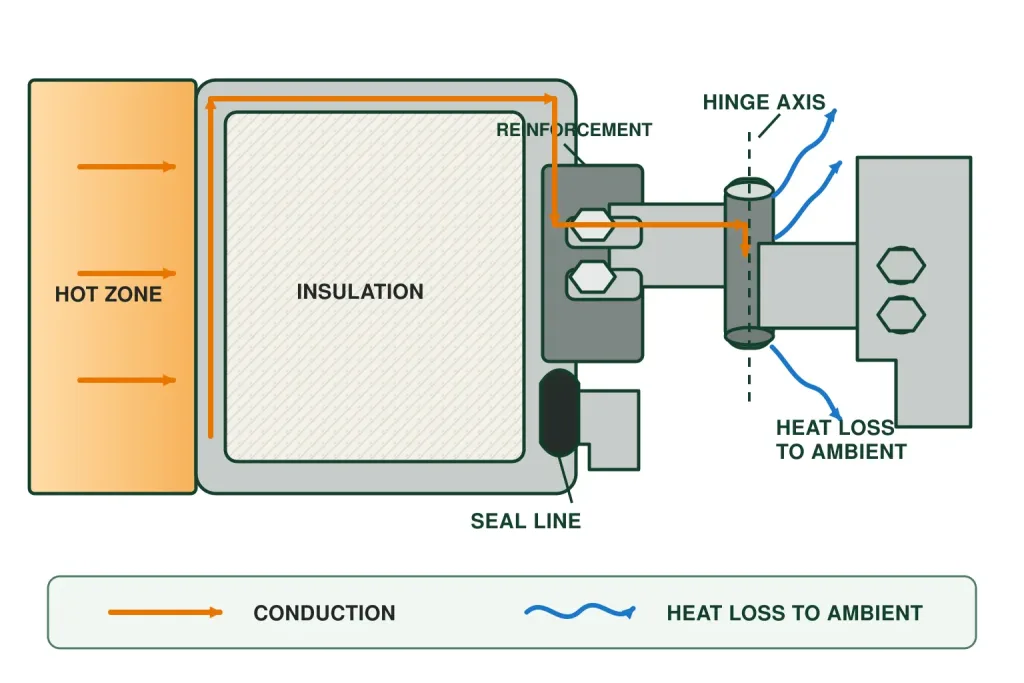
Conduction can travel from the inner liner through edge returns, reinforcement, brackets, fasteners, and hinge leaves. Radiation reaches surfaces that can see the hot cavity when the door opens. Escaping process air adds convective exposure around the pin and bracket. External airflow, guards, nearby ducts, or a structural heat sink can cool one region while another remains hot.
Draw those paths on the oven-door section. Mark the hot cavity, insulation boundary, frame rail, door reinforcement, hinge stand-off, pin, fastener group, and outer ambient side. A catalog material name does not show which component receives each path or how long the exposure lasts.
Moving the hinge farther from the hot face may lower conduction or radiation, but the longer stand-off increases bracket bending and changes the door sweep. Adding an insulating washer or pad may reduce heat flow, yet that layer can compress, creep, absorb cleaning media, or relax joint preload unless its load and temperature behavior are supported by supplier data.
Door Load Is Only the Baseline
Use the complete production-intent door mass and center of gravity. Insulation, inner liners, windows, handles, latch hardware, guards, stiffeners, and mounted instruments all contribute. For a vertical side-hinged door, the first gravitational screening value is the bending moment applied to the hinge support by the door weight acting at its horizontal offset.
Baseline hinge-support bending moment: Mb = m × g × dwhere m is complete door mass, g is gravitational acceleration, and d is the horizontal distance from the hinge axis to the door center of gravity. This is not the torque required to swing the door.
Detailed hinge count, spacing, load distribution, mounting-edge stiffness, and reinforcement belong in the heavy enclosure door hinge guide. This page uses that released load arrangement as an input and focuses on what heat changes afterward.
Thermal Expansion at Hinge and Bracket Datums
Thermal expansion is useful only when the calculation follows a real span between controlled features. Overall door width alone does not show whether the upper bracket rises relative to the lower bracket, whether a stand-off rotates, or whether the hot inner structure moves the outer hinge mounting face.
Free thermal movement: ΔL = α × L × ΔTwhere α is the applicable coefficient of thermal expansion, L is the span between defined datums, and ΔT is the temperature change at that structure.
The equation is a first screening step. Welds, folds, fasteners, insulation, reinforcement, and adjacent structures can restrain free growth. The resulting movement may appear as bowing, bracket rotation, joint slip, local stress, or a change in the common axis between two hinges. Use the actual materials, temperatures, constraints, and section stiffness before assigning a tolerance.
| Controlled Span | Hot-State Question | Hinge Consequence | Evidence Required |
|---|---|---|---|
| Lower-to-upper hinge centers | Do the mounting locations grow or bow together? | Loss of common axis, axial loading, or local binding | Cold and hot center locations from stable frame datums |
| Frame rail to hinge pin | Does the bracket stand-off grow or rotate? | Pin position and mounting moment change | Bracket section, material, attachment, and temperature map |
| Hot inner liner to outer mounting face | Does through-thickness distortion move the door-side leaf? | Leaf angle and closing position change | Layered door section, restraints, and measured movement |
| Pin to bushing or bearing housing | Do materials or component temperatures change the running fit? | Friction rise, binding, or added free play | Exact materials, reference dimensions, temperatures, and functional test |
| Hinge axis to door-edge clearance | Does hot growth consume the opening envelope? | Rubbing or loss of safe sweep clearance | Cold and hot section overlay through the required arc |
Seal contact may change when the hot axis or door edge moves, but this page does not assign a universal gasket-compression value. The hinge requirement is to preserve the project-defined closing position and opening clearance at the specified operating states. For thermal equipment with service doors, removable panels or retained access doors, compare the broader selection route in our HVAC & Thermal Equipment Hinge Solutions page.
Pivot Materials, Clearance, and Lubricant
“Stainless steel hinge” is not a complete high-temperature specification. The functional stack includes the leaves or bodies, pin, bushing or bearing, thrust support, spacer, retainer, lubricant, fasteners, finish, and adjacent bracket. The part with the lowest supported margin can set the working limit even when the visible leaves remain unchanged.
| Pivot Element | High-Temperature Question | Evidence to Request | Unacceptable Assumption |
|---|---|---|---|
| Pin and rotating bore | Does the fit remain functional at the actual component temperatures? | Exact materials, size limits, finish condition, temperature inputs, and hot-motion result | Ambient nominal diameters prove hot clearance |
| Bushing or bearing | Does the material keep its geometry and support under load? | Exact grade, installed condition, load, temperature evidence, and retention method | A generic polymer or bearing family rating proves the installed joint |
| Thrust surface | Where does vertical door reaction go when hot? | Section view, contact area, material pair, lubrication, and wear inspection | The pin alone supports every axial and radial reaction |
| Retainer | Does axial retention remain positive after growth and repeated operation? | Retention geometry, assembly method, material, hot inspection, and movement limit | A room-temperature assembly check proves hot retention |
| Lubricant | Is it suitable for temperature, migration, contamination, and maintenance conditions? | Product identity, supplier data, application amount, location, and service rule | Any high-temperature lubricant is interchangeable |
| Fasteners and finish | Do preload, coating, and surface condition remain acceptable? | Joint design, locking method, material pair, finish, temperature, and witness marks | The leaf material proves every adjacent component |
Hot Motion Is Not a Hand-Feel Check
Define whether the functional record reports breakaway force, running force, torque, maximum value, average value, or a complete trace. State the hinge angle, opening or closing direction, speed, dwell before motion, door load, and measurement point. A local bind can disappear inside one maximum or one operator’s pass/fail judgment.
Compare the same motion record at ambient baseline, closed dwell, immediately after a hot opening, during repeated operation, and after cooldown. A change that follows pin temperature may suggest a different branch from a change that follows bracket movement, but the correlation is evidence for investigation—not automatic proof of one cause.
Pin clearance needs a separate tight-side and loose-side review when the pin and bore use different materials or reach different temperatures. The hinge pin clearance guide covers size limits, finish buildup, thermal fit, free play, and seizure margin. This article supplies the oven-specific temperatures and exposure states for that calculation.
Material decision: Select the exact component stack from evidence for the actual condition. Do not convert a base-metal name, one data-sheet temperature, or an unrelated oven test into approval of the assembled hinge.
Thermal Bridges and Hot Mounting Joints
An external hinge may reduce direct cavity exposure, but its bracket and fasteners can still conduct heat across the door or frame edge. A longer stand-off can cool the pivot while increasing bending and movement. An internal or partly shielded hinge can shorten the load path while placing the pivot closer to the hot structure. Architecture should follow the measured heat path and structural section, not appearance alone.
The joint also has to retain its datum. Bolt-on mounting can support replacement and controlled assembly, but slots and shims need a locked final position. Welding provides a direct structural connection, yet weld shrinkage can move the axis before oven operation, and later heating can expose residual distortion or differential growth. Record the fabrication sequence that establishes the final hinge centers.
Do not leave the door moment in an unsupported outer skin. Use a defined path into a reinforced rail, boxed edge, internal plate, formed return, welded bracket, or another structural member. For backing plates, hole preparation, local dishing, pull-through, and fastener behavior, use the thin sheet-metal hinge mounting guide.
Drawing requirement: Show the complete hot joint—inner liner, insulation, outer skin, reinforcement, frame rail, bracket, fasteners or welds, hinge pin centerline, and temperature points. A front view with hole centers cannot define the thermal bridge or the load-carrying stack.
High-Temperature Failure Evidence
Document a problem in the operating state where it occurs. “The hinge binds” does not say whether resistance rises gradually during dwell, appears immediately after the door opens, develops across repeated batches, or remains after cooldown. Record the exact hinge, door, mounting, lubricant, and process revisions before changing an adjustment.
| Observed Condition | High-Temperature Question | Evidence to Obtain | Engineering Direction |
|---|---|---|---|
| Opening force rises during closed dwell | Is sustained conduction changing fit, bracket position, or lubricant behavior? | Component temperatures, force-versus-angle trace, axis position, and contact marks | Separate pivot fit from structural movement before changing clearance |
| Force changes immediately after opening | Is radiation or hot-air exposure controlling the pivot? | Time-based pin and bushing temperature with immediate motion data | Review shielding, location, material stack, lubricant, and opening schedule |
| Upper and lower hinges behave differently | Do the hinges receive different temperatures or bracket movement? | Separate temperature and axis records at both locations | Correct the asymmetric heat path or structural response |
| Lubricant appears outside the intended zone | Has temperature changed migration, retention, or application behavior? | Lubricant identity, amount, location, temperature history, and contamination inspection | Use supplier-supported lubricant and retention evidence for the exact joint |
| Fastener witness marks move across cycles | Is joint preload relaxing or the bracket slipping under growth? | Joint stack, locking method, temperatures, torque procedure, and witness history | Correct the hot joint and datum rather than repeatedly realigning the door |
| Residual shift remains after cooldown | Has a bracket, skin, joint, bushing, or retainer changed permanently? | Cold baseline comparison, flatness, center locations, clearance, and component inspection | Identify the permanent contributor and revise that component or structure |
Illustrative engineering scenario: A hinge remains smooth through closed dwell but shows a short opening-force rise immediately after the hot door is opened. A steady chamber test does not reproduce the event because the door-open radiation and plume are missing. This is an illustrative scenario, not a customer project record or product test claim.
Validate Closed-Dwell and Door-Open Exposure
A loose hinge sample can characterize component behavior under a defined fixture. It cannot reproduce the oven’s bracket heat path, door moment, structural restraint, upper-to-lower temperature difference, opening plume, or installed alignment. Final approval needs the production-intent door, frame, hinge revision, mounting joints, stops, guards, and opening sequence.
Establish an ambient baseline for axis locations, operating force through the required angle, clearances, joint witness marks, and pivot condition. Run the project-defined heat-up and closed dwell. Measure at the specified component points, then operate the door at the planned time and duration. Continue through the real repeated-opening and cooldown sequence.
Connect temperature to function. A useful record aligns each temperature channel with door position, time, force or torque, hinge angle, and observation. Record whether the reported force is breakaway, running, maximum, average, opening, or closing. One hand-operated “still moves” check cannot show a local bind or a short transient change.
Acceptance criteria remain project-specific. They may include no interference, stable retention, operating force within the released limit, controlled hot axis position, no unapproved joint movement, acceptable clearance or free play, and no material, finish, lubricant, or bushing condition outside supplier evidence. Define those limits before the test starts.
Release Data for the Exact Oven
A supplier needs enough information to review the hinge at the real thermal condition. Keep each input tied to a controlled drawing revision, component location, operating state, and acceptance decision.
Oven and Door Baseline
- Oven type, process, setpoint, heat-up, dwell, and cooldown sequence
- Complete door mass, center of gravity, hinge count, spacing, and opening direction
- Door and frame section through the hinge mounting zone
- Required opening angle, stop, guard, and service condition
Thermal Exposure
- Temperature locations on both hinge and mounting structures
- Closed-dwell, hot-opening, repeated-opening, and cooldown values
- Measurement or modeling method, time reference, and door position
- Radiation, process-air, external airflow, and cleaning exposure
Hinge and Hot Joint
- Controlled hinge drawing and exact pivot-stack materials
- Pin fit, bushing or bearing, thrust support, retention, lubricant, and finish
- Bracket, reinforcement, fasteners, welds, slots, shims, and locking method
- Cold and hot hinge-center datums and required opening clearances
Functional Evidence
- Production-intent sample and assembly revision
- Force or torque method, angle, speed, direction, and reporting rule
- Acceptance limits for motion, retention, clearance, joint movement, and post-cycle condition
- Change-control rule for materials, lubricant, finish, fit, bracket, or process
Use the hinge spec sheet and engineering drawing guide for controlled dimensions, tolerances, materials, finishes, revisions, and separate performance evidence.
Send the Hinge Temperatures and Door Section
Provide the complete door mass and center of gravity, hinge spacing, mounting section, cold and hot datums, actual hinge-component temperatures, heat paths, opening sequence, pivot-stack requirements, stop condition, and project acceptance limits. These inputs allow a recommendation to be reviewed against the real high-temperature duty.
Industrial Oven Door Hinges: Selection Questions
What type of hinge is best for an industrial oven door?
There is no universal best type. The hinge must match the complete door load, actual temperatures at the pin and mounting structure, closed-dwell and door-open heat paths, thermal expansion, opening angle, pivot materials, service procedure, and installed validation. A fixed surface-mounted, offset, weld-on, bolt-on, concealed, bearing-supported, or removable architecture may be appropriate depending on those inputs.
Can the oven setpoint be used as the hinge temperature rating?
Not by itself. An external hinge may be cooler during closed dwell and receive a different short-duration exposure when the door opens. Define temperatures at the leaves, pin, bushing or bearing, retainer, lubricant, fasteners, and mounting brackets for the operating states that matter.
Is an external oven hinge always cooler than an internal hinge?
No. Location outside the insulation can reduce direct cavity exposure, but conduction through brackets and fasteners, radiation during opening, escaping process air, nearby ducts, guards, and external airflow all affect the result. Measure or model the actual component locations rather than approving the architecture from location alone.
Is stainless steel enough to specify a high-temperature oven hinge?
No. The exact alloy and condition matter, and the working limit may come from the pin fit, bushing or bearing, thrust support, retainer, lubricant, fasteners, finish, bracket, or adjacent structure. Review the complete pivot and mounting stack at the actual component temperatures.
What information should be sent to an industrial oven hinge supplier?
Send the oven process and operating sequence, complete door mass and center of gravity, hinge count and spacing, mounting section, component-level temperatures for closed dwell and hot opening, heat-path diagram, pivot materials, lubricant and retention requirements, opening angle, stop, functional test method, acceptance limits, and controlled drawing revisions.
Technical limitation: This article is a high-temperature hinge selection and validation framework for side-hinged industrial oven doors. It does not certify a hinge or completed oven for a temperature, load, cycle life, sanitation condition, fire-safety function, or process requirement. Exact limits and acceptance criteria remain project-specific.