-
+86 13720060320
-
lanna@haitangs.com

Detent Hinge vs Free-Stop Torque Hinge: Preset Positions vs Continuous Hold
A panel can stay open successfully with either a detent hinge or a free-stop torque hinge and still use the wrong motion for the job.
If an operator must return a cover to the same working positions every time, continuous free-stop motion may force them to search for those positions by eye. If the panel needs continuous adjustment, strongly indexed motion can interrupt the movement at positions the operator does not actually need.
The useful question is therefore not simply “Which hinge can hold the panel?” It is:
Should the panel return to defined positions, or should it remain wherever the user releases it?
That motion decision should be made before selecting torque value, material or hinge size.
| Application Requirement | Detent / Indexed Motion | Free-Stop Torque Motion |
|---|---|---|
| Return to a few defined working positions | Strong fit | Possible, but the user must position the panel |
| Hold at many different angles | Usually not the first choice | Strong fit |
| Recognizable indexed position | Yes; tactile strength varies by design | No defined indexed position |
| Smooth continuous repositioning | Depends on the mechanism | Typically |
| Same working position used repeatedly | Strong fit | Possible, but not indexed |
| Position changes frequently with the task or operator | Less natural | Strong fit |
| Defined positions plus holding between them | Hybrid behavior may be required | Free-stop alone does not create indexed positions |
The rest of the decision is about what the user needs the panel to do between the closed and fully open positions.
Start With the Required Motion, Not the Hinge Name
Terms such as positioning hinge, torque hinge, friction hinge and detent hinge are not always used identically across supplier catalogs. Selecting from the product name alone can therefore create the wrong expectation about how the panel will actually move.
Define the motion first.
Imagine moving the panel slowly through its complete operating range. Does it need to settle into a small number of repeatable working positions? That points toward detent or indexed positioning.
Or should the user be able to stop at any useful intermediate angle within the working range without searching for a mechanical position? That points toward continuous free-stop torque.
There is also a third case: the panel needs recognizable indexed positions and useful friction holding between those positions. That is a hybrid requirement and should be stated explicitly rather than assuming every detent hinge behaves that way.
“Positioning” describes the application goal, not necessarily one specific internal hinge mechanism.
Choose Detent Motion When the Working Positions Are Defined
Detent motion is useful when the equipment has recognizable operating states.
A service cover may have a closed position, an inspection position and a fully open position. A display may have several repeatable viewing positions. An equipment lid may need to return to the same access position every time it is opened.
In these cases, the important function is not simply holding against gravity. It is repeatability of position.
The operator should not need to estimate the working position each time. As the panel reaches an indexed position, the mechanism creates a recognizable change in behavior or settles into the intended location, depending on the hinge design.
This makes detent motion particularly useful when the position itself carries meaning:
- a service position that provides defined tool or hand clearance;
- a viewing position intended to be reproduced repeatedly;
- a cover position that must remain clear of an adjacent component;
- an operating state where recognizable indexed positioning helps the user confirm the panel position.
A detent is not automatically a rigid mechanical lock. The exact holding behavior, release effort and motion between indexed positions depend on the mechanism.
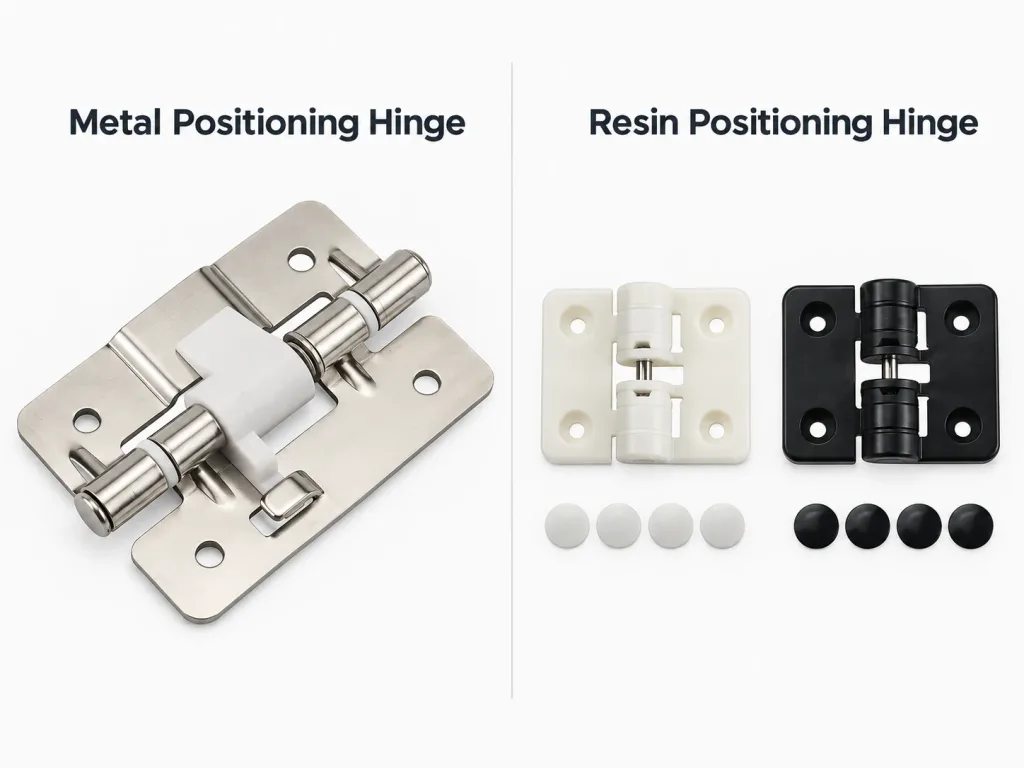
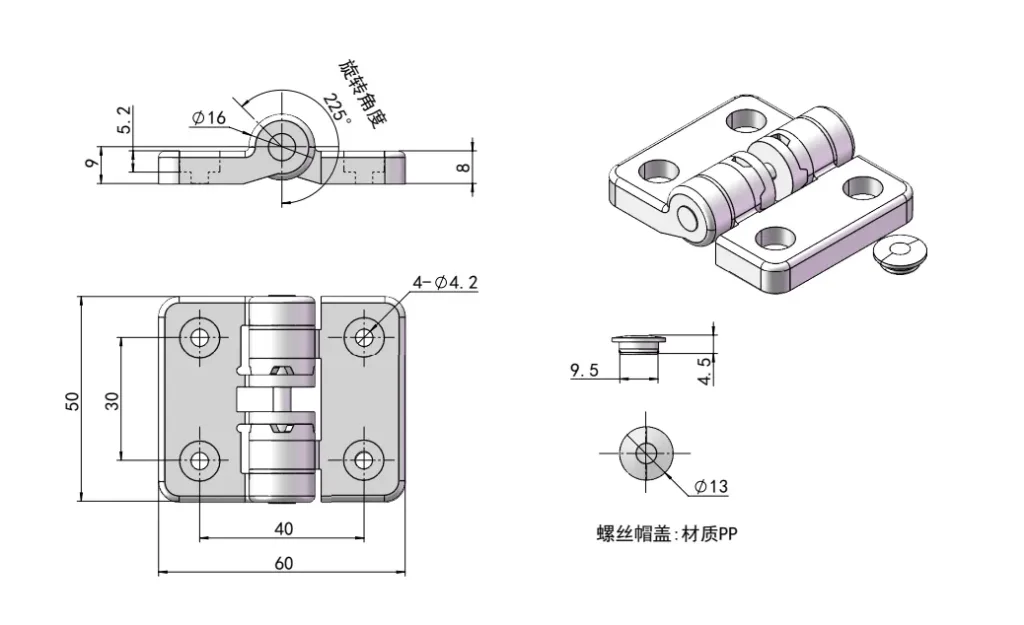
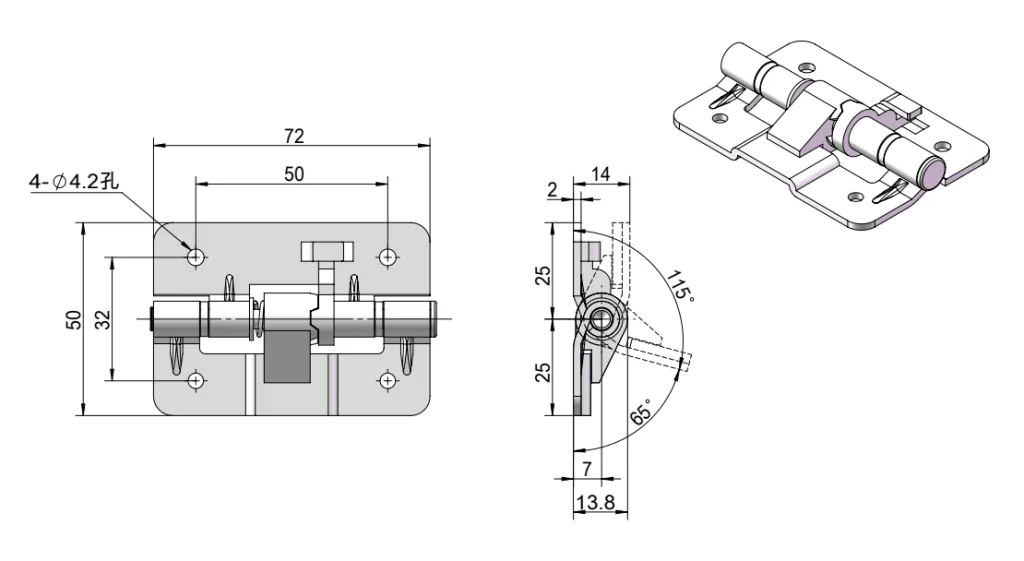
Once the application clearly requires defined working positions, the next step is to compare actual Detent / Positioning Hinges, drawings and available positioning behavior rather than continuing to evaluate generic free-stop hinges.
Choose Free-Stop Torque When the Working Position Changes
A free-stop torque hinge solves a different problem.
Instead of leading the panel toward selected indexed positions, friction resistance acts through the usable motion range so the panel can remain where the user releases it.
That becomes useful when the correct position changes from one use to another.
An operator panel may need one angle for a standing user and another for a seated user. A display may need continuous adjustment because viewing height or surrounding conditions change. A test-equipment lid may need to stay partially open while different components are reached.
In these applications, predefined positions can become unnecessary restrictions.
The user is not trying to return to the working position. The user is choosing a working position.
Once continuous free-stop motion has been selected, a separate question remains: should the friction value be factory-set or adjustable after assembly? That decision is covered separately in our constant vs adjustable torque hinge guide.
Motion type comes first. Torque-control method comes second.
Do Not Assume Free-Stop and Detent Are Opposites in Every Product
The two behaviors are useful categories for making the first decision, but real hinge mechanisms are not always purely one or the other.
A detent hinge can move relatively freely between positions, or it can combine indexed positions with friction resistance between them. Some mechanisms create a pronounced transition into the indexed position; others create a more moderate positioning feel.
That means an RFQ that says only:
“Need a 90° positioning hinge.”
is incomplete.
It does not explain whether 90° is the only working position, one of several positions, the maximum opening angle or simply an approximate position where the panel should stay.
Likewise:
“Need a torque hinge.”
does not say whether the user expects continuous free-stop motion or repeatable indexed positions.
For a hybrid requirement, describe the two functions independently:
- Where should the defined positions be?
- What should the panel do between those positions?
Keeping those questions separate prevents a supplier from solving only half of the motion requirement.
The Same Panel Can Need Different Hinge Motion in Different Products
Panel weight and dimensions do not determine whether the application needs detent or free-stop motion.
Two physically identical covers can require completely different hinge behavior.
One may be an inspection cover used at only one working position. Repeatable indexing may matter more than continuous adjustment.
The other may cover a work area where technicians need different opening positions depending on the component being serviced. Continuous free-stop motion may be more useful even though the physical panel is identical.
The decision comes from the task performed with the moving panel.
This is why hinge selection should not begin from statements such as:
“This is a light lid, so use a torque hinge.”
or:
“It opens to 90°, so use a detent hinge.”
Weight helps determine the mechanical holding requirement. Maximum opening angle defines travel. Neither one, by itself, defines the motion behavior the user needs.
What Happens When the Wrong Motion Type Is Selected?
A motion mismatch often does not look like a failed hinge. The product may still open, stay in place and fit every mounting hole. The problem appears when the equipment is used.
| Observed Behavior | Likely Motion Mismatch | What to Review |
|---|---|---|
| The operator repeatedly searches for the same working position | Continuous free-stop motion may be too unconstrained for the task | Consider whether a defined indexed position is required |
| The preferred working position repeatedly sits between two detents | The indexed positions may be too restrictive | Consider whether continuous free-stop motion is more appropriate |
| The panel needs defined positions but also needs to hold between them | Neither simple detent nor simple free-stop fully describes the requirement | Define a hybrid positioning requirement |
A hinge can therefore meet its component specification and still be the wrong motion architecture for the finished equipment.
Separate Motion Selection From Torque Sizing
After deciding between indexed and continuous motion, the panel still has to be mechanically supported.
For a friction-holding application, the required torque depends on the real moving assembly and its geometry. Panel mass alone is not enough; center-of-gravity distance from the hinge axis changes the moment that the hinge must resist.
But torque sizing should not be used to decide whether the hinge needs detents.
A correctly sized free-stop hinge still will not create repeatable indexed positions if those positions are part of the operating requirement.
Likewise, adding a detent does not remove the need to check whether the hinge and mounting structure are appropriate for the actual panel load.
| Engineering Question | What It Decides |
|---|---|
| What motion should the user experience? | Indexed positions, continuous free-stop or a combination |
| What mechanical resistance is required? | The holding requirement after the motion architecture is defined |
Motion architecture and torque sizing are related, but they are not the same decision. Once free-stop or hybrid friction holding is required, use the actual moving load and hinge geometry to calculate the required hinge torque.
Define What Happens at the Working Position
“Hold the panel open” is also too vague for a motion specification.
For a detent application, clarify whether the position should simply be recognizable, whether it should resist accidental movement and how the user should leave that position.
For a free-stop application, clarify whether the panel should remain wherever the user releases it and whether the operating resistance should remain suitable throughout the required working range.
For either type, distinguish normal positioning behavior from a structural end stop.
A detent position should not automatically be treated as the component that absorbs an impact from a door being thrown open. A friction hinge should not automatically be treated as a structural travel stop either. If the equipment needs a hard limit or impact load path, define that function separately.
Do not ask one positioning mechanism to perform three unrelated jobs: positioning, structural stopping and overload protection.
Validate the Motion in the Complete Assembly
A loose hinge operated by hand can tell you how the mechanism feels. It cannot prove that the completed assembly will behave correctly.
Install the hinge with the production-intent panel, mounting structure and attached components. Then move the assembly through the positions the user will actually use.
For a detent application, verify that each required position is reachable and recognizable in the installed geometry. Check whether cables, gaskets or nearby components create forces or interference that affect the intended position.
For a free-stop application, check intermediate positions rather than only fully closed and fully open. A cable harness can create a restoring force. A flexible mounting bracket can change installed behavior. Added hardware can move the center of gravity away from the hinge axis.
For a hybrid design, test both functions independently: the indexed positions and the holding behavior between them.
The useful validation question is not “Does the hinge move?” It is “Does the completed panel behave the way the operator needs throughout the actual working range?”
Turn the Motion Decision Into a Usable Requirement
Once the motion type is clear, translate the decision into language that a designer, supplier or purchasing team can act on. Avoid relying on a hinge family name alone.
For a Detent Requirement
A useful requirement states the positions that matter and what should happen between them:
The panel requires repeatable indexed positions at [Position A], [Position B] and [Position C]. Motion between indexed positions should be [free-moving / friction-held]. Maximum required travel is [X°].
For a Free-Stop Requirement
If the application needs continuous positioning, state that directly:
The panel should remain at user-selected positions throughout the required operating range. No discrete indexed positions are required.
For a Hybrid Requirement
If both behaviors matter, describe them separately:
The panel requires defined indexed positions at [Position A] and [Position B], with friction holding between those positions.
These statements still need the actual panel geometry, load, mounting envelope and project-specific requirements before a hinge model can be selected, but they make the required motion unambiguous.
“90° hinge” describes a geometry. “Torque hinge” describes too broad a product family. A usable requirement explains what the panel must do.
Make the Motion Decision Before Releasing the Hinge Model
Before choosing the final hinge, describe the application without using a hinge category name.
State what the panel does from closed to open, which positions matter, whether intermediate positions matter, whether the user needs continuous adjustment and whether any position must be repeatable.
| If the Application Requires… | Start With… |
|---|---|
| Repeatable, defined working positions | Detent / positioning hinge |
| Holding anywhere through a continuous range | Free-stop torque hinge |
| Defined positions plus holding between them | Hybrid positioning requirement |
Only after that motion decision should the project move into torque sizing, mounting geometry, material and final model selection.
Compare Detent / Positioning Hinge Options
If your application has defined working positions, review the available Detent / Positioning Hinges and their drawings first.
If none of the standard positioning behaviors matches the application, provide the required positions, panel load and mounting envelope so the motion requirement can be reviewed before a model is selected.
If your application instead requires continuous free-stop positioning, use our constant vs adjustable torque hinge guide to decide how the holding torque should be controlled before selecting a model.
Detent Hinge vs Free-Stop Torque Hinge FAQ
Is a detent hinge the same as a torque hinge?
Not necessarily. The terms vary between product families and suppliers. A detent hinge is defined by indexed or predetermined positions, while a free-stop torque hinge is defined by friction holding through a continuous motion range. Some hinge designs combine both behaviors.
Does a detent hinge hold the panel between detent positions?
It depends on the mechanism. Some designs provide friction holding between indexed positions, while others move more freely between them. Confirm the intermediate motion rather than assuming all detent hinges behave the same way.
When should I choose a detent hinge instead of a free-stop torque hinge?
Choose detent motion when the panel should repeatedly return to specific working positions. Choose free-stop torque when the user needs to select different positions through a continuous range.
Does a higher torque rating make a free-stop hinge behave like a detent hinge?
No. Increasing friction resistance changes the effort required to move or hold the panel, but it does not create defined indexed positions. Motion architecture and required torque are separate selection decisions.
Can a hinge provide both detent positions and free-stop holding?
Yes. Some designs combine indexed positions with friction holding between those positions. When that behavior is required, specify both the required positions and the expected motion between them rather than requesting only a “detent hinge.”
Should I calculate torque before deciding between detent and free-stop?
First define the required motion. Once continuous friction holding or a hybrid mechanism is known to be necessary, calculate the required holding torque from the actual moving load and geometry. A torque calculation cannot determine whether the application itself requires indexed positions.