-
+86 13720060320
-
lanna@haitangs.com

Adjustable Torque Hinges for Equipment Lids: Choosing Opening and Closing Resistance
If an operator has to lift an equipment lid with one hand, tightening both hinges until the lid stays up can solve one problem and create another: now the lid is hard to lift. When choosing adjustable torque hinges for equipment lids, specify opening and closing resistance separately. For a rear-hinged lid that gravity tends to close, start with low resistance on the way up and enough resistance on the way down to meet the holding requirement. If the lid also needs to resist being pushed farther open, evaluate a hinge that provides resistance in both directions.
Which Way Does Gravity Move the Lid?
Look at the lid from one end of its horizontal hinge axis. With the lid partway open, imagine a vertical line down through its center of gravity. If that line falls on the handle side of the axis, gravity tends to close the lid. Opening friction adds to the work of lifting it; closing friction opposes its descent. Reducing opening friction removes drag. It does not lift any of the lid’s weight.
Follow that vertical line all the way to the service position. If it crosses the hinge axis, gravity now tends to pull the lid farther open. A hinge selected only to resist closing can feel right through most of the stroke and offer little resistance near the open stop. Whether the line crosses depends on the finished lid, including any display, handle, or bracket attached to it.
When Does an Equipment Lid Need One-Way or Two-Way Resistance?
| What the operator needs | Hinge behavior to specify |
|---|---|
| The lid should lift easily and stay at a service angle where gravity tends to close it. | Consider a one-way friction hinge with its higher resistance in the closing direction. Check static holding torque at the service angle and the drag that remains during opening. |
| The lid should lift more easily than it lowers, but a light push should not swing it farther open. | Consider asymmetric two-way resistance. Specify a lower, nonzero opening torque and a higher closing torque at the same adjustment setting. |
| The operator repositions the lid in either direction and wants similar resistance from the hinge both ways. | Consider symmetric two-way resistance. Equal hinge torque does not mean equal hand force: gravity still helps in one direction and opposes the other. |
A one-way hinge still permits motion in both directions. “One-way” describes where the friction acts; it does not mean the lid locks against reverse travel. “Adjustable” describes a separate feature. An adjustment screw may change the amount of friction without changing its direction or letting you tune the two directions independently.
Opening and Closing Resistance at the Handle
Consider a lid at one working angle where gravity supplies 6 N·m toward closing. Assume the handle is 0.25 m from the axis, the hand pushes perpendicular to that radius, and the lid moves slowly. The figures below are assumed running torques for the whole hinge set; the latch is released and there is no spring assist.
With 1 N·m of opening resistance and 7 N·m of closing resistance, lifting takes (6 + 1) ÷ 0.25 = 28 N at the handle. Lowering takes a light downward push: (7 − 6) ÷ 0.25 = 4 N. Substitute a pair that supplies 7 N·m in both directions and the closing effort stays at 4 N, but the lifting effort rises to (6 + 7) ÷ 0.25 = 52 N. Someone trying the lid only on the way down would miss the difference.
These are moving forces at one angle. They do not predict the force needed to start the lid after a dwell or whether it will drift when released. This is an illustrative engineering scenario, not a customer project record or product test claim.
Left-Hand Mounting and Clockwise Resistance
A left-hand part number identifies a mounting version. It does not, by itself, tell you which way the lid will feel stiff. HSP’s HG11-047 flip-up lid hinges come in left- and right-hand versions. Their listed torque ranges do not give separate opening and closing values.
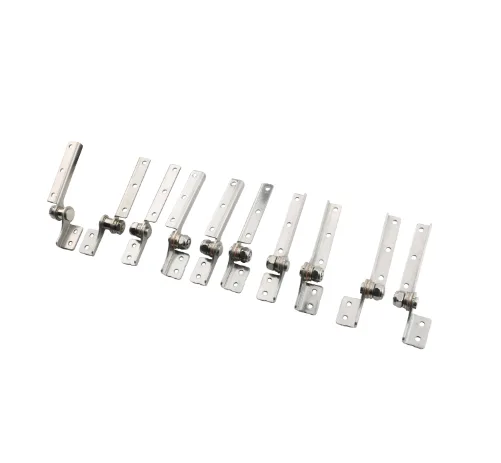
The HG11-011 directional hinge illustrates the other convention. HSP identifies its forward version as counterclockwise and its reverse version as clockwise. A clockwise arrow becomes counterclockwise when viewed from the other shaft end. Before choosing a version, mark the fixed leaf, the moving leaf, the viewing end, and an arrow labeled lid closing on the assembly drawing. Ask the supplier to match its high-resistance arrow to yours.

What to Check on the Sample Lid
Fit the intended hinge pair, handle, and lid hardware. Mark one angle used during normal operation and another where gravity or the operator’s grip changes most. Use the same handle point and pull direction for each comparison.
- Lift through each mark. At the handle, distinguish the initial pull after a pause from the force needed to keep moving. If lifting takes more force than expected for the lid load, check the mounting arrows before increasing the setting.
- Lower through the same marks. Note whether the operator must push down or hold the lid back. A force reading without that distinction can hide a lid that runs ahead of the hand.
- Check the service position separately. With an independent support ready to catch the lid and hands clear, observe any movement after release. Use the project’s agreed dwell time and allowable drift. A smooth moving stroke is not evidence that the lid will stay put.
If one direction passes and the other fails, find out whether both readings change together before turning the adjuster again. The adjustment range and locking guide covers how to document a usable setting once the right directional behavior is established.
Specifying Adjustable Torque Hinges for Equipment Lids
A useful drawing note reads: Viewed from the marked end of the hinge axis, the lid opens in the direction shown. Low resistance on opening; higher resistance on closing. Report opening and closing torque per hinge at the same setting, and static holding torque at the marked service angle. Add the maximum opening force your operator can accept and where on the handle it applies.
Use that note to shortlist adjustable torque hinge models. If the catalog gives only one torque value, send HSP your marked lid drawing for a model review. Include the finished lid mass, center of gravity, hinge count, and service angle so the response can identify the mounting version and the directional data still needed before ordering samples.
Equipment Lid Hinge FAQ
Can I use one torque hinge and one plain pivot on the same lid?
Potentially, if the mounting and load ratings allow it. The friction hinge then supplies the specified resistance by itself. Ask for that arrangement to be reviewed; do not divide the required holding torque between the two mounting points as though both generate friction.
Why is the lid hard to open only when fully closed?
Compare the first pull with the latch released against a restart just clear of the gasket. If only the first pull is high, the seal or latch may be contributing. If the lid is hard to restart at several angles after a pause, starting friction deserves a closer look.
Can I reverse a one-way hinge by turning it around?
Only if the manufacturer permits that mounting orientation and the leaves fit the intended fixed and moving surfaces. If the drawing calls for a reverse-direction variant, order that variant rather than assuming a mirrored installation is equivalent.
Does a gas spring change which direction needs resistance?
It can. A gas spring that pushes the lid open may overcome the lid’s closing moment through part of the stroke. Judge which way the lid tends to move with the spring installed; a bare-lid trial can point to the wrong resistance direction.
Will higher closing friction make the lid close in a set time?
A friction torque value does not specify closing speed. If the requirement is a closing time, state the release angle, lid load, and target time, and evaluate a damping mechanism on the assembly.
Can hinge friction serve as a lock for service access?
A lid that stays put during adjustment is not positively locked. If someone must work underneath it, provide the positive support or locking arrangement required for that equipment rather than relying on friction alone.