-
+86 13720060320
-
lanna@haitangs.com

Heavy-Duty Hinges for Cold Room Doors: Load Support and Seal Alignment
To specify heavy-duty hinges for cold room doors, start with the complete door and its closed section. Match the mounting support, pivot position and opening movement, then check bottom-seal clearance and the final gasket contact. A hinge can match the screw holes and carry the load while following the wrong path for the seal below it.
This guide covers side-hinged insulated entrance doors for walk-in coolers and freezers. The key decisions are how the leaf meets the frame, whether it needs to rise during opening, and how it returns to its sealing position.
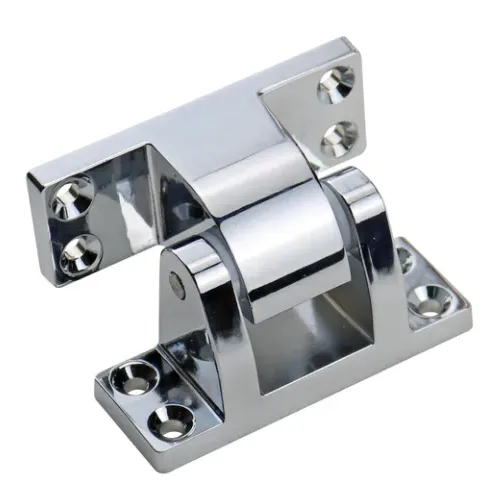
The Insulated Door and Its Mounting Pads
Use the finished door weight, including both skins, insulation, reinforcement, glazing, handles and any kick plates or other hardware carried by the leaf. Supply the door dimensions and hinge locations with that weight: a wider leaf can place a greater moment on the attachments even when its mass is unchanged.
Compare capacity against the intended mounting arrangement and door geometry. The industrial hinge load-rating comparison explains the conditions to check behind published values.
Reinforcement Behind the Insulation
Show where the hinge fasteners engage the door-side reinforcement and frame-side support. A thin skin over foam provides a different attachment from an embedded plate or reinforced edge member. The section should show how each support connects to the surrounding structure.
For through-fastened designs, specify the backing and clamping arrangement for the insulated panel. Tightening against unsupported skins can damage the assembly. Check that the hinge footprint and fastener positions land on the intended reinforcement before approving the model.
The Closed Door Section Sets the Geometry
A cold room door drawing should show the hinge-side frame, door edge and gasket in the intended closed position. This is where flush and overlapping door arrangements become relevant. The two mounting faces may sit on different planes, and the hinge pin must occupy the position needed by that particular section.
Door thickness and hinge offset are separate dimensions. An insulated leaf can become thicker without moving its external hinge mounting face by the same amount. Likewise, a raised frame pad can change the required hinge geometry without changing the leaf thickness.
Use a section through the hinge to establish:
- Where the door-side and frame-side mounting faces lie.
- Where the pin centerline sits relative to the door edge.
- Where the gasket contacts the frame when closed.
- What clearance the thick door edge needs as it starts to swing.
Overlay the candidate hinge drawing on that section. Hole centers alone do not show whether the door will reach the gasket correctly or clear the frame through its opening arc.
The HG02-084 refrigeration door hinge provides a product drawing for this kind of mounting comparison. Use the drawing for the selected version, and retain the drawing’s own dimensional references rather than treating every step in the profile as a universal offset value.
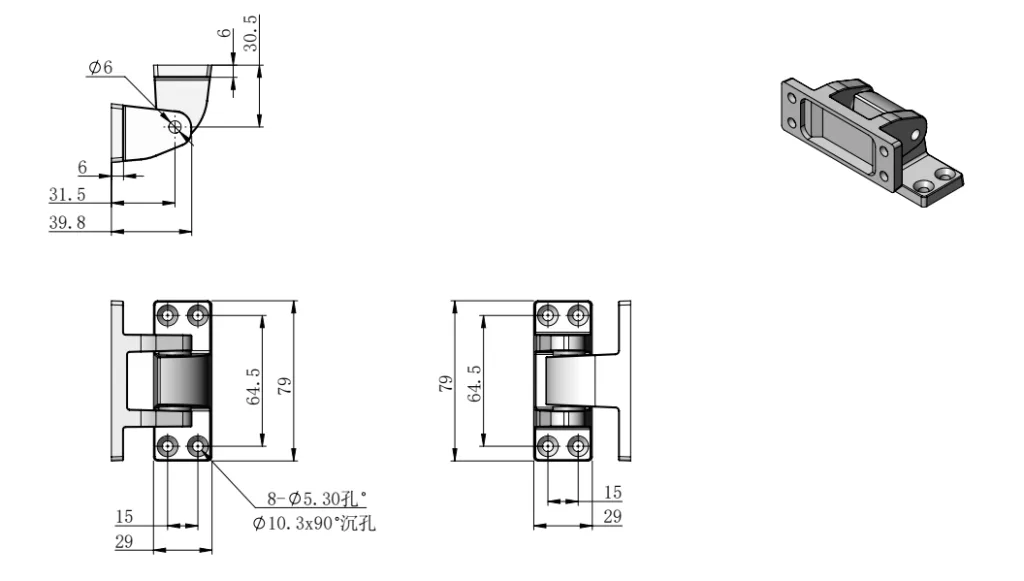
Adjustment can help accommodate the intended installation range, but its direction matters. Vertical adjustment changes leaf height; horizontal adjustment changes lateral position; depth adjustment changes the door’s position toward or away from the sealing face. Only use the adjustments provided by the actual hinge or mounting assembly. An adjustment slot is not a substitute for a matching door section.
Bottom Seals and Rising Hinges
The bottom edge often determines whether a cold room door needs a lifting movement as it opens. A sweep or other bottom seal may need contact with a threshold when closed, while also needing clearance during the swing. The floor level, threshold profile and seal shape all affect that requirement.
A cam-rise hinge raises the leaf as it opens, following the cam profile. A non-rising hinge keeps the leaf at essentially the same height. Either arrangement can belong in a cold room door design when the bottom seal and surrounding geometry are designed for that movement. “Heavy duty” does not identify which motion a hinge provides.
For a rising arrangement, check more than the fully open position. The seal must clear as the door starts moving, and the lifted leaf needs room beneath the head of the frame. The hinge set must provide compatible movement throughout the swing. Mixing a rising hinge with hardware that prevents the required vertical travel can make the assembly bind.
Matching Holes, Different Door Movement
As a hypothetical example, consider a freezer entrance door with cam-rise hinges and a bottom seal selected for that lifting movement. A proposed fixed-pivot replacement matches the screw pattern and has an acceptable support rating. At the mounting pads, the swap appears straightforward.
The replacement follows a different path. The bottom seal stays at its closed height and rubs against a raised part of the threshold. Raising the whole door enough to remove the drag leaves a gap below the seal when closed.
The mismatch is in the motion and sealing geometry. Retaining the required rise with a compatible hinge, or redesigning the bottom-seal arrangement, addresses that conflict. Increasing the support rating would not remove the interference.
Closing Assistance and Gasket Contact
A door can return toward the frame without completing its sealing movement. Define how the gasket, closing device and latch work together during the final approach. Several functions may be combined in one product, but each needs to suit the cold room door configuration.
| Function | What it contributes | What the door design must establish |
|---|---|---|
| Load support | Carries and locates the moving leaf | Suitable hinge arrangement, attachments and frame support |
| Cam-rise movement, where fitted | Changes leaf height during opening and closing | Compatible lift profile, bottom-seal clearance and headroom |
| Spring assistance or a separate closer | Moves the door toward its closed position | Required return range, opening effort and completion of the closing movement |
| Gasket and latch arrangement | Establishes the intended closed contact and retention | Correct seal profile, contact position and latch engagement |
For walk-in cooler door hinges used with a separate closer, check how that closer engages as the leaf approaches the frame. Its mounting and stroke have to suit the actual door movement, including any rise. A closer selected without that geometry may reach the wrong engagement position.
The latch should meet the door at its intended height. If it has to lift a sagging leaf before it can engage, correct the support and alignment first. Pulling harder at the handle can conceal the mismatch while leaving uneven contact elsewhere around the gasket.
Specify a hold-open position separately from maximum opening travel. A door may be able to open farther than the position at which it stays open, and a hold-open feature can change where automatic return begins. For loading access, describe the required behavior rather than ordering from an opening-angle number alone.
Freezer Service and Cleaning Exposure
For walk-in freezer door hinges, specify the temperature and moisture exposure at the hardware, along with the cleaning method. An exterior hinge can experience different conditions from the inner liner; the room setpoint alone does not describe its service environment.
Check the selected assembly’s temperature and cleaning limits, including the pin, bushings or cams, fasteners, finish and lubricant. The leaf material alone does not establish those limits.
HSP lists HG02-084S in SUS304 with a mirror finish and HG02-084 in ZDC with a chrome finish. Specify the required material version in the inquiry. The HG02-129-1 cold storage door hinge is listed in SUS304 with a brushed finish.
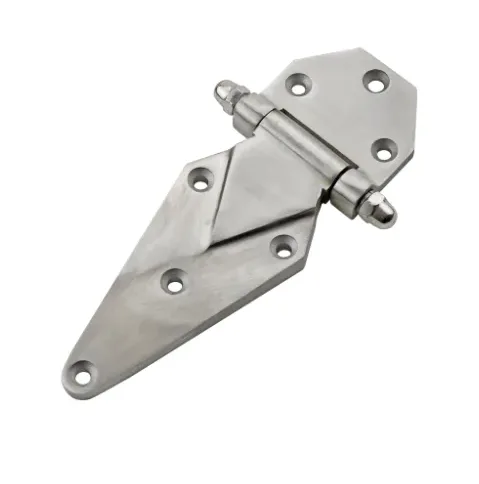
For the selected version, confirm load data and any required lifting, self-closing or adjustment features against the model documentation before sample evaluation.
Checking the Complete Cold Room Door
Evaluate the shortlisted hinge on a representative door with its intended frame, seal, threshold and closing hardware. Establish a square, plumb frame and secure mounting supports before checking the movement. If a hinge pad shifts during operation, resolve that attachment problem first.
Follow the opening and closing path, including intermediate positions. A clearance check at fully open can miss contact near the threshold or frame earlier in the swing. Use the door section and hinge movement data to review these four points:
| Point in the door movement | What to check | If the check fails |
|---|---|---|
| Initial opening at the bottom seal | Observe the seal across the actual floor and threshold profile. Check for folding, catching or unintended drag as any rise begins. | Compare the seal position, local floor level and hinge rise near closed before changing the door height. |
| Door rise through the opening arc | Check the top edge, frame head and attached hardware throughout the permitted travel, using the selected hinge’s rise profile. | Review the rise and available headroom together; clearance at one angle does not establish clearance through the swing. |
| Closer engagement during return | Check that the closer engages and completes its intended stroke while accommodating any change in leaf height. | Compare its mounting position and travel with the door movement before changing closing force. |
| Final closed position | Confirm that the door returns to the intended height and that the bottom and perimeter seals make their specified contact. | Locate the gap or uneven contact, then check the section geometry, door position and seal condition. |
An interference or contact mark identifies where to investigate; it does not establish the cause by itself. A gasket contact check also does not measure the complete door’s air leakage. Use the project’s separate sealing test where one is required.
Repeat the movement and contact checks at the intended operating condition and after the required opening cycles. Record changes in bottom-seal clearance, headroom, closing behavior and the final door position against the acceptance limits agreed for that assembly.
Specifying Hinges for Cold Room Doors
Use the heavy-duty hinge range to shortlist models against the door section and required movement. Resolve the drawing fit and applicable load conditions before fixing a model on the door bill of materials.
Send HSP the door weight and dimensions, closed hinge-side section, reinforcement details, bottom-seal and threshold arrangement, required opening behavior, temperature and cleaning conditions. Request a cold room door hinge model review so the proposed version and drawing can be compared with your assembly before sample evaluation.
Cold Room Door Hinge Questions
Can the same hinge be used on a walk-in cooler and a freezer?
It may be possible when the exact hinge assembly is suitable for both installations. Compare its component limits and the door requirements for each application. Matching hole positions or stainless steel construction alone does not establish compatibility with the freezer’s operating and cleaning conditions.
How should I specify left-hand or right-hand opening?
Send a sketch showing the door viewed from the warm side, the hinge side and the opening direction. Mark the viewing side explicitly. Use the manufacturer’s handing convention for the part number; a label such as “left-hand” without a stated viewpoint can be ambiguous.
Can a replacement hinge use the existing cold room door holes?
Only after checking the hole condition, backing structure and required geometry. A matching pattern does not prove that the fixing still has adequate support. If the holes or inserts are damaged, assess the repair with the door manufacturer before treating the replacement as a direct fit.
Does a cold room door always need cam-rise hinges?
No. A non-rising arrangement may suit a door whose bottom seal and threshold provide the required opening clearance and closed contact. Consider cam-rise movement when the door design needs vertical lift to accommodate the bottom seal. Confirm the whole movement rather than choosing by the cold room label alone.
What head clearance is needed for a rising cold room door?
Use the rise profile for the selected hinge and the actual door-and-frame section. Check the highest position reached within the required opening range, including installation adjustment and the project’s allowances. There is no single clearance value that applies to every rising hinge or cold room door.
Does frost near a hinge mean its load capacity is too low?
No. Frost identifies a moisture and temperature condition, not a hinge load rating. Check door position, gasket contact, local thermal paths and any applicable frame-heating system before attributing it to the hinge. A structural explanation needs mechanical evidence, such as measured movement or changing alignment.