-
+86 13720060320
-
lanna@haitangs.com

How to Identify a Replacement Concealed Hinge for an Industrial Cabinet
To identify a replacement concealed hinge for an industrial cabinet, start with the cabinet model and any markings on the installed assembly. Then document both mounting sides, the hinge mechanism, and the dimensions that distinguish the likely variants. A matching photograph or hole pattern narrows the search; it does not establish interchangeability.
The loose part may be only the door-side member. A welded frame bracket, removable pin, or missing retaining clip can determine which replacement will assemble. Identify the complete arrangement before ordering.
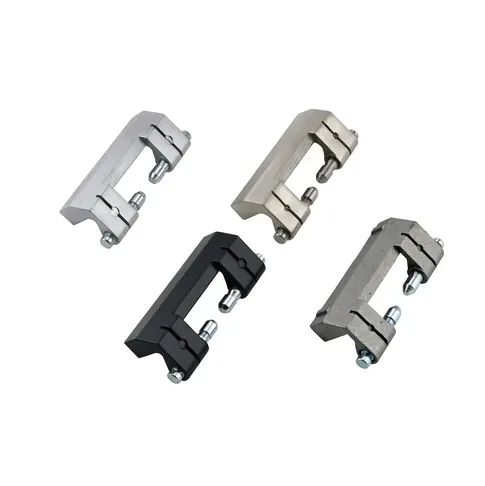
Start With the Cabinet Identity
Look for the equipment manufacturer, cabinet model, serial number, and any door or enclosure assembly number. An OEM parts list or service drawing can connect the hinge to the correct cabinet version even when the hinge itself carries no readable number.
Keep the original punctuation and suffixes when copying a marking. Photograph it before trying to interpret it. A number cast into a leaf might identify that component rather than the complete orderable hinge; a logo may identify the manufacturer without identifying the model.
Search the complete marking together with the manufacturer name, then compare the result with the actual assembly. For a superseded part, ask which successor applies to that cabinet revision and whether it requires a new bracket, pin, or hardware.
If there is no useful marking, describe the part by its visible structure and attachment. “Concealed sheet-metal cabinet hinge, welded frame bracket, removable pin” is a more useful starting point than “small silver hidden hinge.”
What Must the Photos Show?
Photograph the hinge while installed. Follow the equipment isolation procedure and support the door before loosening hardware. A loose part no longer shows its relationship to the cabinet or the available pin-withdrawal space.
| View to capture | What must be visible | What it helps identify |
|---|---|---|
| Door open, hinge installed | Both mounting sides and the adjacent door return or frame flange | Assembly orientation and attachment |
| Close-up of the door side | Leaf, screws, studs, welds, and any spacer | The door-side component and fixing method |
| Close-up of the frame side | Bracket shape, mounting face, and all accessible markings | The mating component that may remain in place |
| Pin ends or release mechanism | Head, groove, clip, latch, or withdrawal direction | How the assembly is retained and separated |
| Removed part, if safe to remove | Front, back, and side views with a scale in the same plane | Shape and approximate size for initial screening |
A ruler provides approximate scale; perspective prevents reliable measurement from the photo alone. Send originals alongside annotated copies, labeling the door and frame sides without covering mounting details.
If the hinge is broken, include the fragments and the intact mating part. For an assembly with several hinges, show their positions and note any differences. A missing clip or broken bracket must not silently disappear from the replacement description.
Mounting, Motion, and Door Removal
“Concealed” describes the installed appearance. It does not tell you whether the hinge uses a single pivot, a folding linkage, a removable pin, or welded mounting parts. Record these characteristics separately because they can occur in the same assembly.
Attachment on each side
Identify the fixing on each side: screws, threaded studs, welds, or a combination. A screw-mounted door member may mate with a welded frame bracket. If that bracket must stay, its interface becomes a fixed condition for the replacement search.
The opening mechanism
A single-pivot hinge turns about one pin axis. A folding concealed hinge uses several connected pivots, so the linkage arrangement matters as well as the mounting faces. Observe the hinge near closed and partway open; an open product photograph alone may hide the difference.
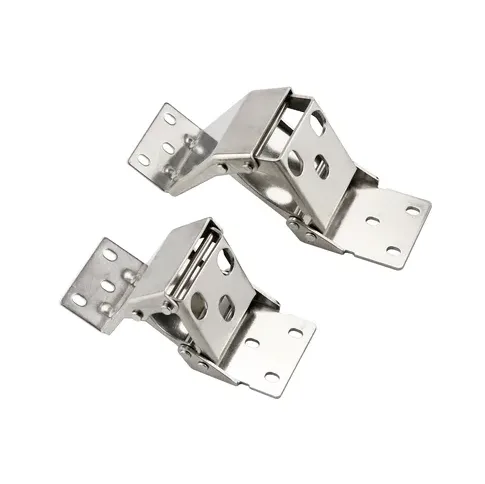
Can the door be removed?
Note whether removal requires withdrawing a pin, releasing a latch, lifting the door, or unfastening a member. Include the available access direction. A visually similar removable hinge is a poor candidate if its pin cannot be withdrawn in the installed cabinet.
Use these observations to narrow the industrial concealed hinge range to plausible structures. Avoid using a furniture cup-hinge identification chart unless the installed hinge actually has that construction.
Measurements That Distinguish Similar Hinges
Use the reference surfaces on the candidate drawing, labeling dimensions on the corresponding view. Keep door-side and frame-side measurements separate. Overall length does not describe how the members meet.
- Mounting pattern: Hole-center spacing, hole or slot size, and distance from the mounting pattern to a recognizable edge. Distinguish clearance holes from threaded holes.
- Mounting-face relationship: The offset, step, or bracket height between the fixing surface and the pivot. Record the folded position for a multi-link hinge.
- Mating interface: Pin diameter, mating barrel or bracket width, engagement arrangement, and the location of any shoulder or retention groove when accessible.
- Hand and orientation: Label the cabinet top, door side, and frame side on a photograph. Show any asymmetry instead of relying only on “left-hand” or “right-hand.”
For slotted mounting holes, record the slot and the installed fastener position. The current screw location may reflect an adjustment, not the nominal hole-center location on the drawing. For a welded member, record where it sits relative to the cabinet flange; there may be no mounting-hole pattern to compare.
Use consistent units and record the measurement method. Do not round a measured value to a familiar metric or inch size simply to make a catalog part look compatible. Thread diameter alone does not establish the thread pitch.
If a pin, hole, or leaf is worn or distorted, label that condition beside the measurement. Compare with an undamaged hinge on the same cabinet where possible. Copying an enlarged hole or bent leaf into a replacement sketch can preserve the damage rather than recover the intended geometry.
For help interpreting views, dimension references, or drawing notes, use the guide to reading a hinge spec sheet and engineering drawing. Here, the purpose of measuring is to identify the candidate configuration, not to create a complete manufacturing drawing from a worn sample.
Read the Full Item Number
A family name can lead to several items. Resolve the size, material, finish, and handed version, then record the complete item number and drawing revision.
For example, the HSP HG02-015 four-axis folding hinge page lists HG02-015-1 and HG02-015-2. Its table gives different values for P1, P2, L1, L2, and H. The shared family code therefore does not identify a single mounting configuration.
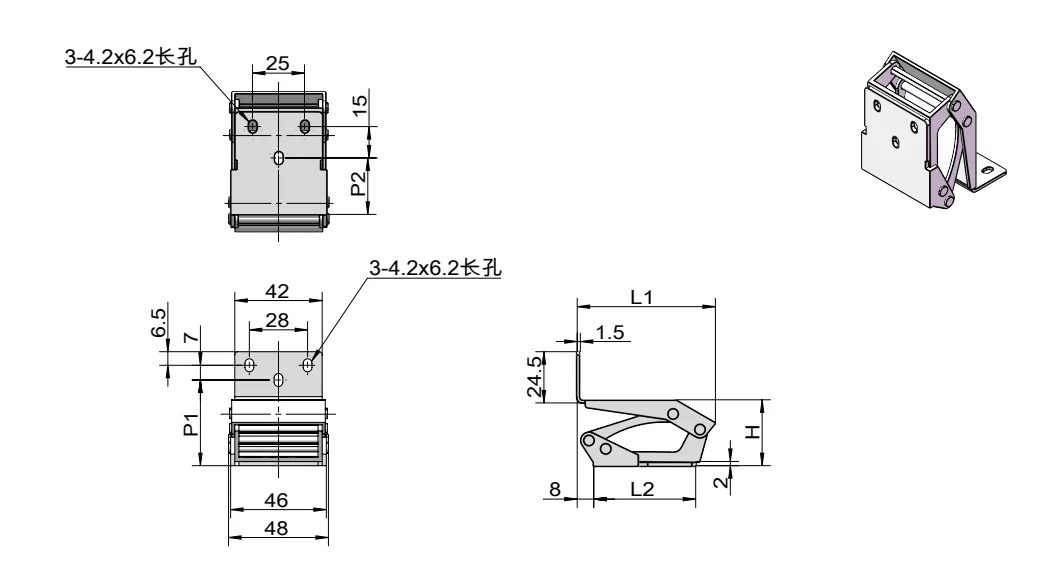
Material and finish also need documentary support. A silver appearance cannot establish stainless steel grade, plating, or the material of an internal pin. Preserve the specified material and finish from the cabinet record, or ask the supplier to identify the available version. Do not apply one manufacturer’s suffix convention to another manufacturer’s parts.
The New Leaf Fits; the Old Bracket Does Not
Consider a cabinet with a damaged door-side hinge member and a frame bracket that remains welded in place. A candidate leaf has the same mounting-hole spacing, and its outline looks close to the original. The buyer plans to replace only that leaf.
A comparison of the assembled views reveals a different width at the pin interface. In this hypothetical configuration, the original pin cannot fully engage the replacement and seat its retaining clip. The mounting holes fit, but the mixed assembly does not.
The useful next step is to ask whether the supplier has a documented leaf-and-pin combination for the retained bracket. If not, a complete replacement assembly may be necessary, which would also require reviewing the welded bracket location and the cabinet work involved. Altering the pin or omitting the clip would not establish compatibility.
This is an illustrative engineering scenario, not a customer project record or product test claim.
Narrow the Replacement Concealed Hinge Shortlist
Separate documented candidates from visual matches. The evidence determines whether to pursue an exact spare, resolve missing details, or review a retrofit.
| Evidence available | What it supports | Next step |
|---|---|---|
| Exact OEM spare tied to the cabinet model or revision | A documented replacement route | Confirm the supplied components and any installation changes |
| Candidate drawing matches the relevant interfaces; retained parts are identified | A candidate for application and fit review | Obtain confirmation of the complete mating configuration and review a sample |
| Similar photograph or matching hole pattern only | Initial visual screening | Resolve the bracket, pin, orientation, and exact item before ordering |
| Different pivot arrangement, retained-part interface, or mounting location | A possible retrofit, not an established direct replacement | Review the required cabinet changes before proceeding |
Identification does not establish the load capacity or service life of an alternative hinge. If the original specification is unavailable, the supplier still needs the door mass, dimensions, hinge arrangement, and operating conditions to assess suitability. A change in door equipment or hinge quantity also needs to be disclosed.
A sample should be assessed with the actual mating parts and cabinet. Look for complete retention, unobstructed movement, and correct closure. If the pivot location or folding mechanism changes, use the separate concealed hinge cutout and opening clearance guide for the geometry review; matching fastener locations is not enough.
Have an unidentified hinge? Share your hinge photos and identification details with HSP. Include the cabinet reference, readable markings, installed views of both mounting sides, and a measured sketch. State which existing parts must remain and whether cabinet modification is allowed. This gives HSP a basis for discussing a replacement concealed hinge candidate without treating a photo match as a confirmed substitute.
Questions About Industrial Cabinet Hinge Replacement
Can I identify a concealed hinge from one photograph?
Usually only to a likely family. One view may hide the frame bracket, back-side fixing, or pin retention. An installed view plus close-ups of both mounting sides gives the supplier a better basis for identification. Dimensions and an exact item reference are still needed to establish the configuration.
What if the original hinge is completely missing?
Document the remaining bracket, holes, weld marks, and cabinet identification. An intact hinge on an otherwise identical door can provide a reference, but compare the cabinet revision and handed arrangement before assuming it is the same part.
Can I replace only the hinge pin?
Only when the hinge design supports that service operation and the correct pin is identified. Diameter alone is insufficient: length, shoulders, retention features, and material may matter. Also inspect the mating bores; a new pin will not restore a worn or cracked bracket.
Does a reversible hinge eliminate left- and right-hand questions?
Only if the specific assembly is documented as reversible. A removable pin, stop, asymmetric bracket, or restricted service access can still make the installed direction significant. Provide a labeled orientation photograph when the catalog wording is unclear.
Can one hinge be replaced while the others remain?
An exact specified spare may allow individual replacement. A different design needs review of how it works with the retained hinges, including its axis or linkage motion and mounting position. Matching the damaged hinge’s external size does not establish that a mixed set will operate correctly.
Is a different opening angle acceptable for a replacement?
Treat it as a functional change unless the cabinet documentation permits it. The door may need a particular service opening, stop position, or clearance to adjacent equipment. A larger catalog angle is not automatically an improvement, and it may not be achievable in the installed cabinet.