-
+86 13720060320
-
lanna@haitangs.com

Medical Cart Hinges: OEM Selection Guide
A hinge can work perfectly while a medical cart is parked and still become the wrong hinge after the cart is loaded, rolled across a threshold, wiped with the specified disinfectant, and parked beside a bed. Medical cart hinges have to support the moving panel, but they also sit inside a system of thin enclosure walls, latches, stops, cables, accessories, and cleaning boundaries.
The useful starting point is not a material name or a catalog load rating. First identify what each door, lid, display pivot, or service panel must do. Then select the hinge family that produces that motion and verify the complete installed assembly. A catalog description such as “stainless,” “heavy-duty,” or “medical grade” cannot replace that work.
Scope: This article addresses hinge architecture for OEM medical carts, including access doors, lids, folding work surfaces, display pivots, and removable service panels. Stationary laboratory cabinets and general equipment enclosures are outside its scope. It does not establish medical-device compliance, cart stability, infection-control performance, or the suitability of a specific hinge model. Those conclusions require the finished cart design, its documented cleaning process, and project-defined validation.
Map Every Moving Panel
A cart rarely has only one hinge job. The front storage door may need a conventional swing. A rear electronics panel may need to come off for service. A top work surface may need to stay open without a prop. A display may need controlled tilt, while a small flap may need a defined return or detent position.
Record each moving element separately. Combining them under one line—“medical cart hinges”—usually hides the feature that should control selection. The broader industrial hinge selection guide explains the general hinge families; the application record below makes that decision specific to the cart.
Separate operator access from service access. A nurse or technician may open a supply door many times during normal use, while a rear panel is touched only during scheduled maintenance. The first needs predictable one-handed motion and controlled projection into the work area. The second may prioritize full removal, retained hardware, and repeatable reconnection. Using the same architecture for both can add complexity without solving either task well.
Review the panel in four states: secured for movement, released but closed, moving through its useful angle, and open or removed for service. A top lid that behaves well after the cart is parked may still lift or rattle during transport. A side door that clears the cart body may block a drawer or accessory when open. These states expose requirements that a closed-position drawing does not show.
- Panel identity: main door, lid, monitor mount, work shelf, rear service panel, battery cover, or accessory flap.
- Orientation: vertical side-opening, horizontal top-opening, bottom-hinged, or multi-axis.
- Complete moving mass: include glass, lock hardware, trays, displays, cable brackets, insulation, and mounted devices.
- Center of gravity: locate it relative to the hinge pin centerline rather than reporting mass alone.
- Required behavior: free swing, hold at any angle, stop at indexed angles, return toward closed, or remove for service.
- Cart state: parked use, routine rolling, internal transport, shipping, and service removal.
- Cleaning boundary: define which hinge surfaces and internal interfaces can be contacted by the documented cleaning process.
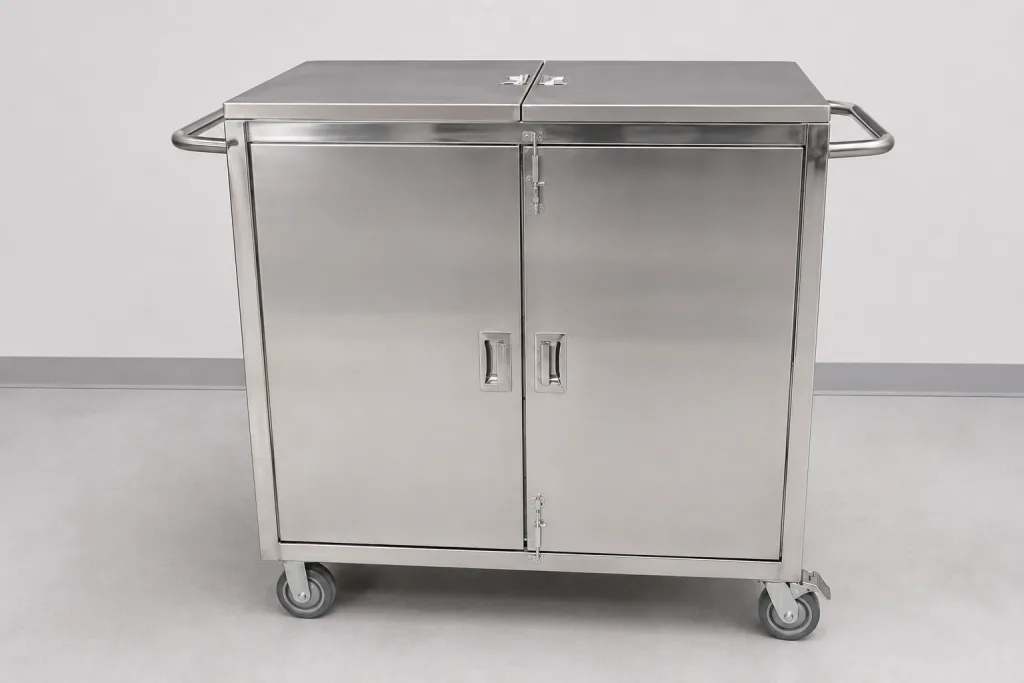
Application illustration of a mobile stainless-steel medical cart with separate front-door and top-lid hinge tasks. Not a customer installation or performance claim.
Choose Medical Cart Hinges by Panel Motion
Choose the mechanism from the panel behavior. Strength comes later. A stronger free-swinging hinge will not hold a work surface open, and a torque hinge does not automatically make a removable service door.
| Moving element | Required behavior | Candidate hinge architecture | Selection question |
|---|---|---|---|
| Side-opening storage or equipment door | Open and close freely while remaining captive | Surface-mounted fixed, concealed, or heavy-duty hinge | Does the installed axis preserve the door gap, latch position, and usable bedside opening? |
| Rear or lower service panel | Swing normally and occasionally detach | Lift-off or controlled removable hinge | Is there a safe removal vector, and can rolling or transport loads cause unintended release? |
| Top lid or folding work surface | Hold at intermediate angles or move with controlled resistance | Constant, adjustable, one-way torque, or positioning hinge | What moment acts about the pivot, and what operating feel is acceptable through the useful angle? |
| Display or user-interface pivot | Reposition repeatedly without drift | Single-axis or multi-axis torque hinge | Are holding torque, breakaway feel, cable reaction, and user reach defined for the complete display assembly? |
| Small access flap | Return, damp, or hold at one or more fixed positions | Spring, damping, or detent hinge | Could the return force or closing speed create a pinch, slam, or latch-engagement problem? |
| Large door carrying equipment | Support a high moment without sag or binding | Validated heavy-duty hinge arrangement | Can the hinge-line structure and spacing carry the complete door rather than the bare panel? |
Fixed surface-mounted and concealed hinges can both work on a side door, but they spend space differently. A surface hinge leaves more of the mechanism visible and may simplify inspection or replacement. A concealed hinge protects the exterior line and reduces projection, but it needs internal depth and a verified door sweep. Neither choice is automatically cleaner, stronger, or safer without the installed geometry.
Some mechanisms combine functions—a torque hinge may include a detent, or a removable hinge may also provide friction. Treat each claimed function as a separate requirement. The supplier should return the angle, direction, torque or release behavior, tolerance, and test basis for the exact configuration. A hybrid product name alone does not show which function controls the door at each point in its travel.
A medical display pivot is a separate engineering problem from a cart door. If the cart includes an articulated screen, use the dedicated medical monitor arm torque hinge guide for moment, movement feel, cable routing, and torque retention. This page keeps that branch visible without repeating its specification.
The Cart Moves Before the Door Opens
A stationary cabinet mostly asks the hinge to carry gravity and operating forces. A mobile cart adds acceleration, abrupt stops, floor transitions, vibration, handling impact, and sometimes shipment with the door already installed. These events enter the hinge leaves, pins, fasteners, mounting edge, and latch even when nobody operates the door.
The closed-door latch should retain a door during movement. The hinge should support and guide it. Treating hinge friction as the transport latch leaves the door vulnerable to vibration, wear, and variation in operating feel. The transport state also needs to account for work surfaces, monitor mounts, removable panels, and accessories that may have a different secured position from their normal-use position.
Lift-off designs require special attention because a vertical shock can act in the same direction as disengagement. The release method may be tool-free in a controlled service area, but a cart used in public or clinical spaces may need a secondary anti-lift feature that trained personnel can release deliberately.
Define mobile duty in language that can be reproduced. “Used in a hospital” does not state whether the cart crosses elevator joints, moves between buildings, rides in a vehicle, or ships with the door loaded. Record the cart mass and configuration, the panel state, latch state, travel or transport profile, and inspection points. The required exposure and acceptance limits are project-specific; they should not be copied from an unrelated cart or inferred from a hinge catalog.
The door stayed latched, but the hinge line moved. Consider a side door that opens smoothly during a stationary bench check. After the fully loaded cart is rolled through a project-defined route, the latch still closes, yet the upper latch-side gap has narrowed. The hinge is intact. The formed mounting edge has flexed, and the latch is pulling the door back into an apparently acceptable closed position. Checking only “opens” and “latches” would miss the structural change. This is an illustrative engineering scenario, not a customer project record or product test claim.
An open door can also move the cart’s center of gravity outward. The hinge may be mechanically suitable while the complete cart becomes unstable in a particular loading or caster condition. Cart stability is therefore a system-level review owned by the equipment design, not a capability that should be inferred from the hinge.
A Correct Hinge on a Weak Edge
Medical cart enclosures often use formed sheet metal, aluminum skins, molded polymers, composite panels, or a combination of these. The hinge rating is useful only when its mounting structure can transfer load into a stable frame or reinforced return.
A narrow hinge leaf attached to an unsupported skin can dish the panel, elongate a hole, loosen an insert, or rotate the hinge axis. A molded wall can crack or creep around a concentrated fastener pattern. The visible symptom may be door sag or binding, but the root cause sits behind the hinge.
Follow the load from the moving panel through the hinge leaf, fasteners, local reinforcement, cart enclosure return, and internal frame. Through-bolts and backing plates, self-clinching hardware, blind threaded inserts, weld nuts, molded bosses, or bonded reinforcement may all be plausible. The correct joint depends on substrate, rear access, production sequence, serviceability, and the real load case. Detailed joint selection belongs in the thin sheet-metal hinge mounting guide.
Two or more hinges must also share one practical axis. Thin panels can flex enough to let every fastener enter its hole, then spring back after tightening and side-load the pins. The drawing may fit. The door can still bind. Control the hinge pin centerline from stable cart-enclosure datums, support the door during assembly, and inspect movement before the latch is allowed to correct the closed position.
The fastener pattern also changes the edge load. Closely spaced holes in a narrow leaf concentrate bearing and pull-out forces, while a wider pattern can spread them only if the material behind the full footprint is stiff. Slots may help assembly adjustment, but they can permit movement if clamp load and bearing support are inadequate. Formed returns, internal rails, and backing plates should extend load into the cart structure rather than end beside the last fastener and create a new stress concentration.
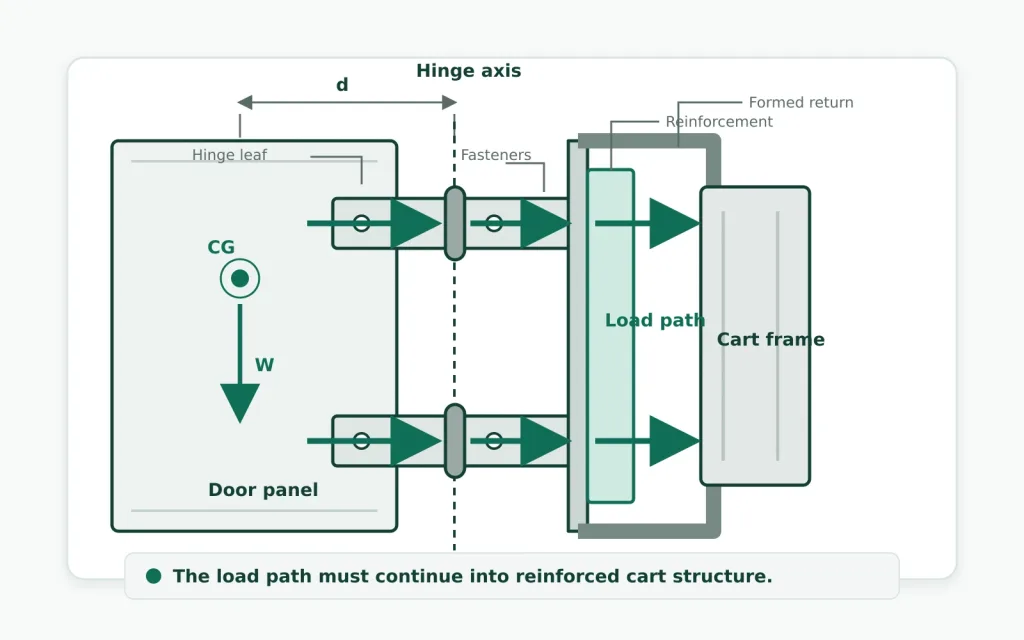
Door load must pass through the hinge, fasteners, reinforcement, formed return and cart frame.
Cleaning Around the Hinge Line
“Hospital cleaning” is not one exposure condition. The equipment manufacturer should identify the actual agents, concentration or prepared form, contact time, wipe frequency, temperature, rinse condition if any, and surfaces included in the cleaning instructions. Without that list, material compatibility remains to be confirmed.
An exposed hinge is visible and easy to inspect, but its leaf edges, fastener heads, and pin area can interrupt the wipe path. A concealed hinge reduces external projection and snag points, yet it uses internal space and may create a hidden cavity. The correct architecture depends on whether that cavity lies inside the defined cleaning boundary and whether it can be inspected or serviced.
| Hinge element | Supplier return needed | Installed concern |
|---|---|---|
| Leaves or housing | Exact material grade, finish, and coating system | Wipe exposure, edge condition, discoloration, corrosion, and finish damage |
| Pin or shaft | Material, retention method, and surface condition | Fluid entry, wear debris, pin movement, and cleaning access |
| Bushing, washer, or friction stack | Component materials and any exposure limitation | Swelling, embrittlement, lubricant migration, torque change, or particle release |
| Fasteners and backing hardware | Material, coating, locking feature, and supplied/not-supplied status | Dissimilar-material contact, trapped liquid, recess cleaning, and preload retention |
| Lubricant or process residue | Location and supplier restriction, if present | Migration into a cleaned surface or loss of hinge function after repeated wiping |
A stainless leaf does not prove that the pin, friction stack, fasteners, or nearby mounting materials suit the same exposure. Likewise, a supplier declaration for the loose hinge does not prove that the installed joint can be cleaned as intended. Evaluate the exact hinge revision inside the cart’s documented cleaning procedure.
Geometry matters alongside chemistry. Liquid can collect below a lower hinge, behind an offset leaf, around a recessed screw, or between a backing plate and cart-enclosure skin. A nominally compatible material can still discolor or corrode where solution is retained and drying is slow. The assembly review should identify drainage direction, inspectable surfaces, removable covers, sealant boundaries if used, and locations where cleaning residue could enter a pivot or mounting hole.
Ask for evidence that matches the proposed finish and component stack. A material certificate identifies composition; it does not demonstrate the appearance, motion, or torque of the installed hinge after the cart’s cleaning sequence. If chemical compatibility has not been tested for the exact model, label it for sample evaluation rather than converting a general material statement into a performance claim.
Useful Opening Angle at the Bedside
A drawing may show a 180-degree hinge while the finished door provides only a fraction of that useful access. Cart handles, caster envelopes, monitor posts, drawer pulls, cable hooks, wall bumpers, power cords, accessory rails, and neighboring equipment all compete for the same space.
Start from the service or user task. A supply door may need one-handed access without projecting into a walkway. An electronics door may need enough angle to remove a module. A work surface may need to clear the operator’s hand and remain inside the cart footprint. A rear panel may be opened only in a maintenance area, which permits a different envelope from bedside use.
Trace the moving door edge and every attached item from closed to the required operating angle. Repeat the check with the cart in its most restrictive intended position, not only in open factory space. Include finger clearance, cable bend, handle reach, latch projection, and the space needed to release any removable hinge.
Bottom-hinged doors and fold-down shelves need an additional check. At the open position, the hinge, stay, stop, and mounting structure may carry an applied working load rather than only the panel mass. State whether the surface is a light access flap or an intended work support. If people can lean on it or place equipment on it, that load belongs in the complete assembly requirement and should not be assigned to the hinge without defined evidence.
Opening angle is a mechanism limit. Useful access is an assembly result. Record both values on the project drawing so a catalog angle is not mistaken for the clearance available beside the finished cart.
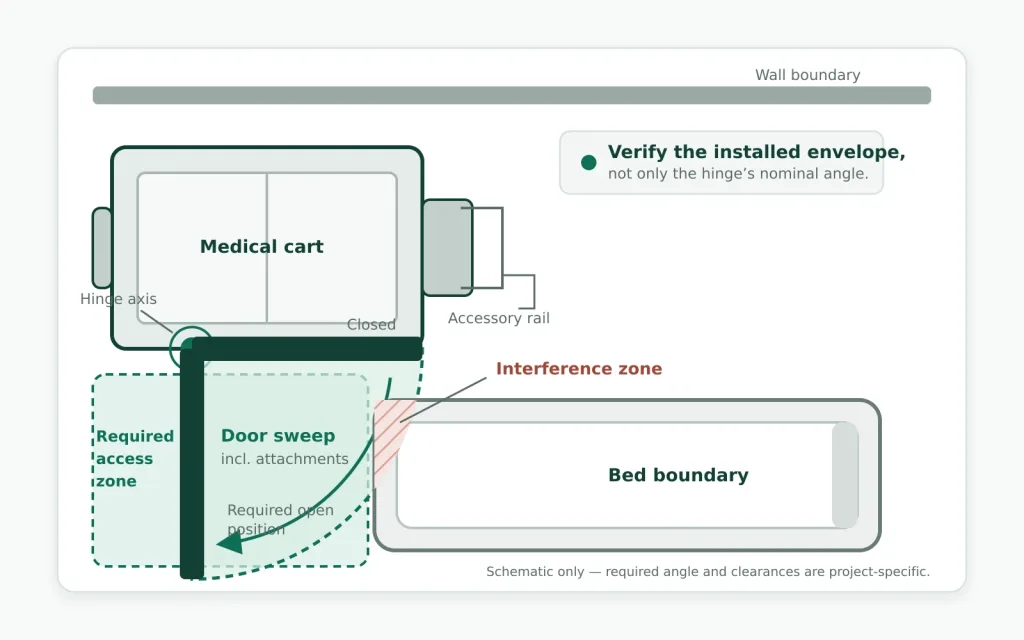
Useful access depends on the finished cart, nearby equipment and service space—not only the hinge opening limit.
Removable Panels Need Controlled Release
A removable rear or lower panel can shorten service work when a technician needs direct access to batteries, power supplies, pumps, wiring, or control modules. Removal should solve a real access problem; otherwise, a captive door often reduces handling, loss, and reinstallation risk. For equipment that combines cabinet doors, display pivots and removable service access, compare the application routes in our Medical & Laboratory Equipment Hinge Solutions page.
For a lift-off arrangement, define the removal direction, required opening angle, axial disengagement travel, available lift space, panel handling path, and the method that prevents unintended release. These dimensions come from the selected hinge drawing and the complete cart-enclosure section. The detailed process is covered in the lift-off hinge clearance and pin-retention guide.
Reinstallation must restore more than appearance. Check the door gap, latch engagement, cable connection, shielding or bonding feature if applicable, and any gasket contact after the panel is removed and replaced. If the technician must lift the panel to engage the latch, the hinge axis or mounting structure has not returned to the approved condition.
Panel mass and handling also set a practical boundary. A hinge can be mechanically removable while the panel remains awkward for one person to lift, rotate, support, and place without damaging nearby equipment. Define who removes it, where it is held, whether handles or a support fixture are needed, and how it is prevented from falling after the final hinge disengages. These are service-layout inputs, not properties that a leaf dimension can answer.
Latches, Stops, and Cables Share the Load
The hinge does not work alone. A latch retains the closed panel during rolling. A stop arrests opening before the hinge, cable, or adjacent equipment is overloaded. A stay or torque element supports a lid in use. Each device needs a defined job.
Keep three reactions separate: the hinge carries and guides the moving panel; the latch retains the closed state; the stop absorbs the opening limit. Do not assume an internal hinge feature can serve as the structural stop unless the supplier identifies and rates that function for the exact configuration.
Door-mounted cables and hoses add another reaction. A service loop can pull the door toward closed, increase operating force, rub at a sharp edge, or become the unintended stop. Route it around the real hinge axis, protect the bend, and provide strain relief on both sides. If wiring passes through a hollow shaft or hinge opening, the available passage, edge condition, rotation range, and assembly method must come from the controlled drawing.
Adjustable torque can compensate for a defined variation in a lid or display assembly. It should not be used to hide a misaligned axis, a cable that is too short, or a panel that changes mass after accessories are added. Correct the structure first; tune the mechanism second.
A compression latch or gasket can also mask hinge error. When the latch pulls a distorted door into place, the closed gap may look acceptable even though the hinge line has shifted. Inspect the door immediately before latch pull-in and compare the force or position needed to engage the latch. A growing need to lift, push, or twist the door is evidence of an assembly change, not a reason to tighten the latch further.
Installed-Sample Evidence
A loose hinge sample can confirm finish, basic motion, and drawing dimensions. It cannot prove cart behavior. Use a production-intent or representative assembly when the decision depends on door moment, a thin mounting edge, cleaning exposure, latch recovery, cable reaction, or transport retention.
| Installed check | What to observe or measure | Acceptance source |
|---|---|---|
| Baseline geometry | Door gaps, hinge-axis position, latch engagement, leaf seating, and mounting-surface condition before operation | Released assembly drawing and project tolerance |
| Fully loaded movement | Operating force, binding, drift, sag, noise, cable reaction, and access through the useful angle | Project-specific functional requirement |
| Mobile-duty condition | Fastener movement, pin migration, gap change, unintended opening or lift, and latch recovery after the defined rolling or transport exposure | OEM-defined route or transport profile; test conditions must be recorded |
| Opening envelope | Interference with handles, accessories, bed or wall boundary, cables, and service-removal path | Equipment layout and service task |
| Cleaning exposure | Finish change, corrosion, swelling, residue, lubricant migration, torque change, and retained wipe access | Documented equipment cleaning procedure and project acceptance criteria |
| Removal and reinstallation | Release effort, safe handling, retained hardware, restored gap, latch alignment, and connected services | Service procedure and assembly drawing |
| Repeated operation | Change in play, operating feel, hold position, gap, fastener condition, and mounting-edge deformation | Project-defined cycle count and end-state limits |
Record the hinge model and revision, complete panel configuration, fasteners, reinforcement, latch and stop arrangement, cable routing, cleaning condition, cart loading, and test sequence. A statement that the door “passed” is not transferable to production if the tested configuration is unknown.
Test order can reveal interactions. Establish the unloaded baseline, add the final door-mounted equipment, operate the panel, apply the defined mobile-duty condition, repeat the cleaning exposure, and then recheck the same geometry and operating measures. When the latch can hide misalignment, inspect both before and after latch engagement. When a torque or detent function is involved, use the same angle, direction, dwell, and measurement method at each comparison point.
A preliminary model recommendation narrows the candidate family. Engineering review checks the proposed drawing against the cart. Sample approval demonstrates the production-intent assembly under defined conditions. Production approval still depends on the OEM’s complete equipment controls. These labels should not be treated as interchangeable evidence.
Medical Cart Hinge Questions
Does a medical cart always need stainless steel hinges?
No universal material applies to every cart. Stainless steel may be appropriate for repeated cleaning or corrosion exposure, while coated metal, aluminum, zinc alloy, or engineered polymer may suit other boundaries. The decision requires the actual cleaning protocol, full component stack, surrounding materials, mechanical load, and supplier evidence for the exact hinge.
Are concealed hinges better for medical cart doors?
They can reduce external projection and create an uninterrupted outer face. They also consume internal space and can create a cavity behind the door return. Compare exposed and concealed arrangements by wipe path, inspection access, door sweep, mounting depth, fastener access, and serviceability rather than appearance alone.
Can a lift-off hinge be used on a mobile medical cart?
Yes, when full panel removal is required and the design includes adequate disengagement clearance, a safe handling path, correct pin direction, and retention against unintended lift during use or transport. Tool-free removal is not automatically appropriate for every public-facing or frequently moved cart.
How many hinges should a medical cart door use?
There is no universal count. Door moment, height, hinge spacing, axis alignment, mounting-edge stiffness, accessories, operating frequency, and mobile loads determine the arrangement. Adding another hinge can reduce local deflection, but it can also create binding when the axes do not align.
What does the term medical-grade hinge actually prove?
By itself, the phrase does not define load capacity, cleaning compatibility, cycle retention, corrosion limits, particle behavior, or regulatory status. Replace it with measurable requirements and evidence tied to the exact hinge revision and installed equipment.
Inputs for a Hinge Model Review
Before selecting a part number, assemble one application package for the specific moving panel. Do not send only a hinge photograph or overall cart width.
- Overall medical cart view with the moving panel identified.
- Door, lid, display, or service-panel dimensions and complete moving mass.
- Center-of-gravity location or a component layout that allows it to be estimated.
- Door-edge and frame cross-sections, substrate material, thickness, formed returns, and reinforcement.
- Required motion: free swing, hold, detent, return, damping, or controlled removal.
- Closed position, hinge axis, required useful opening angle, and surrounding clearance envelope.
- Hinge count, spacing, handing, mounting-hole limits, and accessible assembly side.
- Latch, stop, stay, gasket, cable, hose, handle, and door-mounted accessory locations.
- Parked, rolling, internal-transport, and shipping conditions that apply to the panel.
- Cleaning agents and procedure, contact surfaces, frequency, and acceptance criteria.
- Required supplier drawing, material return, functional data, and sample evidence.
The correct medical cart hinges are the ones that preserve the required motion, alignment, cleaning boundary, retention, and service access on the finished assembly. If any of the inputs above are unknown, mark them for engineering review rather than replacing them with a catalog assumption.
Send the Medical Cart Door and Mounting Section
Submit the moving-panel drawing, cart-side mounting cross-section, complete panel mass, required motion, opening envelope, cleaning exposure, and mobile-duty condition. HSP can use those inputs to identify a technically plausible existing hinge family and return the model-specific information that still needs confirmation. Final suitability remains subject to installed-sample validation.