-
+86 13720060320
-
lanna@haitangs.com

How to Choose an Industrial Hinge: Selection Guide
Choosing an industrial hinge means matching the hinge to the door, load, motion, environment, service plan, and how the product is built — not picking the strongest part in a catalog. The right approach is to settle the category first: does the panel need to hold position on its own, come off quickly for service, stay hidden behind a clean face, or simply carry heavy load reliably? Once that is clear, material, mounting, and cycle-life fall into place. This is a pillar guide. It gives engineers, procurement specialists, OEM buyers, and project managers a single decision framework, then points to the detailed page that handles each hinge type in depth — so you start broad here and drill down only where your application needs it.
The reason this matters is simple: a hinge that looks correct on a drawing can still fail in the field if one requirement was missed. Most premature hinge failures are not manufacturing defects — they are selection mistakes, where the load, the environment, or the service pattern was never fully defined before a part number was chosen. The sections below walk through the dimensions that decide the outcome, in the order most teams should work through them.
Start with the use case, not the catalog
The first step is to describe what the hinge must actually do in the real application. A hinge for a heavy machine access door, a control cabinet, a medical monitor arm, a removable service panel, and a concealed equipment cover are all solving different problems, even when they look alike at a glance. So the selection should begin with function — support, position control, removal, concealment, or endurance — because the correct type depends far more on the job than on the word “industrial” itself.
This framing also prevents the single most common error we see: choosing a hinge because it resembles one used on a previous product, rather than because it fits the current load and duty. Two cabinets that look identical can have very different door weights, opening frequencies, and cleaning regimes, and those differences — not the visual similarity — decide the hinge. You can see how the categories are organized across the industrial hinge range, but the catalog is where you finish the choice, not where you start it.
The decision dimensions at a glance
Industrial hinge choice comes down to a handful of dimensions. Skip one and the hinge can pass on paper yet fail in service, which is why selection is a system-design task, not a part-number task — and why a robust category such as a heavy-duty hinge still has to be verified against every dimension below, not assumed. The table below summarizes what each dimension governs and where it most often goes wrong.
| Dimension | The real question | Where it goes wrong |
|---|---|---|
| Load & moment | How much weight, and how far from the hinge line? | Sizing to raw weight and ignoring the moment from the center of gravity |
| Motion type | Free swing, hold position, lift-off, or concealed? | Using a free-swinging hinge where the panel must stay put |
| Cycle life | How often does it move, and does it still hold after? | Reading a cycle count without a torque-retention figure |
| Environment | Corrosion, cleaning, dust, heat, UV, outdoors? | Indoor-grade material on an outdoor or washdown door |
| Mounting | Weld-on, screw, through-hole, stud, concealed? | Mounting that blocks service or loosens under vibration |
| Serviceability | Install, remove, adjust, replace — how easily? | Easy to install, but impossible to service in the field |
| Space & appearance | Clearance, cable routing, hidden mechanism? | Hinge fouls cables, seals, or the visible face |
Narrow it down by motion type
The fastest way to cut the field down is to start from the motion requirement, because it points almost immediately to a single hinge category. If the door only needs to open and close, a standard or heavy-duty hinge is enough. The interesting cases are the ones where the panel has to do something more — and each of those has its own detailed guide.
When the panel must hold position — a lid, display, or cover that should stay exactly where it is set without a prop or lock — the answer is a torque (friction) hinge. This is the deepest sub-topic, because torque selection is about more than a single number: how much holding force remains after thousands of cycles, and whether the torque should be fixed at the factory or tuned later, are decisions in their own right, each handled in a dedicated guide further below.
When the door must come off quickly for service, a lift-off hinge lets it be removed without unscrewing leaves, while a door that simply has to carry heavy, frequent load takes a heavy-duty hinge as its baseline.
When the mechanism must stay hidden for appearance or tamper resistance, a concealed hinge is the place to start. Each of these categories has its own selection detail, linked from the relevant sections that follow.
From the field: holding a control-panel hatch at any angle
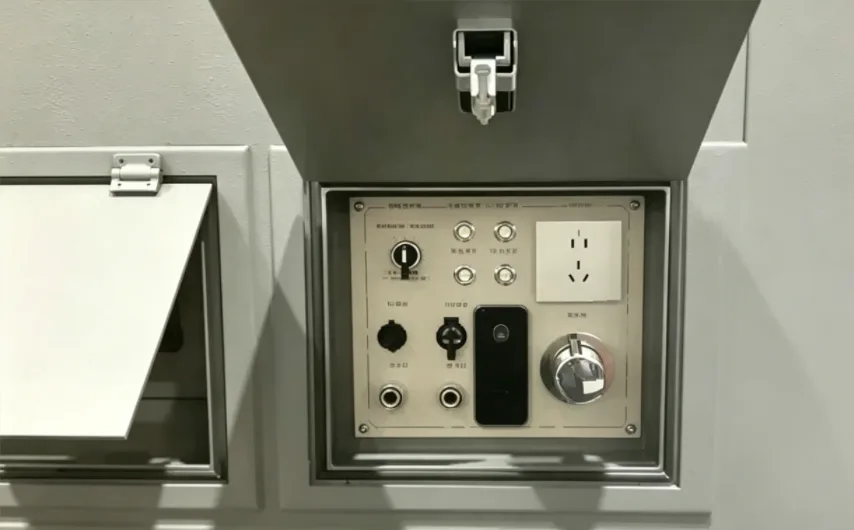
A short example shows why motion type drives the decision. On a recessed equipment control-panel hatch we supplied, the operator lifts the flap to reach the power outlet, switches, and service connections set into the panel behind it. A standard hinge would have let that flap fall shut on the operator’s hands, or forced them to hold it with one hand while working with the other. We specified a constant torque hinge, which lets the flap stay open at any angle, hands-free, and return to the same positions repeatably. Because every unit needed to feel identical, a fixed factory-set torque was the right call rather than an adjustable one — the full trade-off is in the constant vs adjustable torque hinge guide. The lesson generalizes: the panel did not need a stronger hinge, it needed the right motion behavior, and that is the decision the catalog cannot make for you.
Confirm load and the moment, not just weight
Load is the most common reason hinges fail early, and the trap is that teams size to the door’s raw weight. The real driver is usually the moment — the weight multiplied by how far the center of gravity sits from the hinge line. A modest door that is wide, or that carries displays, controls, or insulation mounted far from the pivot, can demand far more holding capacity than its mass suggests. Evaluate door size, panel thickness, hinge count, opening angle, and operating force together, and treat load capacity as a primary design input for any door that is heavy, wide, or used often. When a single hinge cannot carry the moment cleanly, the answer is usually more hinge points or a stronger category, not simply “the strongest version” of an undersized type. At the opposite end, small panels in tight spaces have their own constraints, covered in the mini torque hinge guide.
Let the environment set the material
The environment can matter as much as the load. A hinge that performs perfectly in a clean indoor enclosure can fail quickly outdoors, in humidity, near chemicals, or under washdown, where corrosion seizes moving parts or eats fasteners. When exposure is aggressive, selection should start from material and corrosion resistance rather than mechanical load: stainless grades for chloride and washdown, coated or galvanized steel for milder indoor duty, and a clear answer on whether the finish survives the cleaning regime. Ask where the hinge lives during daily operation — water, salt, disinfectants, oil mist, dust, heat, UV, or temperature cycling all change the right material. For weatherproofed outdoor cabinets specifically, the way the hinge has to preserve the enclosure’s sealing rating is covered in the outdoor enclosure hinge guide.
Match mounting and service to how the product is built
Mounting method is not just a manufacturing detail; it affects strength, assembly speed, and whether the hinge can be replaced later. Weld-on mounting suits heavy structures and resists vibration loosening, but makes disassembly hard. Screw or through-hole mounting speeds assembly and replacement. Stud or concealed mounting serves packaging and appearance goals. For a high-volume OEM build, production consistency may matter more than one-time install ease; for a serviceable enclosure, the ability to replace a hinge without major teardown may matter more.
Service planning is the dimension teams most often defer, and it is where field problems are born. If technicians remove the door frequently, a lift-off or detachable hinge saves time; keeping alignment after repeated removal is the focus of the lift-off hinge guide. A hinge that installs easily but services poorly will pass prototyping and then generate recurring complaints once the product is in the field, so the service plan belongs in the decision before the final category is locked — not after.
The same decision from four points of view
Different stakeholders weigh these dimensions differently, and a good specification reconciles all four rather than letting one dominate.
- The design engineer owns load, moment, motion behavior, and cycle life — making sure the hinge holds, moves, and survives the duty cycle without drift or binding.
- The procurement specialist owns evidence and supply — load ratings, material and corrosion data, certifications, and whether the supplier can hold quality and volume across the program.
- The OEM buyer owns total cost of ownership — not just unit price, but warranty exposure, service calls, and the cost of a field failure traced back to a hinge.
- The project manager owns risk and timeline — confirming the choice is validated with samples before release, so a late hinge change does not stall the build.
When these views conflict — a cheaper hinge that complicates service, or a robust hinge that slows assembly — the resolution is always to return to the application requirement, not to split the difference on price.
Common selection mistakes to avoid
Most hinge problems trace back to a small number of recurring selection errors, and they are worth naming because they cut across every hinge type. The first is sizing to weight instead of moment, which leaves a door that is fine when bench-tested but sags once it is loaded and opened in service. The second is treating a cycle-life number as a guarantee, when what actually matters is how much holding force or alignment remains after those cycles — the distinction the torque hinge cycle life guide works through in detail. The third is specifying an indoor-grade material or finish for a door that will be cleaned with chemicals, left outdoors, or exposed to salt — the mechanism corrodes and seizes long before it wears out mechanically. The fourth is ignoring the service plan, so a door that is easy to assemble becomes a maintenance headache once it must be removed or realigned in the field. The fifth, and easiest to overlook, is letting mounting or cable routing interfere with the hinge, which produces wobble and binding that get misdiagnosed as hinge failures when the hinge itself is sound. Catching these early, at the specification stage, costs nothing; catching them after tooling or field deployment is expensive.
A simple selection workflow
For most projects, working in this order moves cleanly from function to structure to lifecycle and avoids choosing by catalog appearance:
- Define the application and exactly what the hinge must do.
- Confirm load, door size, and opening geometry — including the moment, not just the weight.
- Decide the motion need: free swing, position control, removal, or concealment.
- Check environment, corrosion, and cleaning requirements.
- Choose the mounting method that matches production and service.
- Confirm cycle life and maintenance expectations.
- Validate the final option with samples or testing before release.
What procurement should ask the supplier
Procurement teams need a faster filter than engineering, but the questions point the same way: ask for the load rating, cycle life, material and finish, corrosion performance, mounting method, and available documentation such as quality certifications or test evidence. For a regulated or medical-adjacent product, expect material declarations to back any “medical grade” or “corrosion-resistant” claim — the label should be supported by data, not marketing. It is also worth asking whether the supplier offers a related product family: in many programs the best answer is not one part forced to fit every door, but a range of hinges across sizes and duty conditions, with the supplier able to point you to the right sub-category. A capable hinge that cannot be supplied consistently across the program is a risk, so treat the hinge as a lifecycle component, not a commodity line item. Confirm the application requirements first, then source the part that matches the design intent.
Once you know which function the hinge must serve, move to the detailed page for that type and finish the specification there. If you want help matching a hinge to a specific door, panel, or enclosure, share the load, motion, environment, and service requirements and our engineering team can point you to the right category and the right specification for it.
FAQ
What is the first step in choosing an industrial hinge?
Start with the use case – the load, motion, environment, serviceability, and appearance the assembly requires. The correct hinge category depends on what the door or panel must actually do, not on what looks similar in the catalog.
How do I know which hinge type I need?
Match the hinge to the motion requirement. Holding position points to a torque hinge, quick removal to a lift-off hinge, a hidden mechanism to a concealed hinge, and heavy frequent load to a heavy-duty or weld-on hinge.
What matters most for industrial hinge selection?
Load and moment, motion type, cycle life, environment, mounting method, and service plan are the biggest factors. The moment from the door’s center of gravity often matters more than the raw weight, and is the most common thing teams miss.
Should procurement choose the hinge before engineering defines the application?
No. Confirm the application requirements first – load, motion, environment, and service plan – then source the hinge that matches the design intent and operating conditions. Choosing a part number before the duty is defined is a common cause of field failures.
When should I move from this guide to a detailed hinge page?
As soon as you know which function the hinge must serve. Once the motion need is clear – hold position, lift off, conceal, or carry heavy load – move to the detailed page for that specific hinge type to finish the specification.