-
+86 13720060320
-
lanna@haitangs.com

Outdoor Enclosure Hinges: Holding the NEMA/IP Rating in the Field
An outdoor enclosure is only as good as the rating on its label. A cabinet sold as NEMA 4X or IP66 has to hold that rating not on day one, but after years of sun, rain, wind, and temperature swings. The component most likely to quietly break that promise is the hinge — because when a hinge corrodes, loosens, or lets the door drop, the gasket stops sealing and the rating is gone, long before anyone opens the door to check. This guide is about that specific problem: choosing and mounting hinges so an outdoor enclosure keeps its protection rating across its service life. (For the metallurgy, weld detail, and type-by-type selection behind the recommendations here, the linked guides go deeper — this page stays focused on the outdoor weatherproofing side.) This is one part of a wider decision — for the complete selection framework, see choosing the right industrial hinge.
The rating-loss chain (why outdoor is different)
Indoors, a tired hinge is a nuisance. Outdoors, it is the first link in a chain that ends in equipment failure. The sequence is always the same: the hinge degrades, the door falls out of alignment, gasket compression goes uneven on the latch side, the seal opens a path, and water or dust reaches the electronics. The enclosure still looks closed — it just no longer protects anything. What makes outdoor service uniquely demanding is not one severe condition but the constant, low-level combination below, working on the hinge for years without maintenance.
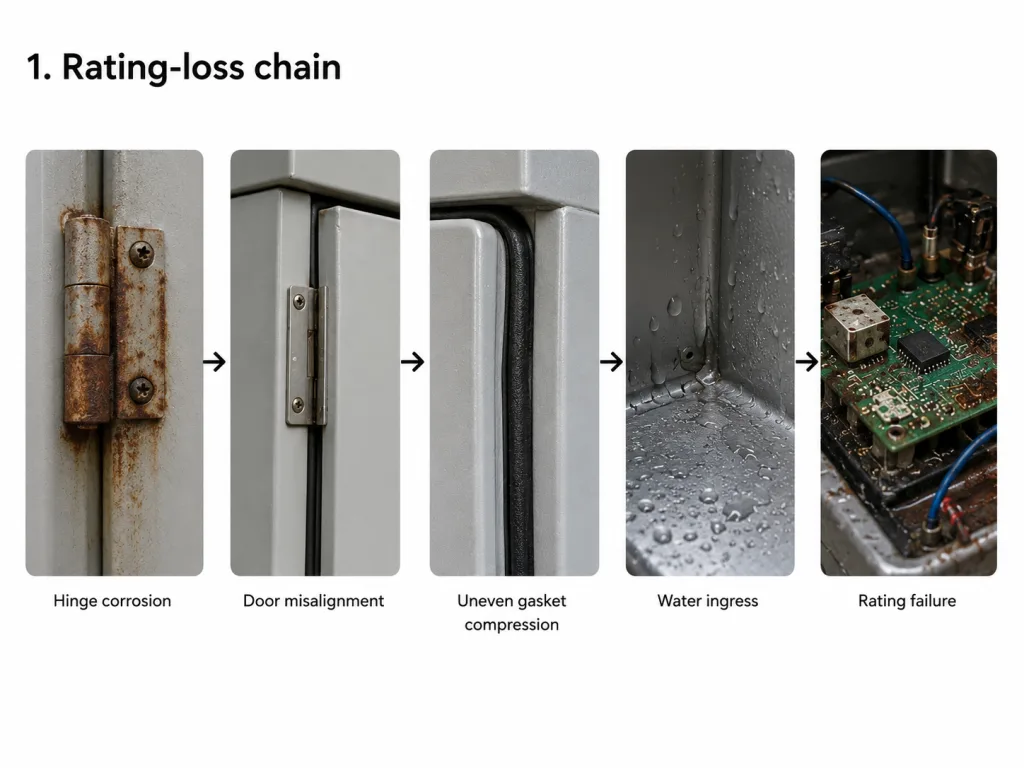
- UV and weathering: sunlight degrades polymer bushings, washers, and any non-metallic hinge component, and chalks or fades coatings — a failure mode indoor hardware never sees.
- Condensation and thermal cycling: day-night swings drive moisture in and out of knuckles and screw holes, and repeatedly expand and contract the joint, working fasteners loose.
- Wind load on the open door: a technician’s open door becomes a sail; gusts apply shock loads the hinge never sees on the bench, bending leaves and enlarging pin clearance over time.
- Pole-mount and transport vibration: roadside and pole-mounted cabinets vibrate continuously, which walks loose pins out and backs dry fasteners off.
The design target outdoors is not “a hinge that opens.” It is “a hinge that holds the door in sealing alignment for the life of the rating.”
Zone finder: match the site, then read the right guide
Material grade is set by how much chloride the site sees — so start there. Find your zone, take the baseline grade, then follow the link for the full material and type rationale. (Where a site fits two zones, specify for the more severe one. And always state the grade on the drawing — never just “stainless steel,” or 304 may arrive where 316 was needed.) For field equipment where exposure, vibration and service access must be considered together, see our Outdoor & Mobile Equipment Hinge Solutions application page.
| If your site is… | Zone | Baseline grade | Typical hinge route |
|---|---|---|---|
| Inland, mild, low chloride (general telecom, utility, automation) | A — Standard | 304 | Reinforced bolt-on door hinge |
| Roadside / motorway, winter deicing salt (traffic, EV charging, signal) | B — Road salt | 316 | Staked-pin or welded, vibration-proof |
| Coastal, marine-adjacent, persistent salt spray | C — Coastal | 316 | Removable for service, low-crevice |
| Washdown, chemical, public/vandal-exposed | D — Chemical / security | 316 or specialty | Concealed or sealed, no exposed hardware |
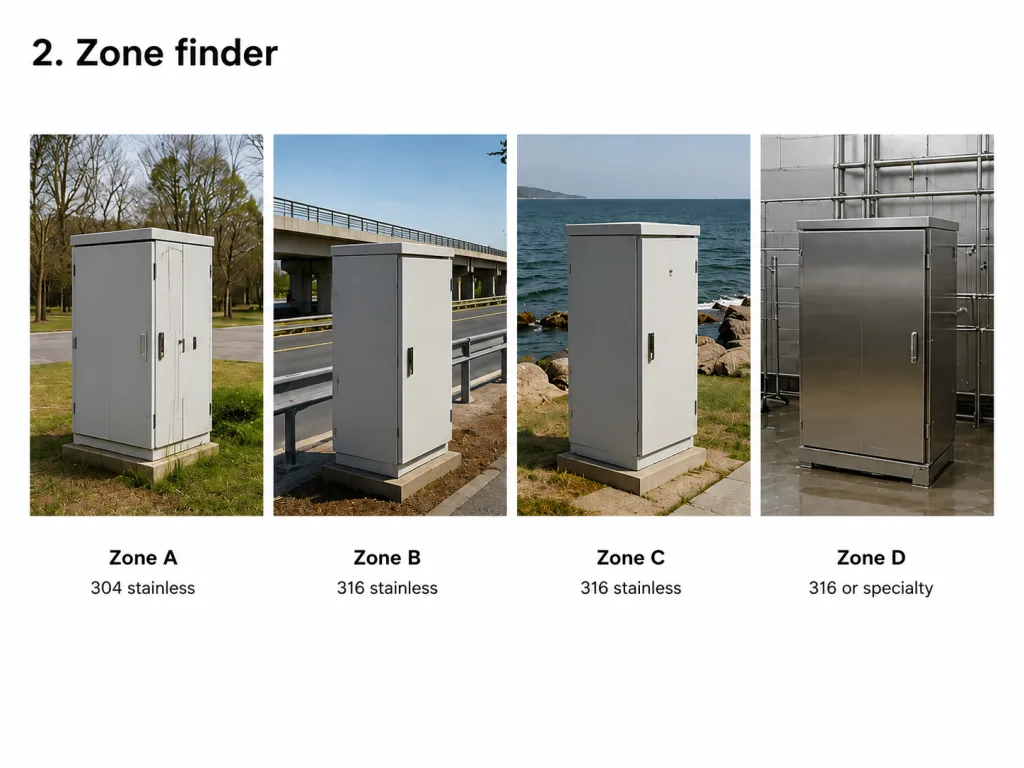
The “hinge route” above is a starting point, not the whole decision. For Zone B welded assemblies where fasteners must never loosen, the full reasoning and weld detail are in the weld-on hinge selection guide. For Zone C cabinets that must be opened for service, see how removable hardware is specified in the lift-off hinge guide. For Zone D public-facing or anti-tamper cabinets, the corrosion and security trade-offs are covered in the concealed hinge guide. For Zone A standard heavy outdoor doors, browse heavy-duty hinges.
Keeping the seal: hinge details that protect the rating
Once the grade and type are chosen, four outdoor-specific details decide whether the rating actually survives in the field. None of these are about the hinge in isolation — they are about the hinge as part of the weather seal.
- Don’t turn mounting holes into water paths. Every screw penetration through the enclosure wall is a potential leak. Seal them with washers, gaskets, or internal studs, and on high-exposure faces reduce through-holes — or remove them entirely with a welded joint.
- Design drainage, not traps. A hinge leaf laid flat against the wall can trap salt-laden water behind it and start crevice corrosion you never see. Favor geometry that sheds water and leaves no standing pocket at the mounting line.
- Size hinge count for the loaded door, weather included. Tall outdoor doors flex and catch wind; two small hinges let the latch side sag and the gasket gap. A third hinge point, or continuous hinge-side support, keeps compression even along the full height.
- Lock the pin and the fasteners against vibration. Specify a staked or captive pin so it cannot walk out, and a fastener retention method (thread locker, weld nuts, rivet nuts, or integrated studs) rated for continuous roadside or pole-mount vibration.
One more outdoor-only trap: mixing metals at the mounting line. A stainless hinge bolted straight to an aluminum frame in damp, salty air drives galvanic corrosion of the aluminum. Outdoors this is not theoretical — isolate dissimilar metals with washers or sealant, or match the materials.
What to add to your RFQ for an outdoor build
A type-specific RFQ checklist already lives in each linked guide. For an outdoor build, add the items those checklists don’t emphasize — the ones that decide weather survival rather than mechanical fit:
- Your exposure zone (A–D above) and whether the site is also subject to standing water, blowing sand, or full sun on the hinge side.
- The required NEMA / IP rating the door must hold (for example NEMA 4X or IP66), so the hinge is treated as part of the seal, not just hardware.
- Frame material at the mounting line, so galvanic pairing and isolation can be confirmed before drawings are released.
- Pin retention type and a vibration profile for the install (roadside, pole-mounted, transported, or static).
- Whether corrosion documentation (ASTM B117 salt-spray, material certificates) must ship with the parts for the project file.
The hinge is a small line on the bill of materials, but outdoors it carries the whole rating. Tell us your zone, the door’s loaded weight and dimensions, the frame material, and the NEMA/IP target, and our engineering team can match material, pin retention, mounting, and corrosion isolation to the site so the enclosure holds its rating in the field.