-
+86 13720060320
-
lanna@haitangs.com

Mini Torque Hinge: When to Use One for Small Panels
A mini torque hinge is the right choice when a small, lightweight door, lid, or access panel needs controlled positioning in limited space — not simply because the panel is small. The real question is whether the panel needs to stay open, hold a working angle, move with controlled resistance, or free the user’s hands during service. If it only needs to swing open and shut, a standard small hinge is enough; if it must hold position without a gas spring, stay arm, or separate support, a mini torque hinge is usually the better choice. This page covers that single decision; for the broader framework across every hinge type, see choosing the right industrial hinge.
Quick answer: when a mini torque hinge makes sense
| Use a mini torque hinge when… | Avoid it when… |
|---|---|
| The panel is small and lightweight | The panel is heavy or oversized |
| The lid needs to stay open by itself | The door only needs free swing |
| Space is too tight for a gas strut or stay arm | There is room for a stronger support system |
| Controlled motion improves usability | Added friction would make operation worse |
| Load and center of gravity are within the hinge range | The hinge would be near or beyond its torque limit |
In short, a mini torque hinge is useful when a small panel needs controlled positioning, not just rotation. Once the type is right, size it from the real load: use the torque hinge calculator with the panel weight, opening angle, and center-of-gravity distance before settling on a model.
What a mini torque hinge actually solves
A regular small hinge lets a lid rotate. A mini torque hinge adds resistance so the panel stays at an angle, opens smoothly, and does not drop or swing freely — which matters most in compact equipment where the user needs both hands free. It suits small access panels, compact equipment covers, instrument lids, operator panels, display housings, and light service doors. The value is not the hinge’s size; it is the motion behavior it creates: the panel feels controlled, stays open during service, resists slamming, and needs no separate support hardware.
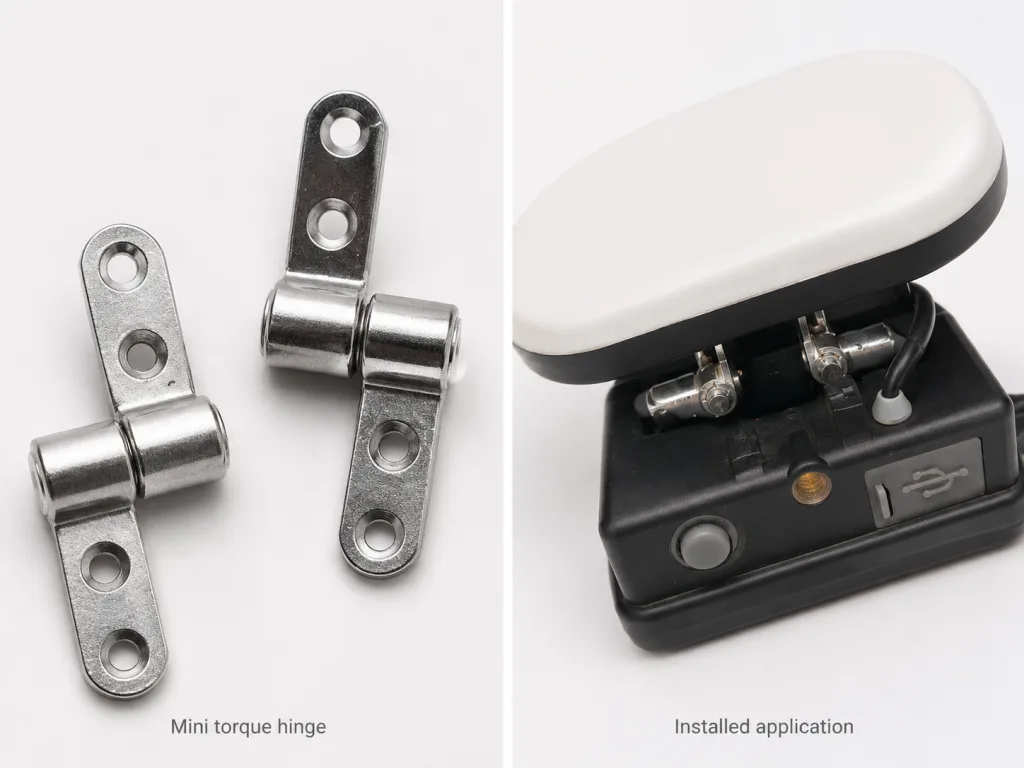
One application where we have validated this directly is a head-mounted outdoor lamp. The mini torque hinge lets the user tilt the light head and have it hold at any angle hands-free, so the beam stays aimed without drifting down while the user works. Because a headlamp is adjusted constantly in the field, holding torque cannot fade early. In our own cycle testing, this hinge retained its hold with roughly 15% torque decay after 5,000 cycles — still well within a usable holding range for a panel of that weight. That is the behavior a mini torque hinge has to deliver: not just fitting the space, but keeping enough holding force after thousands of real adjustments.
When to use one — and when not to
A mini torque hinge fits when the panel is small, the load is modest, and the application needs hands-free access or controlled positioning: the lid must stay open while someone works, must not fall closed during inspection, must fit a small footprint where a gas spring or support arm would be too large, or must feel controlled rather than loose. This is common in compact industrial products where a full-size torque hinge or strut simply will not fit.
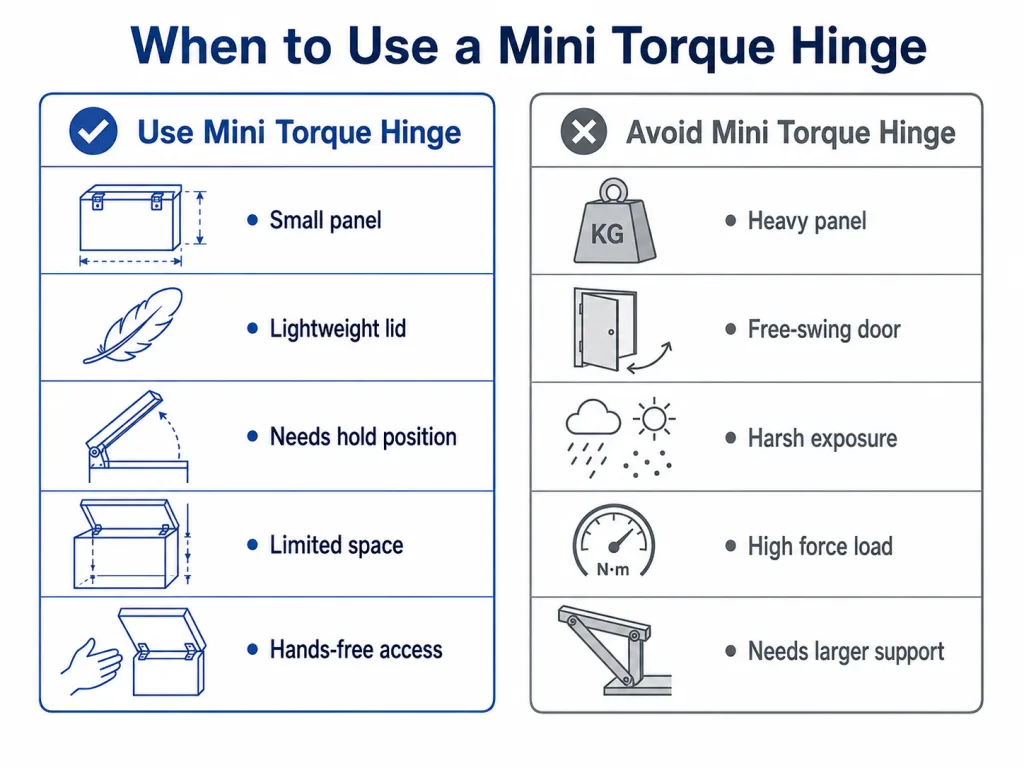
Avoid one when the panel is too heavy for the available torque range, when the center of gravity sits too far from the hinge line, when the door needs to swing freely with very low resistance, or when the environment exposes the hinge to heavy dust, moisture, salt, or chemicals without the right material protection. A common mistake is trying to solve a load problem by picking “the strongest mini hinge” — if the panel is outside the mini hinge’s practical range, a larger torque hinge or a different support method is the better answer. Note too that a small panel can still demand more torque than expected when its center of gravity is far from the hinge line, so geometry matters as much as weight. With mini hinges the torque range is smaller, so a hinge that is only slightly undersized can feel weak from day one.
Cycle life, torque type, and material
Three further checks decide whether a mini torque hinge holds up in service, and each is covered in depth elsewhere — this section only flags what is specific to small panels.
- Cycle life and torque retention: small panels often open frequently, so confirm the hinge still holds with acceptable torque after the expected cycles, not just that it survives them. If this is the main approval risk, see the torque hinge cycle life guide.
- Constant vs adjustable: constant torque suits a frozen design where every unit needs the same feel; adjustable suits evolving products or variants that need tuning — but the setting must be documented and locked. The full trade-off is in the constant vs adjustable torque hinge guide.
- Environment: because the parts are small, even minor contamination or corrosion shows up quickly in motion quality — match material and finish to dust, humidity, salt, or chemical exposure.
Specification checklist
Before sourcing, define the application rather than treating the hinge as a catalog part. Confirm the panel (width, height, thickness, material, weight, center-of-gravity location); the motion requirement (opening angle, hold position, one-way or two-way holding, desired feel, hands-free or not); the space and mounting (available mounting area, screw/hole pattern, clearance, hinge count, visible or concealed); the performance target (torque range, expected cycle life, acceptable torque drift, temperature, indoor/outdoor, contamination exposure); and the production need (constant or adjustable, repeatable factory setting vs field adjustment, inspection and documentation method).
FAQ
What is a mini torque hinge?
A mini torque hinge is a compact friction hinge that helps a small door, lid, or access panel stay in position without a separate gas spring, lid stay, or support arm. It is used when a small panel needs controlled movement instead of free swing.
When should I use a mini torque hinge?
Use one when the panel is small, lightweight, and needs to stay open or hold a working angle in limited space – for compact equipment covers, access panels, instrument lids, and small industrial doors.
What is the difference between a mini and a standard torque hinge?
Mainly size and load range. A mini torque hinge is made for smaller, lighter panels with limited mounting space; a standard torque hinge is better for larger panels, heavier doors, or higher torque requirements.
Can a mini torque hinge replace a gas spring?
Only when the panel is small enough and the required holding torque is within the hinge range. For heavier lids or larger covers, a gas spring, stay arm, or larger torque hinge may be more appropriate.
Final recommendation
Use a mini torque hinge when a small door, lid, or access panel needs controlled positioning in limited space — chosen because the application needs the panel to stay open, hold an angle, move smoothly, or support hands-free access, not because the hinge is compact. Before approval, confirm panel weight, center of gravity, opening angle, torque target, cycle requirement, mounting space, and environment. Share those details and our engineering team can match a compact torque hinge to your panel.