-
+86 13720060320
-
lanna@haitangs.com

Lift-Off Hinge Clearance & Pin Retention for Cabinets
A cabinet door can use the correct lift-off hinge and still be difficult—or unsafe—to remove if the design does not provide enough axial clearance, the hinge pins face the wrong direction, or vibration allows the door to lift unintentionally. These problems usually appear after the cabinet is assembled, when wiring, rain hoods, adjacent equipment, floor clearance, or frame flex restrict the removal path.
This guide focuses on the structural details that must be defined after an engineer has already decided to use a removable hinge: lift-off clearance, pin direction, left- and right-hand orientation, retention method, frame stiffness, mounting tolerance, and repeatable door alignment. For the broader question of whether a removable access panel should use this hinge type at all, see our guide to lift-off hinges for removable access panels.
Design rule: A lift-off hinge should be selected together with the door removal path. Confirm how far the door must move along the hinge axis, where that movement will occur, and what prevents accidental lift-off before the hole pattern is released for production.
Why Clearance Must Be Defined Before Hinge Selection
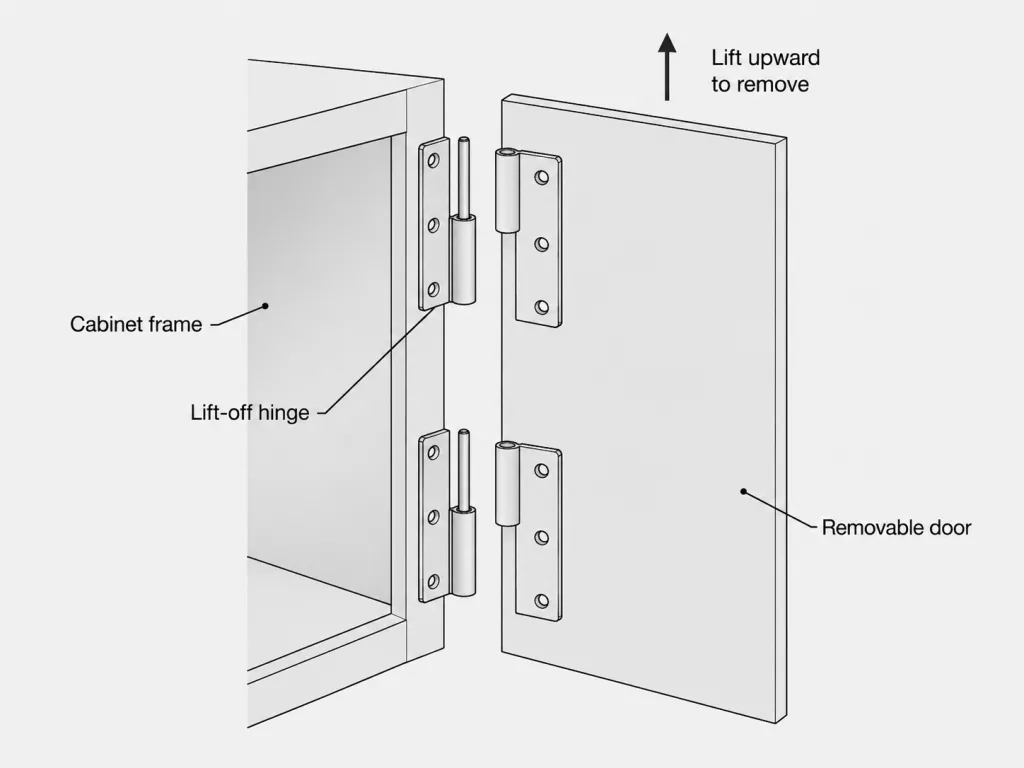
A lift-off hinge separates only after the moving leaf travels far enough along the pin axis to clear the engaged pin or knuckle. That movement is not the same as the door opening angle. A door may swing freely to 120° and still be impossible to remove because a top flange, cable tray, canopy, ceiling, adjacent cabinet, or floor blocks the required lift.
The removal path should be reviewed on the complete cabinet assembly, not on the hinge drawing alone. Include the door edge, handle, lock rods, gasket, wiring harness, bonding strap, door-mounted devices, and any structure above or below the cabinet.
How Much Lift-Off Clearance Is Required?
The minimum axial clearance is based on the distance the hinge leaf must travel before the pin is fully disengaged. The design value should include more than the nominal pin engagement shown on the supplier drawing.
| Clearance Component | What It Represents | Why It Must Be Included |
|---|---|---|
| Pin engagement length | The axial distance between the engaged hinge parts | The door cannot separate until this engagement is cleared |
| Assembly tolerance | Variation in pin length, knuckle position, frame fabrication, and mounting | A nominally sufficient gap may become too small at worst-case tolerance |
| Door sag or frame deflection | Vertical movement caused by door load | A loaded door may need more lift than an unloaded prototype |
| Gasket and latch release | Movement needed to release compression or clear latch hardware | The door may need to move outward or open farther before lifting |
| Handling allowance | Extra space for an operator to control the door | Exact zero-clearance removal is difficult and unsafe in service |
Do not apply one universal lift-off clearance to all hinges. The required value depends on the actual pin engagement, leaf geometry, installation tolerance, and door movement. The supplier drawing should identify the disengagement travel, and the cabinet drawing should provide a larger usable clearance after worst-case tolerances are applied.
Common oversight: Engineers often check the lift distance with the door fully open but forget that the operator may need to tilt or move the door sideways after disengagement. Confirm both the axial lift and the complete extraction path.
Check the Complete Door Removal Path
The door does not disappear after it clears the pins. It still needs a controlled path away from the cabinet. Review the process from the operator’s point of view:
- Release the latch and gasket compression. Confirm that lock rods, compression latches, or overlapping flanges do not prevent initial movement.
- Open to the required removal angle. Some doors can lift only after they clear a return flange, rain channel, or adjacent panel.
- Lift along the hinge axis. Confirm that a canopy, cable tray, wall, ceiling, or enclosure above the door does not block the disengagement travel.
- Move the door away from the cabinet. Check handles, wiring, grounding straps, hoses, and protruding equipment.
- Support and carry the door safely. A removable design is not practical if one person cannot control the loaded door or if there is nowhere to place it during service.
For wide or heavy cabinet doors, the extraction path should be tested with the real center of gravity. A door-mounted display or cooling component can make the panel rotate unexpectedly as soon as the hinges disengage.
Pin Direction, Handing, and Hinge Orientation
Many lift-off hinge designs are directional, and some are handed. The pin orientation determines the removal vector, while mirrored cabinet doors may require different left-hand and right-hand parts. Other models may be reversible, so handing and permissible installation orientation should be confirmed from the supplier drawing rather than assumed.
| Design Question | What to Confirm | Risk if Undefined |
|---|---|---|
| Which direction does the door lift? | Upward, downward, or another defined vector along the pin axis | The cabinet may be installed where removal is physically blocked |
| Are all hinge pins oriented the same way? | Both or all hinge sets must release through one coordinated movement | Opposing pin directions can make the door non-removable |
| Is the door left-hand or right-hand? | Define from a consistent viewing side on the drawing | Mirrored parts may be ordered or installed incorrectly |
| Which leaf mounts to the door? | Door leaf and frame leaf must be identified | The pin may face the wrong direction after assembly |
| Can the hinge be inverted? | Confirm whether inversion changes retention or drainage behavior | An apparently symmetrical hinge may not function the same way upside down |
On double-door cabinets, treat each door as a separate handed assembly. The left door and right door may use mirrored hinges even when their dimensions are identical. The production drawing should show the pin direction, door opening direction, and removal direction with arrows rather than relying only on part names.
Pin Retention and Anti-Lift Are Different Requirements
“Retained pin” can describe several different design features. It is important to separate the way the pin is fixed to the hinge from the way the complete door is prevented from lifting off accidentally.
| Retention Function | Typical Methods | Purpose |
|---|---|---|
| Pin-to-leaf retention | Press-fit, staked, swaged, welded, or formed pin | Prevents the pin itself from walking out of the fixed leaf |
| Door anti-lift retention | Stop screw, retaining clip, keeper plate, latch-controlled lift, or removable blocker | Prevents the door from disengaging during vibration, handling, or unauthorized access |
| Service release control | Tool-free release, tool-released screw, captive fastener, or internal release | Defines who can remove the door and how quickly |
| Security retention | Internal access, tamper-resistant hardware, concealed blocker, or locked-door interlock | Prevents removal while the cabinet is closed or locked |
A retained pin does not automatically mean the door is retained. The pin may remain permanently attached to one leaf while the mating leaf can still lift away without restriction. Conversely, a tool-released anti-lift screw may keep the door secure even though the hinge remains fully removable during authorized service.
Tool-Free Removal vs. Controlled Release
The release method should follow the service and risk requirements of the cabinet. Tool-free removal is useful when doors are removed frequently in a controlled maintenance area. It may be inappropriate for public-facing equipment, roadside cabinets, moving machinery, or heavy doors.
| Cabinet Condition | Preferred Retention Approach |
|---|---|
| Frequent indoor maintenance with trained technicians | Tool-free lift-off may be appropriate |
| Occasional service with unauthorized access risk | Tool-released anti-lift device |
| Roadside, vehicle-mounted, or vibrating equipment | Consider positive secondary retention based on the shock and vibration risk |
| Public-facing or security-sensitive cabinet | Retention accessible only after unlocking or opening the door |
| Heavy removable door | Controlled release plus defined lifting procedure or assistance |
Security should be reviewed at the complete cabinet level. A locked door may already prevent the vertical movement needed for lift-off, but that must be demonstrated in the production assembly. Do not assume the latch automatically provides anti-lift protection unless the geometry has been checked at worst-case tolerance.
Anti-Lift Protection for Vibration and Transport
Vertical shock can move a removable door in the same direction required for hinge disengagement. This is particularly relevant for mobile equipment, generator enclosures, trailers, rail equipment, machinery cabinets, and cabinets shipped with the door already installed.
The design review should confirm:
- Whether transport or operating vibration acts along the hinge axis
- Whether the latch limits vertical door movement when closed
- Whether the door can lift while partially open
- Whether a secondary stop is required during transport
- Whether the retention device remains captive after release
- Whether the operator can visually confirm that retention has been re-engaged
A simple anti-lift screw can be effective, but its location matters. It should not be hidden behind equipment that makes service difficult, and repeated removal should not damage threads in thin sheet metal. Where frequent access is expected, a captive or replaceable threaded feature may be more durable.
For generator enclosures that combine retained access doors, removable service panels and transport-related constraints, compare the application routes on our Generator Enclosure & Access Door Hinge Solutions page.
Frame Stiffness and Fastener Requirements
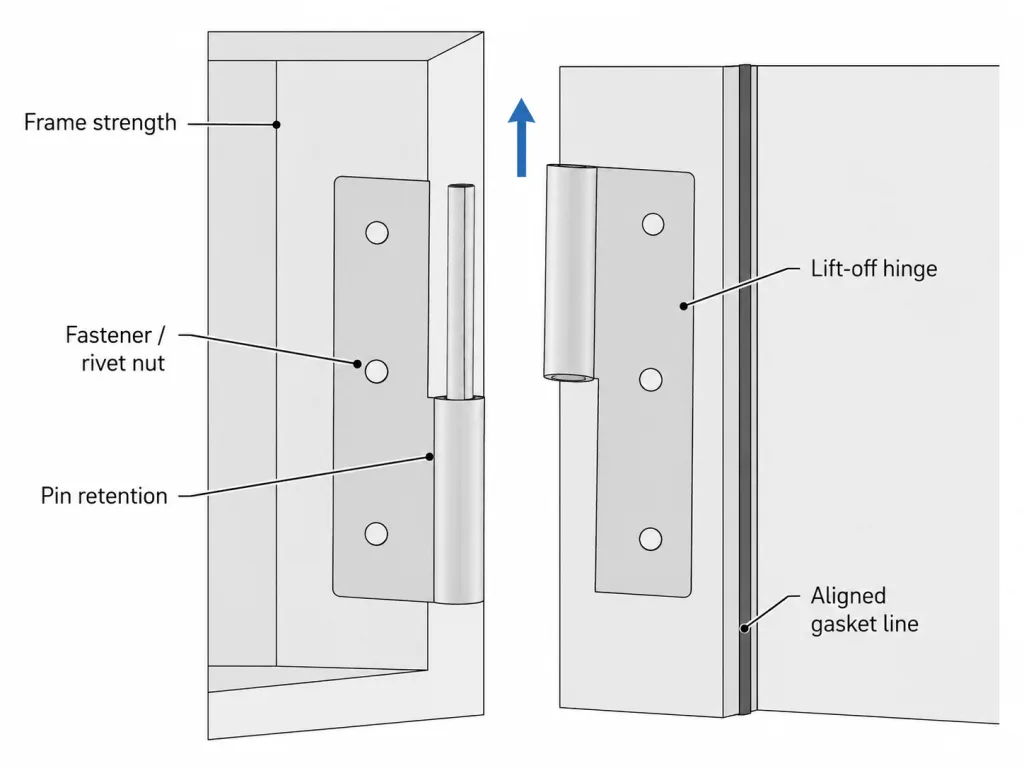
A lift-off hinge transfers door load through the hinge leaves, fasteners, and cabinet structure. Even when the hinge is correctly sized, a flexible frame can allow the door to sag or return to a different position after every removal.
Review the complete load path:
- Sheet thickness: Thin material may deform around screws or rivet nuts.
- Reinforcement: A backing plate, formed return, weld nut, or local stiffener may be needed.
- Fastener engagement: Confirm thread depth, screw length, washer use, and installation torque.
- Mounting flatness: Distorted or coated surfaces can twist the hinge leaves out of alignment.
- Existing holes: Enlarged, stripped, or corroded holes should be repaired before retrofit.
- Edge distance: Fasteners installed too close to a sheet edge can tear or deform the frame.
Do not solve frame flex by selecting a higher-capacity hinge alone. The hinge may survive while the cabinet structure continues to move, causing latch misalignment, gasket leakage, or uneven load sharing.
Coaxial Alignment and Installation Tolerance
Multiple lift-off hinges must share one practical rotation and removal axis. If the hinge centers are not aligned, the door may bind while opening and resist lifting even when enough nominal clearance exists.
The drawing and inspection plan should control:
- Vertical or axial spacing between hinges
- Offset from the cabinet datum edge
- Leaf parallelism
- Pin-axis straightness across all hinge locations
- Hole-position tolerance
- Door and frame flatness
- Coating buildup on mounting surfaces
During prototype assembly, the door should open and lift without using the fasteners to force misaligned leaves into position. If tightening the screws is required to pull the hinge into alignment, the structure is storing stress that can increase wear and make future removal difficult.
Maintaining Gasket and Latch Alignment After Reinstallation
For sealed cabinets, the hinge must return the door to a repeatable position so that the latch compresses the gasket as intended. The hinge itself does not create an IP or NEMA rating; sealing performance belongs to the complete validated enclosure assembly.
After repeated removal and reinstallation, confirm:
- The door gap remains consistent around the perimeter
- The latch engages without forcing the door sideways
- The gasket shows even compression rather than local crushing or release
- The door does not drop before the latch is closed
- The hinge leaves seat fully after the door is lowered into place
- No cable, bonding strap, or accessory prevents the door from returning to its datum position
Where outdoor exposure, washdown, or corrosion is a major design constraint, review the complete material and coating system in our outdoor enclosure hinge guide. Stainless steel is often preferred for sustained wet or chloride exposure, but the final choice should consider the hinge body, pin, fasteners, adjacent metals, coating system, test duration, acceptance criteria, and maintenance interval.
Drawing Notes for Lift-Off Cabinet Hinges
A production drawing should communicate more than the mounting-hole pattern. Include the information needed to preserve removability and retention after the cabinet moves from prototype to production.
| Drawing Requirement | Recommended Note or Control |
|---|---|
| Removal direction | Show an arrow along the required lift vector |
| Minimum usable clearance | Dimension the available space after worst-case tolerances |
| Door opening position for removal | State the minimum angle or required sequence |
| Handing | Identify left-hand and right-hand assemblies from a defined viewing side |
| Leaf assignment | Mark which leaf mounts to the door and which mounts to the frame |
| Retention method | Specify anti-lift hardware and whether a tool is required |
| Fasteners | Define size, length, material, engagement, and installation torque where needed |
| Alignment datum | Control hinge locations from common cabinet datums |
| Functional inspection | Require opening, lift-off, reinstallation, and latch-alignment checks |
Prototype Validation Checklist
- The door can reach the required removal angle without interference.
- The available axial clearance exceeds the actual disengagement travel at worst-case tolerance.
- All hinge pins release in the same coordinated direction.
- Left-hand and right-hand parts are correctly identified.
- The door remains retained during transport, vibration, and normal operation.
- The anti-lift feature can be released and re-engaged without damaging the cabinet.
- The loaded door can be handled safely by the intended number of technicians.
- All hinge axes remain aligned after fasteners are tightened.
- The door returns to the same gap and latch position after repeated removal.
- Gasket compression and validated enclosure sealing performance are not compromised.
- Fasteners and frame reinforcement remain secure after repeated service cycles.
- The approved hinge orientation is clearly controlled on the production drawing.
Record the Prototype Test Conditions
A statement that the door “worked” is not reusable engineering evidence unless the test conditions are recorded. Keep the hinge part number and drawing revision, fully loaded door mass, center-of-gravity condition, measured disengagement travel, available cabinet clearance, retention configuration, fastener specification, number of removal and reinstallation cycles, and the door-gap and latch-alignment results before and after testing.
If the test uses a temporary fixture instead of the production cabinet, document the fixture stiffness and the differences from the final frame. This allows later design changes, supplier reviews, and production inspections to be compared against the same approved baseline.
Frequently Asked Questions
How much clearance does a lift-off cabinet hinge need?
The required clearance must exceed the hinge’s actual axial disengagement travel and also allow for fabrication tolerance, door sag, gasket or latch release, and safe handling. Use the supplier’s pin-engagement drawing and confirm the available space on the complete cabinet assembly rather than applying one universal value.
Should all lift-off hinge pins face the same direction?
For a conventional multi-hinge removable door, the pins normally need a coordinated release direction. Specialized designs may differ, so confirm the supplier drawing. Opposing pin directions can prevent removal or force the door to twist.
Can a lift-off cabinet door be protected against accidental removal?
Yes. Anti-lift retention can use a stop screw, retaining clip, keeper plate, latch-controlled movement, or another tool-released feature. The correct method depends on vibration, transport, service frequency, door weight, and security requirements.
Does a retained pin prevent the complete door from lifting off?
Not necessarily. Pin retention only means the pin remains fixed to one hinge leaf. The mating leaf may still lift away. Door retention requires a separate anti-lift feature or cabinet geometry that blocks disengagement until an authorized release step is completed.
How should left-hand and right-hand lift-off hinges be specified?
Define handing from a consistent viewing side, identify the door and frame leaves, and show the pin and removal direction with arrows. Double-door cabinets may require mirrored hinge assemblies even when both doors use the same nominal dimensions.
Summary: Design the Removal Path Before Releasing the Drawing
Reliable lift-off cabinet doors depend on more than hinge size and door weight. The design must provide enough axial clearance, one coordinated pin direction, a safe extraction path, appropriate anti-lift retention, a stiff mounting structure, and repeatable alignment after the door is reinstalled.
Define those requirements on the cabinet drawing and validate them with the fully loaded door. This prevents late-stage interference, accidental disengagement, difficult service, latch misalignment, and loss of gasket compression.
| Need a Lift-Off Hinge Review for an Industrial Cabinet? Send the door weight, dimensions, opening direction, available lift clearance, frame material, operating environment, and required retention method. Our engineering team can review the mounting orientation and recommend a suitable model from the lift-off hinge range. Contact our engineers → |