-
+86 13720060320
-
lanna@haitangs.com

Constant vs Adjustable Torque Hinge: How to Choose
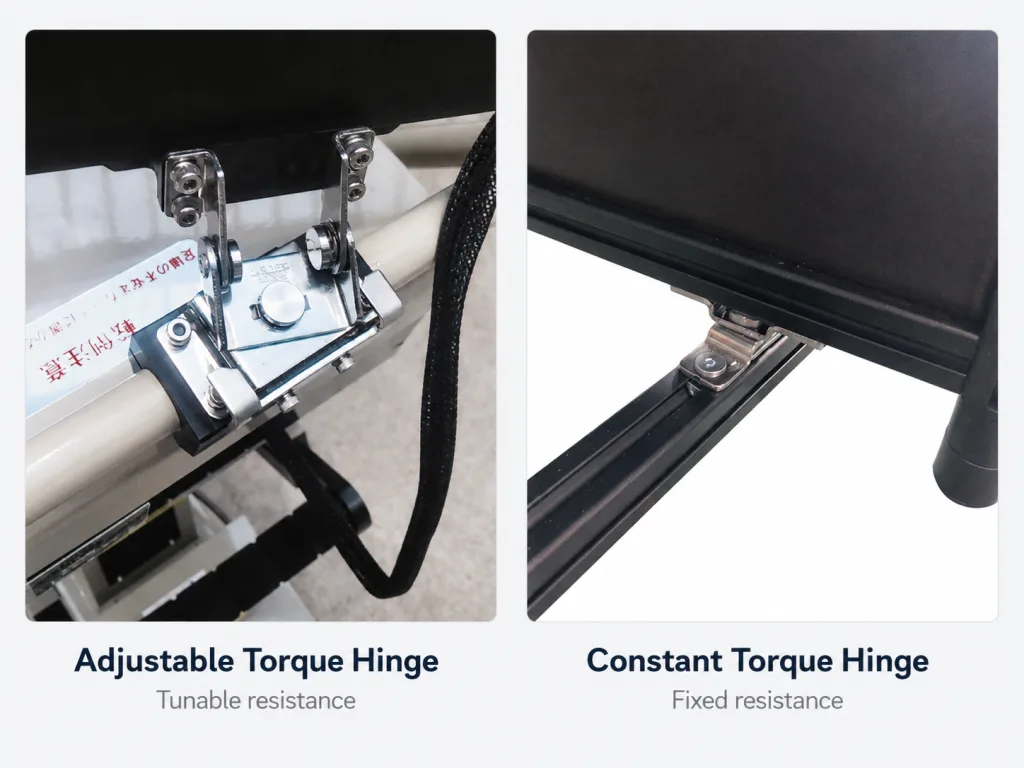
Choose a constant torque hinge when the load is known, the design is frozen, and every unit needs the same repeatable feel. Choose an adjustable torque hinge when the load may change, the design is still evolving, or the final torque must be tuned after assembly. That one trade-off — process stability vs field flexibility — drives the whole decision. This page is about choosing the torque-control method for industrial equipment; for sizing, door weight, and holding moment, use the torque hinge calculator first. If you are still deciding which hinge type you need at all, start with how to choose an industrial hinge.
Quick answer: constant vs adjustable
| Choose constant torque when… | Choose adjustable torque when… |
|---|---|
| The panel weight is stable | The final panel weight may change |
| The product design is already frozen | The product is still in prototype or pilot build |
| Every unit needs the same feel | The torque must be tuned after assembly |
| High-volume repeatability matters | Different variants need different resistance |
| You want fewer adjustment steps in assembly | Field technicians may need adjustment flexibility |
| Production consistency matters most | Flexibility matters more than fixed repeatability |
In short: a constant torque hinge supports process stability, and an adjustable torque hinge supports field flexibility. Everything below is how to decide which one your program actually needs.
Why torque requirements don’t always stay fixed
Torque hinges hold a door, lid, display, or cover at position without a gas spring or stay arm. The catch is that the required torque is often not clear at the start of a project — a panel gains weight after a display is added, a cable bundle changes, a gasket is revised, a handle is upgraded, or a variant uses a larger panel. If the load is stable and predictable, constant torque is easier to control. If the load may shift, adjustable torque gives engineering or service room to tune the final feel. The wrong call usually shows up later in the field: the panel drifts, feels too stiff, won’t stay open, or feels different from one unit to the next.
What each one is best for
Constant torque locks in one validated resistance value and is not normally changed in the field. Its biggest advantage for OEMs is repeatability: once selected, the same part installs the same way across thousands of units. It suits medical devices, test equipment, operator panels, diagnostic instruments, display screens, and equipment covers where every unit should behave identically. The one risk: the specification must be right up front — if the panel gets heavier after selection, the hinge may no longer hold.
Adjustable torque lets resistance be tuned with a screw, nut, or adjustment mechanism instead of being fixed at the factory. It suits products still in development, uncertain final loads, variant families sharing one hinge location, panels that gain accessories later, and field-serviceable covers. It reduces redesign during prototyping — but the trade-off is process control. If the setting is not documented, locked, or checked during assembly, one unit can feel different from another.
| Decision factor | Constant torque | Adjustable torque |
|---|---|---|
| Best for | Stable, repeatable designs | Variable or evolving designs |
| Torque setting | Predefined | Tunable |
| Production consistency | Strong | Depends on adjustment control |
| If panel weight changes | May need a new hinge selection | Can often be adjusted |
| Best project stage | Mature production | Prototype, pilot, or variant family |
| Main risk | Wrong torque selected up front | Inconsistent setting between units |
Selection logic and common failures
Before choosing, answer: Is the panel weight final? Is the center of gravity known? Will there be multiple variants? Does every unit need a consistent feel? Will technicians tune the hinge in the field? Is the product in prototype, pilot, or full production? Is torque drift over time a critical risk? If the answers point to stable weight, stable geometry, and repeatable production, choose constant. If they point to changing load, field tuning, or variant flexibility, choose adjustable.
The failures are functional, not dramatic — the hinge still moves, but the panel misbehaves: panel drift (torque too low for the load), uneven feel between units (adjustable hinges set without a controlled process), over-adjustment (too stiff, extra stress), under-adjustment (drifts or falls closed), and torque loss over time. That last one is its own topic — if cycle life and torque retention are the main concern, review the torque hinge cycle life guide before approving the hinge. Dust, humidity, salt, heat, or chemical exposure can also degrade feel and motion, so material and finish must match the environment.
If you use adjustable torque, control the adjustment: define the range, the initial factory setting, the adjustment method and tool, a locking method if needed, and an inspection or recheck step. Without that, adjustability quietly becomes inconsistency. When the choice is made and the spec is set, share the panel weight, center of gravity, cycle requirement, environment, and whether the design is fixed or still changing, and our engineering team can match the hinge to the program rather than the category.
FAQ
What is the main difference between constant and adjustable torque hinges?
A constant torque hinge provides a fixed, factory-set resistance for repeatable positioning. An adjustable torque hinge lets the resistance be tuned with a screw, nut, or adjustment mechanism after assembly.
Which torque hinge is better for OEM production?
For stable, high-volume production, constant torque is usually better because it removes an adjustment step and reduces unit-to-unit variation. For prototypes, pilot builds, or variant families, adjustable torque is often better because it allows tuning after assembly.
When should I choose an adjustable torque hinge?
When the panel load may change, when different product variants need different resistance, or when technicians need to tune the hinge after installation. Document and lock the setting so consistency is maintained.
How do I size a torque hinge before choosing constant or adjustable?
Start with panel weight, center of gravity, opening angle, and required hold position. Use the torque hinge calculator first, then choose constant or adjustable based on production needs and how much the load may vary.