-
+86 13720060320
-
lanna@haitangs.com

Quality Checklist for Importing Industrial Hinges
Quick answer: Before accepting an imported hinge shipment, check five things — dimensions against the drawing, material and finish against the certificate, function (movement, torque, or closing), surface and cosmetic quality, and the documentation. Agree the inspection standard and sampling plan before production, so acceptance is judged against a fixed reference rather than opinion after the goods arrive.
Importing hinges adds distance between you and the production line, so quality control is your protection against a shipment that does not match what was agreed. The goal is not to inspect every piece by hand, but to verify — on a sample, against a fixed standard — that the order matches the approved sample, the drawing, and the material certificate. This checklist covers what to inspect and when. It is the receiving-and-inspection side of buying; for the full path from requirement to order, see how to source industrial hinges.
Agree the standard before production
The most important quality step happens before anything is made: agreeing what “acceptable” means. An approved sample, a confirmed drawing with tolerances, a defined finish standard, and a sampling and acceptance plan (how many pieces are inspected and how many defects are allowed) give both sides a fixed reference. Without that, inspection becomes a matter of opinion after the goods have shipped, which is the worst time to discover a disagreement. The sampling plan is usually written as an AQL (Acceptance Quality Limit) — the standard industrial method that sets how many pieces to inspect and how many defects are acceptable at each severity level, so acceptance stays objective. Set the standard up front, and inspection later is simply a comparison against it rather than a negotiation.
An AQL plan sorts defects by severity, so a cosmetic mark and a functional failure are not treated the same:
| Defect level | Example on a hinge | Typical acceptance |
|---|---|---|
| Critical | Wrong material grade, hinge fails to function, unsafe edge | None accepted |
| Major | Out-of-tolerance dimension, wrong finish, torque out of range | Very few accepted |
| Minor | Light cosmetic mark within the agreed standard | Limited number accepted |
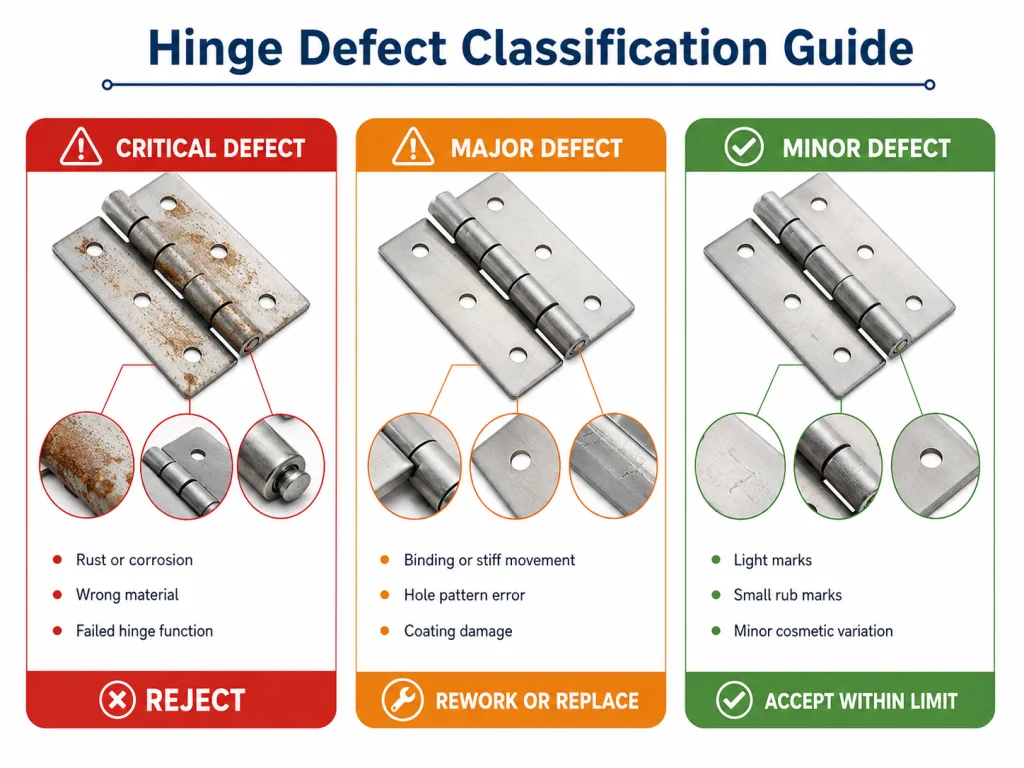
The exact numbers come from the AQL level you agree with the supplier; the point is that severity is defined in advance, so a small cosmetic mark does not sink a shipment and a functional failure is never waved through.
The five checks at a glance
Dimensions
Measure key sizes, hole pattern, and thickness against the drawing tolerances.
Material & finish
Confirm the grade against the material certificate and the finish against the agreed standard.
Function
Check the movement — smooth swing, torque hold, or self-close — against the sample.
The import inspection checklist
On a sampled quantity from the shipment — not the whole order — work through the following. Anything that fails against the agreed standard is a basis to act before acceptance — the usual options are to reject the shipment, have it reworked or sorted, negotiate a discount for a minor deviation, or request replacement, depending on the defect and what the contract allows.
IMPORT HINGE INSPECTION CHECKLIST
---------------------------------
DIMENSIONAL
[ ] Overall dimensions within drawing tolerance
[ ] Hole pattern and hole size correct
[ ] Leaf thickness / pin diameter correct
[ ] Matches the approved sample

MATERIAL & FINISH
[ ] Material grade matches the certificate
[ ] Finish type and coverage as agreed
[ ] No rust, discoloration, or contamination
[ ] Salt-spray / corrosion result on file (if specified)

FUNCTION
[ ] Smooth movement, no binding
[ ] Torque or holding value correct (torque hinges)
[ ] Self-closing action correct (spring hinges)
[ ] Removable/lift-off action correct (if applicable)

COSMETIC / SURFACE
[ ] No dents, burrs, or scratches beyond standard
[ ] Consistent appearance across the sample
[ ] Edges deburred, safe to handle

DOCUMENTATION & PACKING
[ ] Material certificate included
[ ] Test reports included (if specified)
[ ] Correct quantity and part numbers
[ ] Packaging protects against transit damage and corrosion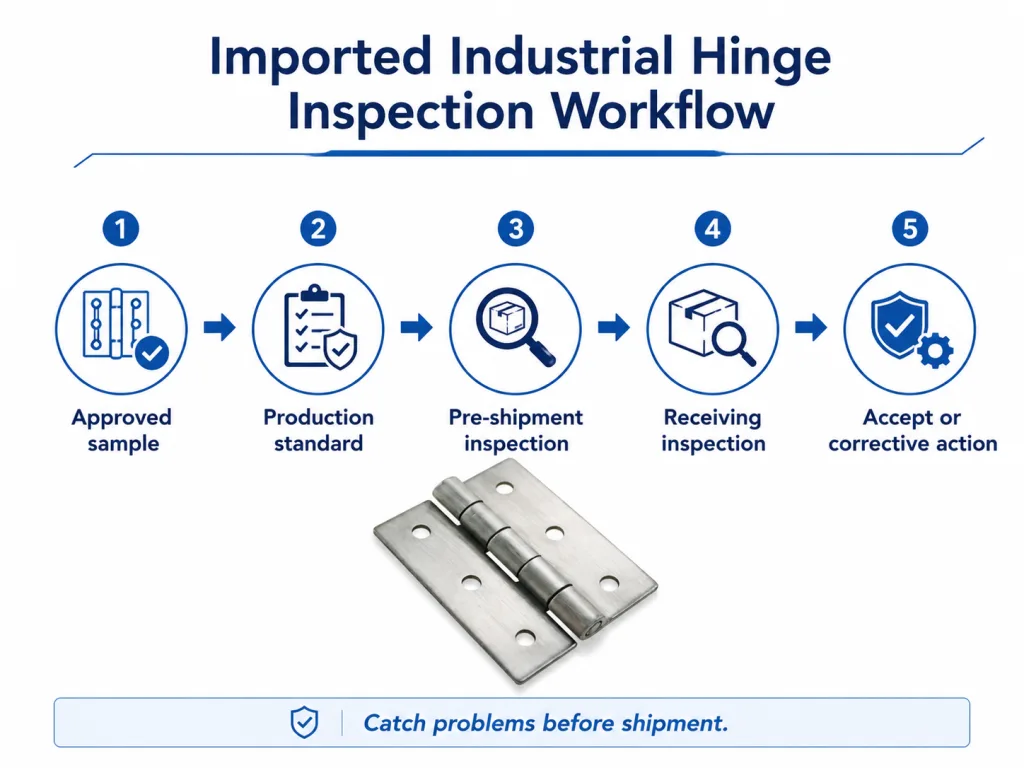
Where to inspect — and by whom
Inspection can happen at two points, and each has a role. Pre-shipment inspection, done at the factory before the goods leave, catches problems while they are still cheap to fix and before you pay for freight on a bad shipment — this is the stronger option for a first order or a critical part. Receiving inspection, done when the goods arrive, is your final check against damage in transit and against the agreed standard. For a capable manufacturer, much of this is already covered in production: dimensional checks, load and fatigue testing, and salt-spray corrosion testing are the kind of in-house controls that reduce what slips through, and the resulting reports are what you verify against. Whether you inspect yourself, use a third-party agency, or rely on the supplier’s documented QC depends on the order’s value and risk.
Key point: The cheapest defect to deal with is the one caught before the goods ship. A pre-shipment check against an agreed standard is far less costly than discovering a problem after paying freight, clearing customs, and unpacking at your site.
If a shipment fails inspection
A failed check is not a dispute when the standard was agreed up front — it is a decision against that standard. The usual routes, chosen by defect severity and what the contract allows, are: reject the shipment when critical defects are present; rework or sort when the issue is fixable and the timeline permits; negotiate a concession (a discount) for a minor, non-functional deviation you can accept; or request replacement for the affected quantity. Record what failed and against which criterion, so the supplier can correct the root cause on the next run rather than repeat it.
Match the material and grade decision to the environment before you even inspect — the grade selection itself is covered in the 304 vs 316 stainless guide.
When your inspection standard, sample, and documentation requirements are defined, share them and our engineering team can align production and reporting to them.
FAQ
What should I check when importing industrial hinges?
Check five areas against an agreed standard: dimensions and hole pattern versus the drawing, material grade and finish versus the certificate, function (smooth movement, torque hold, or self-close), cosmetic and surface quality, and documentation (material certificate, test reports, correct quantity, protective packaging). Inspect a sample from the shipment rather than every piece.
When should hinge quality be inspected?
Ideally at two points: a pre-shipment inspection at the factory before the goods leave, which catches problems while they are cheap to fix and before you pay freight, and a receiving inspection on arrival to check for transit damage. Agree the inspection standard and sampling plan before production so acceptance is judged against a fixed reference.
How do I verify hinge material grade on import?
Verify the grade against the material certificate supplied with the shipment, and confirm it matches what was specified – for example SUS 304 versus SUS 316. For corrosion-critical parts, confirm the salt-spray or corrosion test result is on file. If the grade matters, request the certificate as a condition of the order.
Do I need to inspect every hinge in a shipment?
No. Inspection is normally done on a sample from the shipment using an agreed sampling and acceptance plan – how many pieces are checked and how many defects are allowed. Agreeing that plan before production keeps acceptance objective and avoids inspecting the entire order by hand.
What is AQL in hinge inspection?
AQL (Acceptance Quality Limit) is the standard sampling method for import inspection. It defines how many pieces to inspect from a shipment and how many defects are acceptable at each severity level, so acceptance is objective rather than a matter of opinion. Agree the AQL level before production.
What do I do if a hinge shipment fails inspection?
Depending on the defect and the contract, the options are to reject the shipment, have it reworked or sorted, negotiate a discount for a minor deviation, or request replacement. Because acceptance is judged against a standard agreed before production, a failed check gives you a clear basis to act rather than a dispute.