-
+86 13720060320
-
lanna@haitangs.com

Hinge MOQ, Lead Time & Tooling: What to Expect
Quick answer: MOQ is the smallest quantity a manufacturer will produce in one order — often around 1,000 units for industrial hinges, with lower unit prices at higher volumes. Sample lead time is often around 10 days; tooling for custom parts adds roughly 20 days. Production lead time, trade terms (Incoterms), and payment terms are then agreed per order.
The commercial side of a hinge order comes down to a handful of terms: the MOQ, how price moves with quantity, the lead time for samples and production, the trade and payment terms, and — for custom parts only — the tooling. Knowing typical figures for each lets a buyer plan a realistic schedule and budget instead of being surprised late. This guide covers those commercial terms; the technical selection and the custom development steps are separate — for the whole buying path, see how to source industrial hinges.
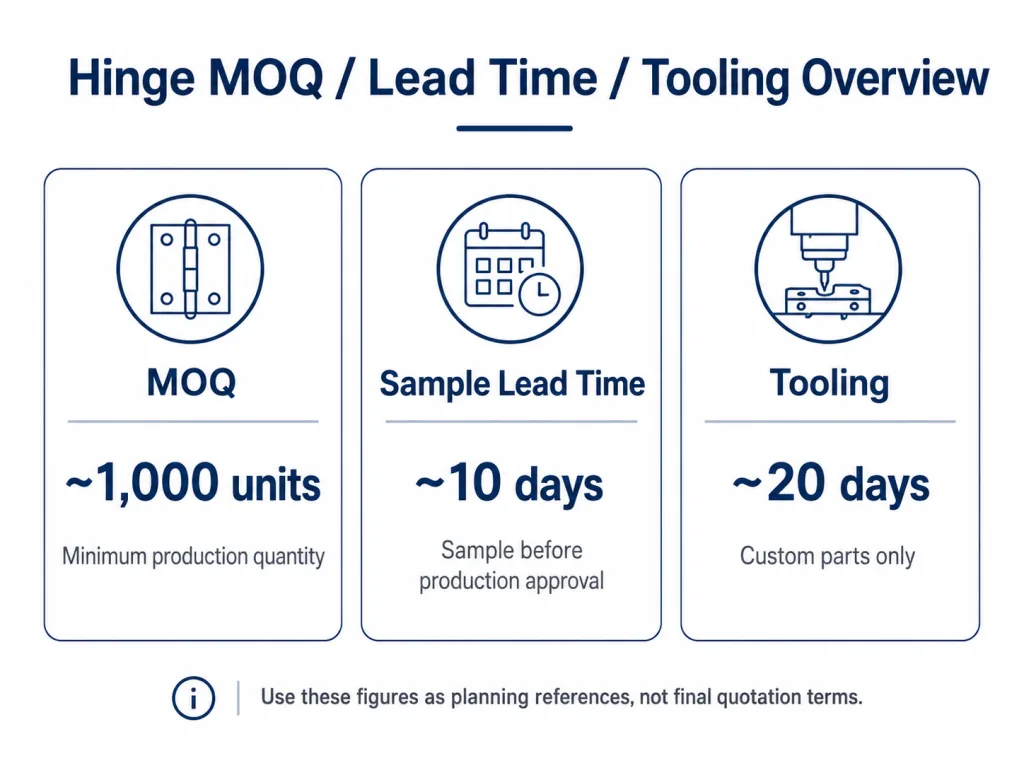
The core terms at a glance
MOQ & price
~1,000 units minimum, with unit price falling at higher quantities. Standard parts may allow less; custom parts hold a firmer minimum.
Lead time
Sample ~10 days, then production by order. Keep the two separate — the sample and sign-off are real time in the plan.
Tooling cost
~20 days, custom only. A one-time cost, sometimes amortized over volume. Skip it when a standard hinge fits.
MOQ and how price moves with quantity
MOQ is the smallest quantity a manufacturer will make in a single production order. It exists because setting up a run — machine setup, material, handling, and quality checks — has a fixed cost that only makes sense above a certain volume. For industrial hinges, a typical MOQ is around 1,000 units, though it varies with the part, the material, and whether the hinge is standard or custom. A standard catalog product may allow a lower quantity because it is already in production; a custom part usually carries a firmer MOQ because the setup is dedicated to your order.
Price and quantity move together. Because the setup cost is spread across the run, the per-unit price generally falls as the order quantity rises — the same reason the MOQ exists. When you request a quote, it is worth asking for pricing at a few quantity levels (quantity breaks), so you can see where the cost curve flattens and choose an order size that balances unit price against how much stock you want to hold. Confirm the MOQ early, before the design conversation gets detailed; if your annual need is well below it, you may order a full MOQ and hold stock, consolidate requirements, or discuss options with the manufacturer, rather than designing a program around a quantity the supplier cannot economically produce.
Lead time — samples and production
Lead time comes in two parts, and it helps to keep them separate. Sample lead time is how long it takes to produce a sample for you to validate before committing to a production run — often around 10 days. A sample validated on the real assembly is the cheapest insurance against a wrong production order. Production lead time is how long the full order takes once approved, and it depends on the quantity, the material, the finish, and the manufacturer’s manufacturing capabilities and current capacity, so it is quoted per order rather than as a fixed number.
Planning point: Add the two lead times together with the approval time between them — sample production, your validation and sign-off, then production. Treating “lead time” as a single number is where timelines slip; the sample and approval stages are real time that belongs in the plan. Also factor in shipping time after production, which depends on the trade terms below.
Trade terms and payment
Two commercial terms decide the landed cost and the cash flow of an order, and both belong in the RFQ. Trade terms (Incoterms) define who handles and pays for shipping, insurance, and customs at each stage — common options range from EXW (you arrange everything from the factory door) through FOB (the supplier delivers to the port) to CIF (the supplier covers freight and insurance to your destination port). The right choice depends on how much of the logistics you want to manage versus hand to the supplier, and it changes the quoted price, so compare quotes on the same Incoterm. Payment terms for a production order are typically split — a deposit to start production and the balance before or on shipment — with the exact split agreed per order and per relationship. Settle both in writing before production, since they affect budget and timing as much as the unit price does.
Tooling cost — for custom parts only
Tooling is the mold or die needed to produce a custom hinge, and it applies only when an existing product cannot meet the requirement. Commercially, it is a one-time cost plus roughly 20 days of lead time, and it is worth clarifying two things up front: who owns the tooling once paid for, and whether the tooling cost can be amortized into the unit price over an agreed volume rather than paid as a single upfront charge. The step-by-step development sequence behind tooling — drawing, confirmation, sample, and production — is covered separately in the custom hinge development process, so this page stays on the cost side. The key commercial point is simple: if a standard hinge fits, you avoid the tooling cost and its lead time entirely, which is why checking standard options first almost always saves both money and weeks.
How the terms fit together
| Term | What it is | Typical reference | Applies to |
|---|---|---|---|
| MOQ | Minimum order quantity | Around 1,000 units | Every order |
| Unit price | Falls as quantity rises | Ask for quantity breaks | Every order |
| Sample lead time | Time to make a sample to validate | Around 10 days | Every order |
| Tooling cost | One-time mold/die charge | ~20 days; ownership + amortization to confirm | Custom parts only |
| Production lead time | Time to make the full order | Quoted per order | Every order |
| Trade terms | Incoterms (EXW / FOB / CIF) | Compare quotes on the same term | Every order |
| Payment terms | Deposit + balance split | Agreed per order | Every order |
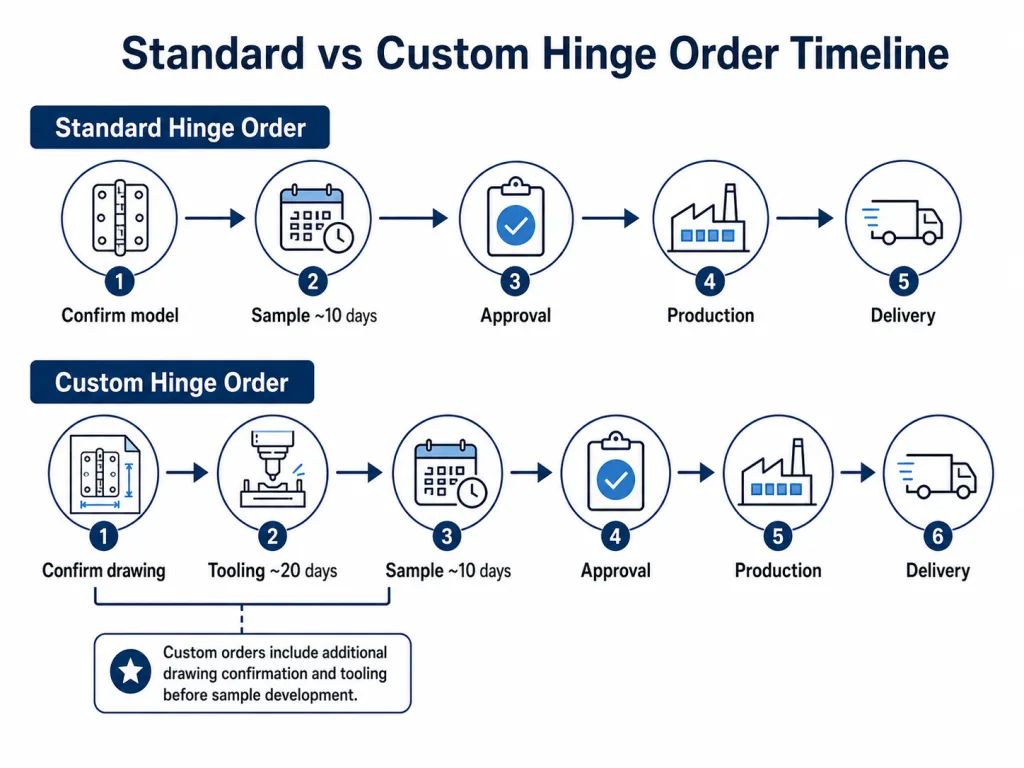
Reference figures like these are a planning starting point, not a quote — the real numbers depend on your part, quantity, material, trade terms, and the manufacturer’s capacity at the time. Share your quantity, part, target Incoterm, and timeline and our engineering team can confirm the MOQ, pricing, lead time, and any tooling for your specific order.
FAQ
What is the MOQ for industrial hinges?
A typical minimum order quantity for industrial hinges is around 1,000 units, though it varies with the part, material, and whether the hinge is standard or custom. Standard catalog products may allow lower quantities because they are already in production; custom parts usually carry a firmer MOQ because the setup is dedicated to your order.
Does the hinge unit price drop at higher quantities?
Usually yes. Because the fixed setup cost is spread across the run, the per-unit price generally falls as quantity rises. Ask for pricing at several quantity levels – quantity breaks – so you can see where the cost curve flattens and choose an order size that balances unit price against the stock you hold.
How long is the lead time for hinge samples and tooling?
Sample lead time is often around 10 days. Tooling for a custom part adds roughly 20 days and applies only when no existing product meets the requirement. Production lead time is separate and quoted per order based on quantity, material, finish, and current capacity.
What Incoterms and payment terms apply to a hinge order?
Trade terms (Incoterms) such as EXW, FOB, or CIF define who handles and pays for shipping, insurance, and customs, and they change the quoted price – so compare quotes on the same term. Payment for a production order is typically split into a deposit to start and a balance before or on shipment, agreed per order.
Who owns the tooling for a custom hinge?
Tooling ownership should be agreed in writing before production. Clarify who owns the mold once the tooling cost is paid, and whether that cost is charged upfront or amortized into the unit price over an agreed volume. If a standard hinge fits, there is no tooling cost at all.