-
+86 13720060320
-
lanna@haitangs.com

OEM vs ODM Hinges: What’s the Difference?
Quick answer: OEM hinges are built to the buyer’s own drawing and specification, while ODM hinges start from the manufacturer’s existing design. Choose OEM when you need a unique, owned design or a build-to-print hinge. Choose ODM when speed, lower development cost, and a proven existing hinge matter more than exclusivity.
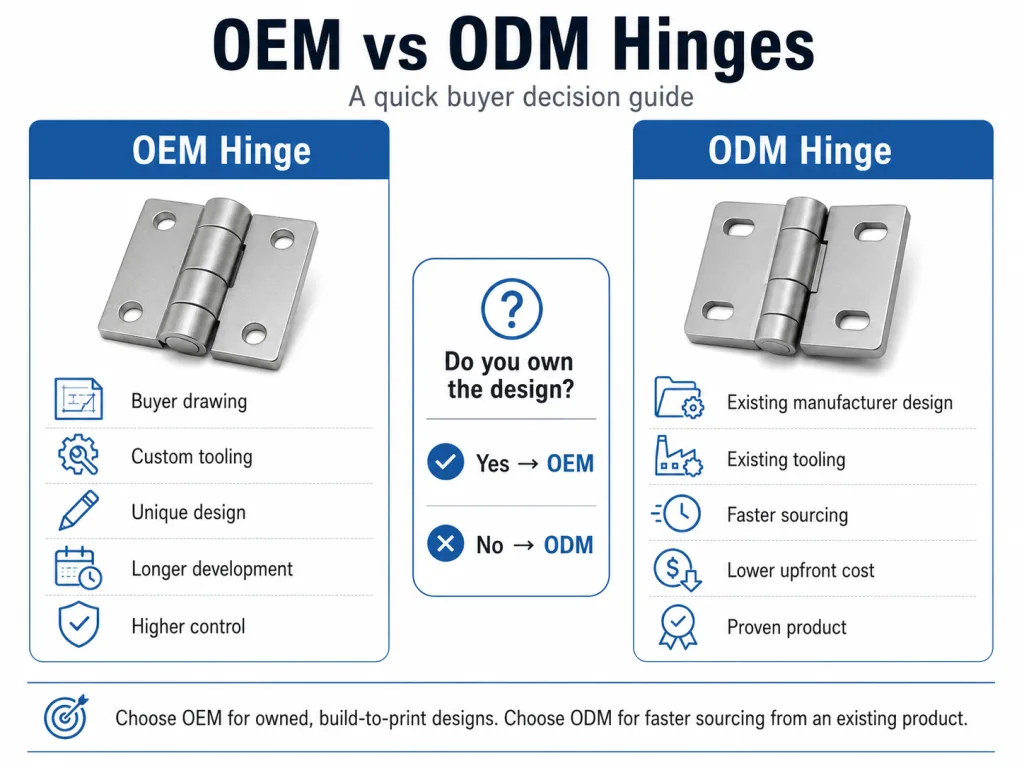
With an OEM hinge, you bring the design and the manufacturer builds it to your drawing. With an ODM hinge, the manufacturer already has the hinge design, and you adapt, brand, or use that existing product. The choice comes down to one practical question: do you already own a specific hinge design that must be built exactly, or do you need a working hinge without developing one from scratch?
Both paths are valid in industrial hinge sourcing, but the wrong one wastes time and money — asking for OEM when an ODM base product would work adds unnecessary tooling cost, while asking for ODM when the hinge must be exclusive creates design-ownership risk. This guide explains the difference in plain terms for buyers, OEM teams, and project managers so you ask a supplier for the right thing. It covers the OEM/ODM distinction; for the full sourcing path — supplier qualification, RFQ, sample validation, and production terms — see the industrial hinge sourcing guide.
OEM vs ODM: the core distinction
OEM — your design
The design is yours. You provide the drawing and specification — dimensions, hole pattern, material, finish, pin structure, opening angle, torque, load, or cycle-life target — and the manufacturer produces that exact part accurately and consistently.
Right when: the hinge is part of a product design you control, has a special interface or non-standard geometry, or is your intellectual property. Advantage: control and exclusivity. Trade-off: time and tooling cost, via the custom hinge development process.
ODM — the maker’s design
The design already exists. The manufacturer developed the hinge, owns the tooling, and offers it as a model — used as-is, modified in material or finish, adjusted within the tooling, or sold under your brand.
Right when: you need a working hinge quickly and do not need an exclusive design. Advantage: speed and lower upfront cost from a proven product. Trade-off: the base design is shared — other buyers may use the same underlying hinge.
OEM vs ODM hinges at a glance
| Buyer question | OEM hinge | ODM hinge |
|---|---|---|
| Who owns the design? | Buyer | Manufacturer |
| Starting point | Buyer’s drawing or spec | Existing manufacturer design |
| Development time | Longer if new tooling needed | Shorter — tooling exists |
| Upfront cost | Higher (design + tooling) | Lower (already developed) |
| Exclusivity | Usually unique to you | Shared base design |
| Best for | Protected designs, exact build-to-print | Fast sourcing, proven products |
| Typical risk | Tooling cost, longer lead time | Less exclusivity |
| Sample validation | Required before production | Still required before production |
Buyer checks before choosing OEM or ODM
Before asking a manufacturer for OEM or ODM pricing, check what you actually need — many sourcing delays happen because the buyer uses the wrong term at the start.
| Buyer check | Lean toward | Why it matters |
|---|---|---|
| You already have a 2D/3D drawing | OEM | The supplier builds to your design |
| The design is your intellectual property | OEM | Ownership and exclusivity matter |
| Needs a unique size, hole pattern, torque, or mount | OEM or modified ODM | A standard product may not fit unchanged |
| An existing hinge fits with minor changes | Modified ODM | Avoids full custom tooling |
| Speed matters more than exclusivity | ODM | Existing tooling shortens the path |
| The application is price-sensitive | ODM | Existing designs lower development cost |
| The hinge must be unique to your product | OEM | ODM designs may be sold to others |
| You only need a different material, finish, or brand | Modified ODM | Full OEM development is unnecessary |
The practical rule is simple: choose OEM when the design must be yours; choose ODM when the function matters more than owning the design.
When a modified ODM hinge is enough
Many real hinge programs fall between full OEM and standard ODM. The buyer may not need a completely new hinge, but the existing product still needs small changes — and a modified ODM hinge is where that fits. The manufacturer starts from an existing design and adapts it where the tooling allows. Common modified-ODM changes include a material change (such as zinc alloy to stainless), a finish change (zinc plating, black coating, or brushed stainless), a hole-pattern or minor size adjustment within the existing tooling, a torque-range adjustment on a torque hinge, or private-label branding and packaging.
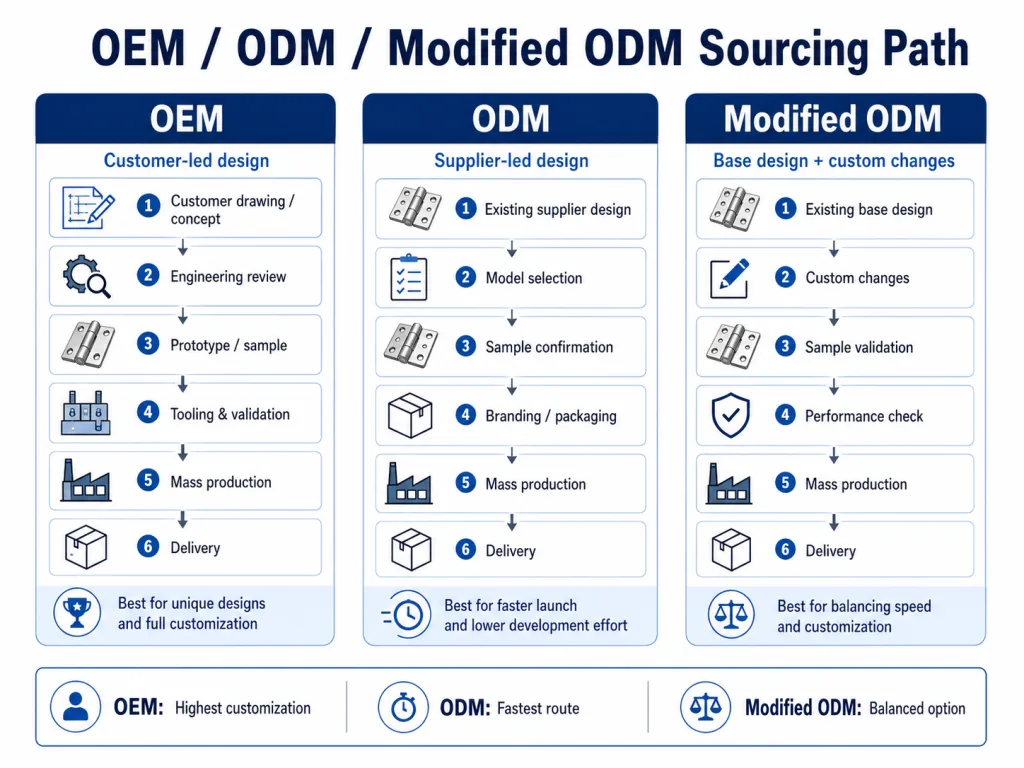
This route is often faster and less expensive than full OEM development because the base structure already exists, and it is safer than forcing a catalog part into an application where it does not quite fit. It does have limits, though: if the base geometry, load path, pin structure, mounting method, or motion requirement must change completely, the project needs full OEM development instead.
Common mistakes when asking for OEM or ODM
- Calling every custom request OEM. A different finish, material, or packaging may still fit an ODM path. Labeling everything OEM adds unnecessary tooling discussion and slows the quote.
- Choosing OEM without checking existing products first. A standard or modified ODM hinge may already meet the application, saving tooling cost, development time, and sample delay. OEM should solve a real design gap, not replace proper product selection.
- Using ODM when exclusivity is required. The base design belongs to the manufacturer. If the hinge is part of a protected product, confirm ownership and exclusivity terms first.
- Sending incomplete requirements. A supplier cannot choose the right path from a vague request — load, mounting, environment, material, finish, and volume all affect whether OEM or ODM fits.
- Skipping the sample stage. Even an ODM hinge should be tested on the real assembly before production; a hinge can look right in a catalog and still fail on door weight, frame stiffness, screw position, or clearance.
Which one should you ask for?
Start from what you already have. If you own a drawing, a protected design, or a part that must be matched exactly, you are asking for OEM, and the manufacturer builds to your specification. If you have no protected design and simply need a hinge that works, you are probably asking for ODM — the manufacturer can recommend an existing model, confirm fit, and offer material, finish, or branding options. If an existing product is close but not perfect, ask whether a modified ODM path works before opening full custom tooling; for industrial buyers this is often the most practical route because it balances speed, cost, and fit. What you actually send with the inquiry depends on the path — an OEM inquiry needs a full drawing and specification, while an ODM inquiry needs your application, load, mounting, and environment so the manufacturer can match a model.
If you are still deciding which hinge type the job needs at all, start from how to choose an industrial hinge before deciding whether the path should be OEM or ODM.
Then describe your situation clearly — a design to build, or a requirement to solve — and our engineering team can advise whether OEM, ODM, or a modified ODM path fits the project.
FAQ
What is the difference between OEM and ODM hinges?
OEM hinges are built to the buyer’s own drawing and specification, while ODM hinges start from the manufacturer’s existing design. OEM gives the buyer more control and design ownership. ODM usually reduces development time and upfront cost because the product and tooling already exist.
Is OEM or ODM cheaper for hinges?
ODM is usually cheaper upfront because the manufacturer already owns the design and tooling. OEM can cost more when a new design, engineering review, or custom tooling is required. OEM may still be worth the cost when the hinge must be unique, protected, or built exactly to the buyer’s drawing.
Should I choose OEM or ODM for my product?
Choose OEM if you own a specific design, need exclusivity, or require a hinge built exactly to your drawing. Choose ODM if you need a proven hinge quickly and can start from the manufacturer’s existing product. Many industrial projects use a modified ODM hinge to balance cost, speed, and fit.
Can an ODM hinge be customized?
Often yes. An ODM hinge may be customized in material, finish, branding, packaging, or limited dimensions if the base design and tooling allow it. If the change requires a new hinge structure, new hole geometry, or a different motion design, the project may move from ODM to OEM development.
Can a modified ODM hinge replace full OEM development?
Yes, when the existing hinge design is close enough to the application and only limited changes are needed. A modified ODM hinge can reduce tooling cost and lead time while still improving fit. Full OEM development is only needed when the existing base design cannot meet the required geometry, load, motion, or ownership requirement.
Do ODM hinges still need a sample before production?
Yes. Even a proven ODM hinge should be validated on the real assembly before a production run, because door weight, frame stiffness, screw position, gasket compression, or installation clearance can reveal a fit issue that a catalog cannot show.