-
+86 13720060320
-
lanna@haitangs.com

SUS 304 vs SUS 316 Hinges | Stainless Grade Guide
Choose SUS 304 stainless for general outdoor, washdown, and food-industry hinges, and step up to SUS 316 when chlorides are present — coastal sites, marine equipment, de-icing salt, and many chemical environments — because 316’s added molybdenum is what resists the pitting that 304 cannot. Both grades are corrosion-resistant stainless steels and look identical; the difference is how they behave when salt or chemicals are in the air or water. This guide explains the real distinction and how to pick the grade for a hinge by environment, so you neither under-spec a coastal door nor overpay for 316 where 304 is plenty.
Quick answer: 304 for general industrial, outdoor, and washdown use; 316 where chloride exposure is real — coastal, marine, salt, or chemical. When in doubt near salt water, 316 is the safer specification. The material choice sits inside the wider selection covered in how to choose an industrial hinge; this page is about the grade decision specifically.
What actually differs between 304 and 316
Both are austenitic stainless steels with chromium and nickel, and both form a passive oxide layer that resists rust. The decisive difference is that 316 adds roughly 2–3% molybdenum, which dramatically improves resistance to pitting and crevice corrosion from chlorides. That is the whole story in practice: in clean air, dry indoor settings, or ordinary rain, 304 and 316 perform almost the same, and 304 is the sensible, lower-cost choice. Introduce chlorides — sea spray, coastal humidity, road salt, swimming-pool atmospheres, or many process chemicals — and 304 can develop pinhole pits and rust streaks while 316 keeps its surface intact. A hinge is especially exposed here because it has moving parts and tight crevices around the pin and leaves, exactly where crevice corrosion likes to start.
Why a hinge corrodes earlier than flat stainless
A flat stainless panel and a stainless hinge made from the same grade do not age the same way, and it is worth knowing why before choosing a grade. A hinge is full of the exact features corrosion exploits: the pin and knuckle form tight overlapping gaps, the leaves overlap with a thin film of moisture between them, and the screw holes and fastener seats trap water and contaminants. These are crevices, and crevice corrosion needs only a little trapped chloride-laden moisture to start — somewhere it cannot rinse or dry out. So a hinge can show rust where a smooth panel of the same steel stays clean. On 304 in a chloride environment, the early signs are predictable: rust staining and brown streaks near the screw holes, pitting around the pin area, and a joint that gradually stiffens as corrosion products build in the knuckle. That vulnerability at the joint is the real reason grade selection matters more for a hinge than for the sheet metal around it.
How to choose the grade by environment
| Environment | Recommended grade | Why |
|---|---|---|
| Dry indoor industrial | 304 (or coated/zinc for cost) | No chloride load; 316 is unnecessary |
| General outdoor, rain exposure | 304 | Handles weather without chlorides well |
| Washdown / food & beverage | 304 (316 for harsh sanitizers) | 304 suits most washdown; 316 for aggressive chemicals |
| Coastal / near salt air | 316 | Chloride-laden air pits 304 over time |
| Marine / on-water | 316 | Direct salt exposure needs molybdenum |
| Chemical / de-icing salt | 316 | Aggressive chlorides attack 304 |
The honest rule most engineers use: specify 304 by default, and step up to 316 the moment chlorides enter the picture. The cost premium for 316 is real, so it is not the automatic “better” choice — it is the right choice in the environments where 304 would fail early. The mistake that costs the most is the reverse: putting a 304 hinge on a coastal or marine door to save money, then replacing rusted hinges in a year or two.
One caution in the other direction: 316 is more chloride-resistant, not rust-proof. It can still corrode if its surface is contaminated or poorly finished, if saltwater sits trapped in a crevice and never dries, or if it is bolted with the wrong fasteners in a wet joint. Choosing 316 is the right call for chloride environments, but it does not remove the need for a clean finish, drainage, and matched fasteners.
From the field: 316 hinges on a boat hatch
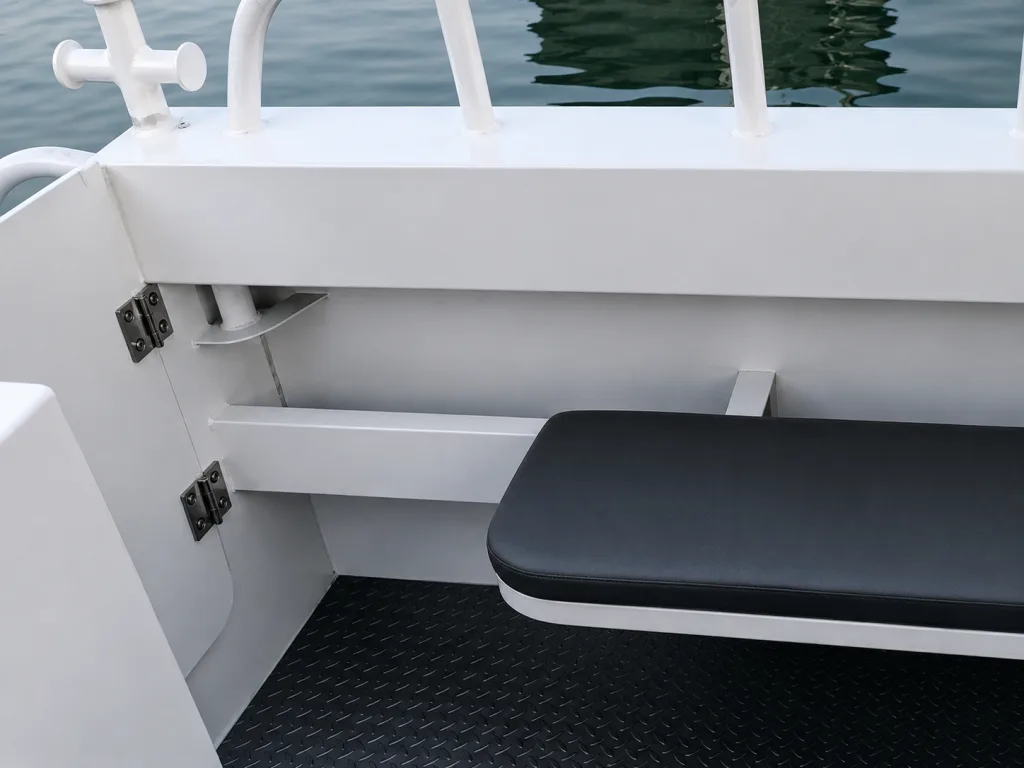
The hatch shown here is a clear case for 316. These are 316 stainless steel hinges on a boat hatch — a storage compartment door on an open deck, directly exposed to salt spray and humid sea air every day. This is the environment 304 cannot handle for long: the chloride load would start pitting the surface and creeping into the pin and leaf crevices, and on a vessel a corroded hatch hinge is both a maintenance and a safety issue. The molybdenum in 316 is doing exactly what it is there for, keeping the surface and the moving joint sound in continuous salt exposure. It is the simplest illustration of the rule: when the application lives on or near salt water, the grade decision is already made.
Beyond the grade: finish and dissimilar metals
Two related points decide whether even the right grade lasts. First, finish: a clean passivated or polished surface resists corrosion better than a rough or contaminated one, because pits start at surface defects and embedded iron particles — so a well-finished 304 can outperform a poorly finished one, and passivation matters on both grades. Second, dissimilar metals: pairing a stainless hinge with fasteners or a frame of a very different metal in a damp, salty joint can drive galvanic corrosion, so match fastener material to the hinge and keep an eye on what the hinge bolts to. For the heaviest doors in these environments, confirm the load and grade together — the heavy-duty hinge range is offered in stainless grades for corrosive sites.
RFQ checklist for stainless hinges
When you request a quote, the grade decision is faster if you give the environment and the door, not just “stainless.” Copy and fill in:
STAINLESS HINGE RFQ
-------------------
Operating environment (indoor / outdoor / washdown / coastal / marine / chemical):
Salt or chloride exposure (none / occasional / constant):
Grade required or recommended (304 / 316):
Finish (passivated / polished / brushed):
Fastener material (match to hinge grade):
Door weight:
Number of hinges:
Sample / salt-spray test needed (yes / no):
When you know the environment, the door, and the load, the grade follows. Share the application — indoor, outdoor, washdown, coastal, marine, or chemical — and our engineering team can confirm whether 304 or 316 is right and which model to use.
FAQ
What is the difference between SUS 304 and SUS 316 hinges?
Both are corrosion-resistant austenitic stainless steels, but 316 adds about 2-3% molybdenum, which strongly improves resistance to pitting and crevice corrosion from chlorides. In dry or chloride-free settings they perform similarly and 304 is the lower-cost choice; near salt or chemicals, 316 lasts where 304 pits.
When should I choose 316 instead of 304 for a hinge?
Choose 316 when chlorides are present – coastal or near-shore sites, marine and on-water equipment, road or de-icing salt, swimming-pool atmospheres, and many process chemicals. For dry indoor, general outdoor, and most washdown use, 304 is sufficient and more economical.
Is 316 stainless always better than 304?
Not always – 316 resists chlorides better, but it costs more, and in chloride-free environments 304 performs about the same. The right choice is by environment: 304 by default, 316 where salt or aggressive chemicals are present. Paying for 316 where 304 would do is overspending, not an upgrade.
Which stainless grade is best for marine or coastal hinges?
316. Direct salt spray and chloride-laden coastal air pit 304 over time, especially in the tight crevices around a hinge pin and leaves. The molybdenum in 316 resists that pitting and crevice corrosion, making it the standard grade for marine and coastal hinge applications.
Will 304 stainless hinges rust outdoors?
304 stainless hinges usually perform well in general outdoor weather. They can show rust staining or pitting in chloride-rich environments such as coastal air, road salt, pool atmospheres, or chemical washdown – often first at the screw holes and pin area, where crevices trap moisture.
Can 316 stainless hinges still corrode?
Yes. 316 resists chloride pitting far better than 304, but it can still corrode if the surface is contaminated or poorly finished, if saltwater stays trapped in a crevice, or if it is paired with incompatible fasteners in a wet joint. It is more resistant, not rust-proof.