Testo di esempio
- +86 13720060320
- lanna@haitangs.com

Cerniere sollevabili
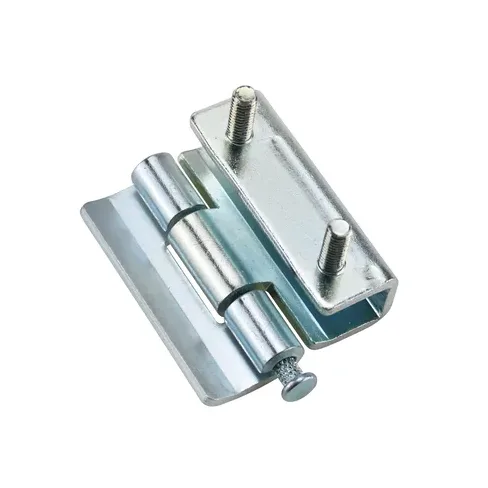
Lift-off hinges (also called detachable hinges, removable hinges, or slip joint hinges) allow a door, cover, or access panel to be removed by simply lifting it vertically off the lower hinge leaf — no tools, no fasteners, no loose pins. They are specified on industrial enclosures, electrical cabinets, machine guards, food machinery, medical equipment, and laboratory cabinets where service access, cleaning efficiency, and panel removability are part of the equipment design. HSP manufactures 25+ lift-off hinge models from 42 mm compact designs to 110 mm heavy-duty variants, in SUS 304 stainless steel, ZDC die-cast zinc alloy, and SPCC cold-rolled steel — with left-hand and right-hand handing available across the range.
For OEM cabinet manufacturers and equipment designers, lift-off hinge selection requires four engineering inputs: hinge handing (left vs right), required lift clearance above the cabinet, panel weight and material, and operating environment. Drawing on 10+ years of supplying industrial hinge solutions to electrical cabinet, food machinery, medical equipment, and control panel OEMs across global markets, our engineering team matches handing, dimensions, material, and finish to the application — including custom configurations for OEM production.
What Are Lift-off Hinges?
A lift-off hinge consists of two separable leaves: the lower leaf has a fixed pin (or pivot post), and the upper leaf has a matching sleeve that slides over the pin. When the door is lifted vertically, the sleeve disengages from the pin and the door comes free in seconds — no screws to remove, no pins to extract. To reinstall, the door is lowered back onto the pin and seats into operating position.
This separable design is the defining feature: standard butt hinges, concealed hinges, and weld-on hinges all require disassembly to remove the door, while lift-off hinges allow removal as part of normal operation. Lift-off hinges are also known by several industry terms — detachable hinges, removable hinges, slip joint hinges, take-apart hinges, and loose joint hinges — all referring to the same separable mechanism.
- Tool-free door removal: Panels lift off in seconds without tools — important for equipment service access, cleaning, retrofit work, and repair operations where downtime matters.
- Left-hand and right-hand handing: Lift-off hinges are not symmetric. The handing must match the door swing direction. HSP offers both L (left-hand) and R (right-hand) configurations across most models — confirmed at order entry to prevent rework.
- Material range: SUS 304 stainless steel for marine, food machinery, washdown, medical, and laboratory applications; ZDC die-cast zinc alloy for decorative-finish indoor industrial cabinets; SPCC cold-rolled steel for cost-sensitive volume production.
- Surface finishes: Brushed (vibratory polished), mirror polished, matte, black, chrome plated, zinc galvanized, and bright finish — selectable to match cabinet appearance and environmental requirements.
- Opening angles: Standard models support 120° opening, with 180° and other configurations available depending on the hinge geometry.
- Size range: From 42 mm compact lift-off hinges for small access panels and medical instruments, up to 110 mm × 72 mm heavy-duty models for industrial cabinet doors.
Common Applications
- Electrical cabinets and control panels: Switchgear cabinets, distribution panels, and industrial controllers where doors are frequently removed for wiring access, retrofit work, and maintenance.
- Food machinery and washdown equipment: Stainless steel cabinet doors that must be removed for thorough cleaning between production batches — SUS 304 with brushed or mirror finish for hygienic surfaces.
- Medical and laboratory equipment: Medical carts, lab instrument housings, analyzer access panels, and laboratory cabinet doors requiring tool-free maintenance access and cleanable surfaces.
- Industrial automation and machine guards: CNC machine doors, automation cell access panels, and inspection covers where service access during scheduled maintenance is part of the equipment operation.
- Server racks and IT enclosures: Server rack side panels, network cabinet doors, and data center enclosures where rapid panel removal enables faster equipment installation and servicing.
- Kiosks and self-service terminals: ATM service panels, kiosk rear-access doors, and vending machine service compartments requiring authorized-personnel removable access.
- Compact enclosures and instrument cases: Small access panels on portable equipment, instrument cases, and commercial display enclosures where the smaller HSP models (42–64 mm) provide both clean appearance and quick access.
How to Choose a Lift-off Hinge
Lift-off hinge selection is unique among industrial hinges because the most common ordering error is the wrong handing (L vs R). Always confirm door swing direction before ordering — verified from the operator side of the cabinet, looking at the closed door.
- Hinge handing (critical): Determine the door swing direction from the operator side. A right-hand (R) lift-off hinge mounts on the right side of the cabinet (when facing the door); a left-hand (L) version mounts on the left. Verify before placing the order — handing cannot be reversed after manufacture for most models.
- Lift clearance above the cabinet: Lift-off hinges require vertical clearance above the door equal to the engagement height of the pin. Confirm that overhead obstructions (cabinet headers, equipment racks, ceiling-mounted devices) do not prevent vertical lift.
- Panel weight and number of hinges: Use multiple hinge points for heavier panels — typical practice is two hinges for panels up to 5–8 kg, three or more for heavier doors. Match hinge size to door weight; larger HSP lift-off models (110 mm × 72 mm) support correspondingly heavier panels.
- Material and finish: SUS 304 for marine, washdown, food, medical, and outdoor applications; ZDC with decorative finishes (chrome, matte, black, mirror) for indoor cabinets where appearance is specified; SPCC zinc-plated for dry indoor industrial use and cost-sensitive volume production.
- Required opening angle: Confirm whether 120° is sufficient for the access requirement, or whether wider opening (180°) is needed. Cabinet doors with adjacent walls or equipment may have practical limits below the hinge’s maximum rated angle.
- Security considerations: Lift-off hinges allow tool-free removal — convenient for service, but also a security factor. For doors that must resist unauthorized removal, combine lift-off hinges with a locking latch, or use fixed hinges instead.
Quality Verification
Each lift-off hinge batch is validated through 2D dimensional inspection — particularly pin diameter and sleeve bore concentricity, which directly affect engagement smoothness and door alignment after reinstallation. Tensile and load testing verify pin strength; fatigue cycle testing confirms repeated removal-and-reinstallation reliability. Salt spray testing per ASTM B117 is performed on SUS 304 and zinc-plated variants for marine and washdown applications.
Lift-off Hinges vs Fixed Industrial Hinges
Lift-off hinges separate vertically without tools — chosen when service access, cleaning, or repeated door removal matters. Fixed industrial hinges (butt, weld-on, concealed) are permanently attached — chosen when load capacity, security, or vibration resistance matters more than removability.
| Fattore di selezione | Cerniere a scomparsa | Fixed Industrial Hinges |
|---|---|---|
| Door removal | Tool-free, vertical lift in seconds | Requires unscrewing or pin extraction |
| Il migliore per | Service access, cleaning, retrofit work | Load capacity, security, vibration applications |
| Handing (L/R) | Direction-specific — must be specified at order | Most models are reversible |
| Security | Lower (door removable without tools) | Higher (door cannot be removed without disassembly) |
| Typical applications | Electrical cabinets, food machinery, medical equipment | Heavy doors, outdoor enclosures, secure cabinets |
| Vertical clearance | Required above door for lift-off | Not required |
Domande frequenti
What is a lift-off hinge?
A lift-off hinge is a two-leaf hinge where the upper leaf slides vertically off a fixed pin on the lower leaf, allowing the door to be removed without tools. It is also known as a detachable hinge, removable hinge, slip joint hinge, or take-apart hinge.
How do I determine left-hand vs right-hand handing?
Stand on the operator side of the cabinet facing the closed door. If the hinge is on the right side and the door opens to the right, specify right-hand (R). If the hinge is on the left side, specify left-hand (L). Confirm handing before ordering — most lift-off hinges cannot be reversed after manufacture.
What materials and finishes are available?
HSP lift-off hinges are available in SUS 304 stainless steel (brushed, mirror polished, or bright finish), ZDC die-cast zinc alloy (chrome, matte, or black), and SPCC cold-rolled steel (zinc galvanized or bright finish). Selection depends on environment, appearance requirement, and budget.
What size range is available?
Standard catalog sizes range from 42 mm compact models for small access panels and instruments, up to 110 mm × 72 mm heavy-duty models for industrial cabinet doors. Selection is matched to door weight and panel dimensions.
Are lift-off hinges secure enough for exterior cabinets?
Lift-off hinges allow tool-free door removal — convenient for service but lower in anti-removal security. For exterior cabinets, theft-sensitive compartments, or doors requiring resistance to unauthorized removal, combine lift-off hinges with a locking latch, or specify fixed-pin hinges instead.
Can lift-off hinges be customized for OEM production?
Yes. Custom dimensions, mounting hole patterns, opening angles, materials, and surface finishes are available for OEM orders. Customers provide drawings or sample requirements; samples are typically prepared within 10 working days. Production MOQ starts from 1,000 units.
Can you recommend a lift-off hinge for my application?
Yes. Please provide door dimensions, door weight, swing direction (L or R), required opening angle, vertical clearance above the cabinet, operating environment, and material preference. We can recommend a standard model or develop a custom solution. Contattate il nostro team di ingegneri per l'assistenza tecnica.