-
+86 13720060320
-
lanna@haitangs.com

Bisagras con resorte de cierre automático | Bisagra con resorte frente a cierrapuertas
Una bisagra con resorte de cierre automático utiliza un resorte de torsión interno para cerrar la puerta por sí sola una vez soltada; por lo tanto, el momento adecuado para utilizarla es cuando no se debe permitir en ningún caso que una puerta quede abierta por accidente, como en el caso de una protección de seguridad, la puerta de la carcasa de una máquina o un panel de una cámara frigorífica. Ahí radica todo el valor: el cierre no depende de que alguien se acuerde de cerrar la puerta. Esta guía explica cuándo una puerta realmente necesita cerrarse automáticamente y cómo se compara una bisagra con resorte con las dos alternativas que los compradores suelen barajar: un cierrapuertas independiente y una bisagra normal sin cierre automático. Para ver los modelos, la Gama de bisagras con resorte (de cierre automático) abarca los tipos que se describen aquí.
Respuesta rápida: Utiliza una bisagra con resorte de cierre automático cuando la puerta deba volver a la posición cerrada por defecto y la aplicación no requiera un cierrapuertas hidráulico voluminoso. Utiliza un cierrapuertas cuando la puerta sea más grande, más pesada o necesite una velocidad de cierre amortiguada. Utiliza una bisagra simple solo cuando no se requiera en absoluto el cierre automático.
Respuesta rápida: ¿necesitas una bisagra de cierre automático?
| Utiliza una bisagra con resorte de cierre automático cuando… | Una bisagra sencilla está bien cuando… |
|---|---|
| La puerta es una barrera de seguridad que debe cerrarse tras el acceso. | La puerta debe permanecer abierta mientras se utiliza. |
| Dejarlo abierto supone un peligro o rompe la contención | Una puerta abierta no supone ningún problema de seguridad ni de estanqueidad |
| La gente pasa por allí con las manos ocupadas y no puede cerrarlo | La puerta se abre y se cierra a propósito. |
| La cámara frigorífica o la barrera no deben quedarse entreabiertas | La puerta debe mantenerse en su posición cuando se suelta. |
| Quieres cerrar la puerta sin necesidad de un cerrojo voluminoso | Se exige un sistema de retención controlada. |
En resumen: elige una bisagra con resorte cuando la La puerta debe estar cerrada por defecto. y no puedes confiar en que una persona se encargue de ello. Si se quiere que la puerta se mantenga abierta o se quede en la posición en la que se ha ajustado, hay que utilizar una bisagra de par, no una de cierre automático.
Cómo funciona realmente una bisagra con resorte de cierre automático
Una bisagra de resorte sustituye (o complementa) al pivote normal con un resorte de torsión interno. Cuando se empuja o se tira de la puerta para abrirla, el resorte se tensa; al soltarla, el resorte impulsa la puerta de vuelta a la posición cerrada sin necesidad de ningún dispositivo externo. El funcionamiento es automático y autónomo: no hay que instalar ni mantener ningún brazo superior, cilindro hidráulico ni cierrapuertas de suelo. Esto la hace muy adecuada para puertas, rejas y paneles en los que una puerta abierta es el modo de fallo contra el que se diseña. Cabe señalar que los términos “bisagra de cierre automático” y “bisagra con resorte” describen aquí la misma familia: es el resorte el que produce la acción de cierre automático, por lo que ambos términos se utilizan indistintamente para este tipo de bisagras.
Desde el terreno: bisagras de resorte en las puertas de seguridad
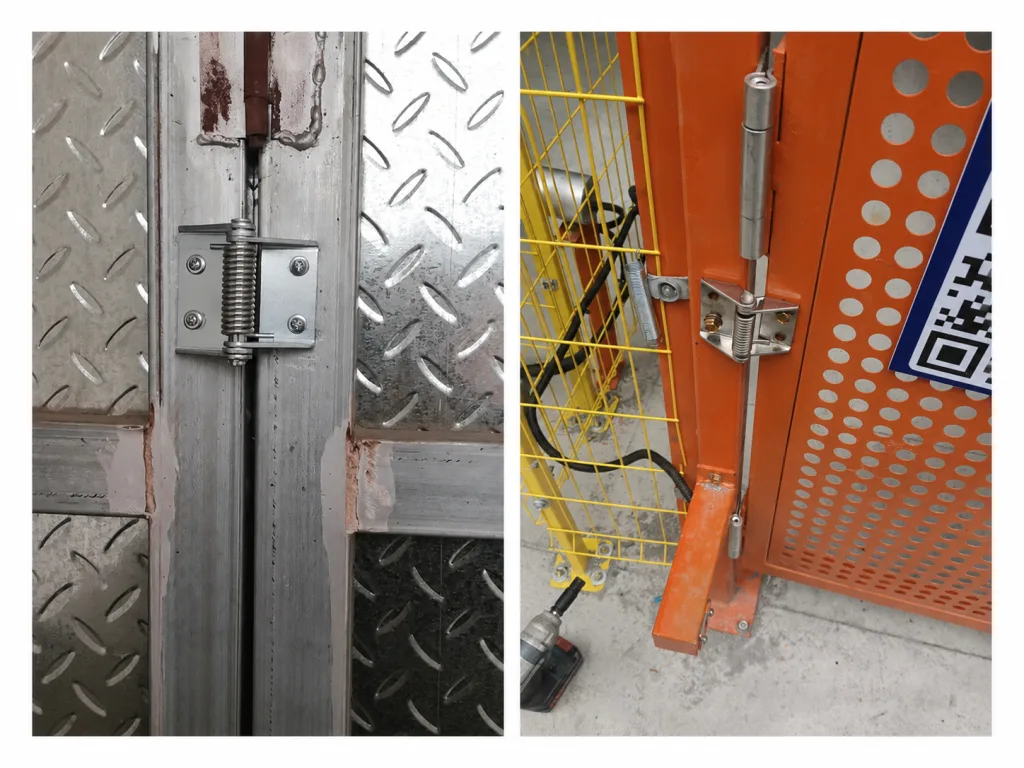
Las puertas que se muestran aquí son un ejemplo real de un caso de uso adecuado. Se trata de puertas industriales de protección y barrera —la puerta de protección para maquinaria con paneles perforados y la puerta de acceso metálica— equipadas con hojas en V. bisagras con cierre automático por resorte (nuestra serie XG02-037, 83 × 70 mm, alambre de resorte de Ø3). Una vez que un trabajador ha pasado, la bisagra vuelve a cerrar la puerta por sí sola, por lo que la puerta de seguridad no puede quedarse abierta por error. Ahí es precisamente donde una bisagra de cierre automático demuestra su utilidad: la función de seguridad depende de que la puerta esté cerrada, y la memoria humana no es un mecanismo de cierre fiable. Esta misma bisagra se ofrece en dos materiales, lo cual es importante en función de dónde se instale la puerta — Acero galvanizado SPCC para puertas de protección en interiores en entornos secos, y acero inoxidable SUS304 para puertas en exteriores, en entornos húmedos o sometidas a lavado a presión — de modo que el comportamiento de cierre es el mismo, mientras que la resistencia a la corrosión se adapta al entorno.
Bisagra con resorte, cierrapuertas y bisagra normal
Cuando una puerta debe cerrarse sola, la bisagra con resorte es una de las tres opciones posibles, y las ventajas e inconvenientes determinan cuál es la más adecuada.
| Opción | Lo mejor para | Compensación |
|---|---|---|
| Bisagra de resorte (de cierre automático) | Barreras, puertas y paneles que requieran un cierre automático en un diseño compacto | Menor control sobre la velocidad de cierre que un cierrapuertas amortiguado |
| Cierrapuertas (brazo hidráulico) | Puertas más grandes o pesadas que requieren un cierre controlado y amortiguado | Herrajes aéreos voluminosos; mayores costes y mantenimiento |
| Bisagra simple (sin cierre) | Puertas diseñadas para permanecer en el lugar donde se colocan | Depende totalmente de que alguien cierre la puerta |
La bisagra de resorte es la mejor opción cuando la puerta es ligera o de peso medio, el cierre debe ser automático y no hay espacio ni presupuesto para un cierrapuertas superior —lo que se aplica a la mayoría de las protecciones de maquinaria, puertas de barrera y paneles de equipos—. Un cierrapuertas hidráulico es la mejor solución cuando una puerta más pesada necesita un cierre lento, controlado y amortiguado (una puerta batiente que no debe dar un portazo), a costa de un mayor volumen y mantenimiento. Una bisagra simple solo es adecuada cuando el cierre automático no es un requisito en absoluto. Y si la necesidad real es la contraria —una puerta o panel que debe mantener un ángulo abierto en lugar de cerrado, lo que apunta más bien a una bisagra de torsión; la lógica de selección más amplia que se aplica a todos estos tipos se encuentra en Cómo elegir una bisagra industrial.
Fuerza de cierre frente al peso de la puerta
Instalar una bisagra con resorte no garantiza automáticamente que la puerta se cierre. El resorte tiene que superar todas las fuerzas que se oponen al cierre —el propio peso y anchura de la puerta, la fricción en el pivote, cualquier pestillo que haya que accionar hasta el fondo y la compresión de la junta en una puerta hermética— y aún así disponer de fuerza de reserva. Si la fuerza del resorte es insuficiente, la puerta se queda a medio cerrar o no encaja en el pestillo; si es excesiva, la puerta resulta difícil de abrir, lo que supone un problema en sí mismo en una puerta por la que la gente pasa todo el día. Por eso el peso, la anchura y el número de bisagras de la puerta son factores que influyen conjuntamente: un mayor número de bisagras distribuye la fuerza de cierre por toda la puerta, y una puerta más ancha o pesada necesita esa fuerza distribuida para cerrarse de manera uniforme. Adapta el tamaño del resorte a la puerta real, incluyendo su pestillo y su junta, no solo al peso del panel.
Velocidad de cierre y riesgo de golpe seco
Una bisagra con resorte vuelve a cerrar la puerta, pero no controla a qué velocidad tal y como lo hace un cierrapuertas hidráulico. En una puerta de seguridad ligera, eso está bien. En una puerta más pesada, la misma fuerza del muelle que garantiza el cierre también puede hacer que la puerta se cierre de golpe, lo que supone un desgaste para el marco, el pestillo y cualquiera que se interponga en su camino. Esta es la diferencia más clara con respecto a un cierrapuertas: cuando una puerta es lo suficientemente pesada como para que un cierre incontrolado se convierta en un portazo, un cierrapuertas hidráulico amortiguado es la mejor opción, y es mejor reservar la bisagra con resorte para puertas y paneles ligeros o de peso medio, en los que se acepta un cierre automático rápido.
Material, entorno y manipulación
Dado que una bisagra de resorte cuenta con un resorte y un pasador móviles, la corrosión no es solo un problema estético: el óxido puede endurecer o bloquear el funcionamiento del resorte y hacer que una puerta de cierre automático deje de cerrarse. Adapta el material al entorno: acero galvanizado para protecciones interiores en ambientes secos, y acero inoxidable, como el SUS304, para puertas en entornos húmedos, sometidas a lavado, al aire libre o en zonas costeras, donde el resorte debe seguir funcionando durante años. Comprueba también el sentido de apertura, ya que estas bisagras son direccionales —una bisagra de la izquierda en una puerta que se abre hacia la derecha no cerrará correctamente— y asegúrate de que se desea el cierre automático en todo el recorrido de la puerta. Si, por el contrario, la puerta necesita mantener un ángulo abierto en lugar de volver a uno cerrado; eso es cosa de una bisagra de par; revisa el gama de bisagras de torsión en su lugar.
Lista de comprobación para la solicitud de presupuesto de bisagras de cierre automático
Para obtener un presupuesto preciso desde el primer momento, facilítale al proveedor los datos de la puerta y del entorno, no solo el tamaño de la bisagra. Copia y rellena:
SOLICITUD DE PRESUPUESTO PARA BISAGRAS DE CIERRE AUTOMÁTICO
----------------------
Peso de la puerta:
Ancho x altura de la puerta:
Sentido de apertura (izquierda / derecha):
Número de bisagras:
Ángulo de cierre requerido (cierre completo desde qué grado de apertura):
Resistencia del pestillo o de la junta (sí / no, tipo):
Entorno de funcionamiento (interior / exterior / lavable / costero):
Material / acabado (galvanizado / SUS304):
Cantidad de muestras necesaria:
Volumen anual:
Una vez definidos el tamaño, el peso, el ángulo de apertura y el entorno de la puerta, compártelos y nuestro equipo de ingenieros Podemos confirmar el modelo, la fuerza del muelle y el material para la aplicación.
PREGUNTAS FRECUENTES
¿Para qué sirve una bisagra con resorte de cierre automático?
Se utiliza en aquellos casos en los que una puerta debe cerrarse automáticamente tras el paso: protecciones de seguridad, puertas de cerramientos de maquinaria, puertas de barrera y paneles de cámaras frigoríficas. Un resorte de torsión interno devuelve la puerta a la posición cerrada cuando se suelta, por lo que no puede dejarse abierta por error, lo cual es importante cuando la seguridad o la función de estanqueidad de la puerta dependen de que esté cerrada.
¿Una bisagra con resorte es lo mismo que una bisagra de cierre automático?
En este tipo de bisagras, sí: es el muelle el que produce el cierre automático, por lo que ambos términos se utilizan indistintamente. Una bisagra con muelle (de cierre automático) utiliza un muelle de torsión interno para que la puerta vuelva a cerrarse sin necesidad de un cierrapuertas independiente.
Bisagra de resorte o cierrapuertas: ¿cuál debería usar?
Utiliza una bisagra de resorte para protecciones, puertas y paneles de peso ligero a medio que requieran un cierre automático en un diseño compacto y sin herrajes superiores. Utiliza un cierrapuertas hidráulico cuando una puerta más pesada necesite un cierre lento, controlado y amortiguado, aceptando el mayor volumen, el coste y el mantenimiento que ello conlleva.
¿De qué material debe ser la bisagra de una verja de cierre automático?
Adáptalo al entorno. El acero galvanizado es adecuado para la protección en interiores secos; el acero inoxidable (como el SUS304) es adecuado para puertas en exteriores, en entornos húmedos o sometidas a lavado, donde la corrosión podría bloquear el muelle u oxidar las hojas. El mecanismo de cierre es el mismo; el material lo protege durante toda la vida útil de la puerta.
¿Puede una bisagra con resorte de cierre automático regular la velocidad de cierre?
Una bisagra de resorte devuelve la puerta a la posición cerrada, pero normalmente no controla la velocidad de cierre como lo hace un cierrapuertas hidráulico. En puertas de seguridad ligeras, esto es suficiente; sin embargo, para puertas más grandes o pesadas que requieren un cierre lento y amortiguado para evitar que se den de golpe, un cierrapuertas es la mejor opción.
¿Cómo puedo saber si una bisagra con resorte es lo suficientemente resistente para mi puerta?
Comprueba el peso y la anchura de la puerta, el número de bisagras, si hay resistencia en el pestillo o en la junta, y el ángulo de cierre necesario. La bisagra debe proporcionar suficiente fuerza elástica para que la puerta vuelva completamente a la posición cerrada y se bloquee, sin que resulte demasiado difícil de abrir. Facilita esos datos y el proveedor podrá confirmar la fuerza elástica y el número de bisagras.