Przykładowy tekst
- +86 13720060320
- lanna@haitangs.com

Zawiasy sprężynowe
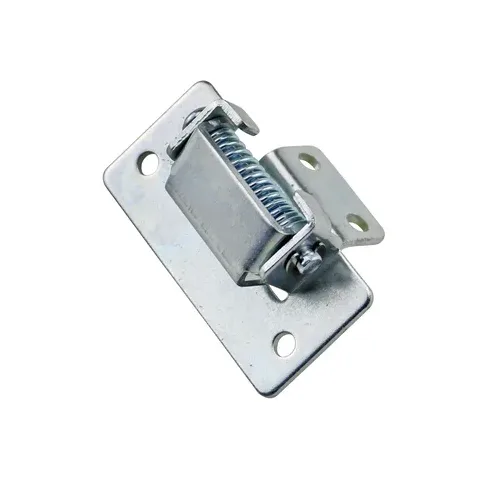
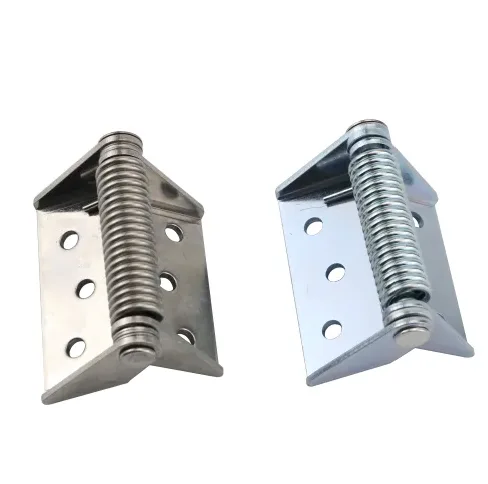
Spring hinges (also called self-closing hinges or torsion spring hinges) are mechanical hinges with an internal torsion spring that returns the door, lid, or panel to the closed position automatically after it has been opened — no external door closer, no manual action, no separate latch required. They are specified on industrial cabinet doors, machine safety guards, electrical enclosures, fire-rated access doors, and food machinery panels where doors must never be left unintentionally open, and where built-in self-closing is part of the equipment safety or operational design. HSP manufactures 2+ spring hinge series in SUS 304 stainless steel and SPCC cold-rolled steel — with both compact horizontal-spring designs (56 × 27 mm) and standard vertical-spring V-leaf designs (83 × 70 mm to 83 × 83 mm).
For OEM cabinet manufacturers and equipment designers, spring hinge selection comes down to three factors: required closing force matched to door weight, mounting geometry (horizontal spring vs vertical V-leaf), and material grade for the operating environment. Drawing on 10+ years of supplying industrial hinge solutions to electrical cabinet, food machinery, and machine guard OEMs, our engineering team matches spring force, dimensions, and material to the application — including custom torque calibration for OEM production. Standard models are available from in-stock inventory with 24-hour dispatch; custom configurations are typically prepared within 20–25 working days.
What Are Spring Hinges?
A spring hinge is a hinge with a torsion spring built into the knuckle (or arranged between the leaves). When the door is opened, the spring is compressed, storing mechanical energy. When the door is released, the spring releases its stored energy and returns the door to the closed position — automatically, without external closers or manual action.
This passive self-closing behavior makes spring hinges the standard solution where automatic door closure is a safety, hygiene, or operational requirement. Unlike pneumatic door closers (which require separate hardware mounted above the door), spring hinges integrate the closing mechanism inside the hinge itself — saving installation space, reducing parts count, and eliminating the need for additional fasteners or visible closing arms.
- Built-in torsion spring: The spring is integrated into the hinge geometry — either horizontally between the leaves or vertically along the knuckle axis. No external closer hardware required.
- Self-closing action: Automatically returns the door to closed after release. Closing force is matched to door weight at the design stage.
- Two design variants: Compact horizontal-spring designs (such as HSP HG02-011, 56 × 27 mm) for small access panels and lightweight covers; standard vertical-spring V-leaf designs (such as HSP XG02-037, 83 × 70 mm and 83 × 83 mm) for industrial cabinet doors and machine guards.
- Materials: SUS 304 stainless steel (vibratory polished or brushed finish) for marine, food machinery, and outdoor applications; SPCC cold-rolled steel (zinc galvanized) for indoor industrial cabinets and cost-sensitive volume production.
- Spring wire diameter: Standard catalog models use Φ3 mm spring wire for medium closing force; custom wire diameters available for lighter or heavier closing-force requirements.
- Mounting hole patterns: Φ4.2 through-hole on compact models, Φ7 mm holes on standard V-leaf models — compatible with M4 and M6 fasteners.
Typowe zastosowania
- Machine safety guards and access panels: Self-closing safety doors on production machinery, CNC machine guards, and conveyor access panels where guards must never be left open during operation.
- Electrical cabinet doors and control panels: Switchgear enclosures and control cabinets in industrial environments where door closure is part of the IP protection rating and fault isolation strategy.
- Food machinery and processing equipment: Self-closing access doors on food processing equipment where SUS 304 hygiene combined with passive closure helps maintain sealed operation between cleaning intervals.
- Cold storage and refrigeration: Self-closing panels on refrigerated enclosures, cold-room access doors, and temperature-controlled cabinet doors where unintended open doors compromise temperature control.
- Cabinet doors with frequent access: High-traffic operator access panels on industrial equipment where manual closure is impractical or inconsistent.
- Equipment lids and inspection covers: Spring-loaded inspection covers, instrument case lids, and small access hatches where the cover must remain closed unless actively held open.
- Compact furniture and architectural panels: Built-in cabinet doors, drop-down access panels, and architectural cover applications where a separate door closer would be visually intrusive.
How to Choose a Spring Hinge
Spring hinge selection requires matching the closing force to door weight, door width, and the rotation angle at which the door is typically left to release. Specifying a spring hinge with too little force will leave the door drifting open; too much force will make the door difficult to open and may compress gaskets excessively.
- Door weight and width: Heavier doors and wider doors (with greater leverage arm from the hinge axis) require higher spring force. For lightweight access panels under 2 kg, the compact HG02-011 horizontal-spring design is typically sufficient; for medium industrial doors, the standard V-leaf XG02-037 design provides higher closing force.
- Closing angle and release behavior: Confirm whether the application needs aggressive snap-close behavior (high spring force) or controlled return (moderate spring force). Snap-close suits safety guards; controlled return suits operator access panels where excessive force could pinch fingers.
- Number of hinges per door: Use multiple spring hinges to distribute closing force evenly. Typical practice is two hinges for light to medium doors, three hinges for heavier doors. Total closing force scales with the number of hinges used.
- Material and finish: SUS 304 stainless (vibratory polished or brushed) for food machinery, marine, washdown, and outdoor environments; SPCC cold-rolled steel (galvanized) for dry indoor industrial applications and cost-sensitive volume production.
- Mounting geometry: Confirm available mounting space and bolt pattern. The compact HG02-011 uses a 56 × 27 mm footprint with Φ4.2 holes; the V-leaf XG02-037 uses an 83 mm leaf width with Φ7 holes. Both bolt-on for field installation.
- Cycle life expectation: Spring hinges retain their closing force across high cycle counts when sized appropriately. For high-traffic doors (such as food production lines), confirm cycle life expectations during the OEM specification phase.
Weryfikacja jakości
Each spring hinge batch is validated through 2D dimensional inspection, spring force measurement (verifying closing torque at the rated angle), fatigue cycle testing on dedicated test rigs to confirm spring retention over long-term operation, and salt spray testing per ASTM B117 for SUS 304 and galvanized variants. Test reports are available on request for OEM projects.
Spring Hinges vs Standard Industrial Hinges
Spring hinges include a built-in torsion spring for automatic self-closing — chosen where doors must close passively without operator action. Standard heavy-duty hinges, lift-off hinges, and concealed hinges hold the door at any open position until manually closed.
| Czynnik wyboru | Zawiasy sprężynowe | Standard Industrial Hinges |
|---|---|---|
| Closing behavior | Automatic self-close after release | Stays open until manually closed |
| External hardware | None — closer integrated | Separate closer optional |
| Best applications | Safety guards, cold storage, food equipment, electrical cabinets | General industrial doors, machine guards, cabinet access |
| Operator effort | Higher to open (against spring); none to close | Low to open; manual to close |
| Force tuning | Sized to door weight at order entry | Not applicable |
| Typical materials | SUS 304 stainless, SPCC galvanized | SUS 201/304/316, SPCC, ZDC |
Personalizacja OEM
HSP supports custom spring hinge development for OEM production. Customers provide door weight, dimensions, required closing force, and mounting geometry; our engineering team confirms feasibility, prepares samples within approximately 10 working days, and supports volume production from 1,000 units MOQ. Custom spring wire diameter, leaf dimensions, mounting hole patterns, and surface finishes are all adjustable. Standard HG02-011 models are available from in-stock inventory with 24-hour dispatch for prototype and small-batch needs.
Często zadawane pytania
What is a spring hinge?
A spring hinge is a hinge with an internal torsion spring that automatically returns the door, lid, or panel to the closed position after it has been released. It eliminates the need for a separate door closer and is used where automatic closure is a safety, hygiene, or operational requirement.
How do I match the spring force to my door weight?
Heavier and wider doors require higher spring force. Lightweight access panels under 2 kg typically work with compact horizontal-spring designs; medium industrial doors require standard V-leaf vertical-spring models. Provide door weight and dimensions to our engineering team for selection support — multiple hinges per door distribute closing force evenly.
What is the difference between horizontal-spring and vertical-spring designs?
Horizontal-spring designs (such as the HSP HG02-011, 56 × 27 mm) place the torsion spring horizontally between the leaves — compact form factor, suited to small access panels and lightweight covers. Vertical-spring V-leaf designs (such as the HSP XG02-037, 83 × 70 mm) place the spring vertically along the knuckle axis with V-shaped folded leaves — higher closing force, suited to industrial cabinet doors.
What materials and finishes are available?
HSP spring hinges are available in SUS 304 stainless steel (vibratory polished or brushed finish) for food machinery, marine, and outdoor applications, and SPCC cold-rolled steel (zinc galvanized) for indoor industrial use and cost-sensitive volume production.
How long do spring hinges last?
When sized appropriately to door weight, spring hinges retain their closing force across high cycle counts. Industrial-grade spring hinge designs are typically validated for extended cycle life on dedicated fatigue test rigs — specific cycle life ratings can be confirmed at the OEM specification phase based on the application’s daily opening frequency.
Are spring hinges suitable for fire-rated door applications?
Spring hinges are widely used as part of self-closing door assemblies. For applications requiring formal fire-rating certification, please verify the certification requirements with your fire door supplier or the local authority having jurisdiction — HSP spring hinges are standard industrial components and certification scope should be confirmed for each project.
Can spring hinges be customized for OEM production?
Yes. Custom dimensions, spring wire diameter, closing force, mounting hole patterns, materials, and surface finishes are available for OEM orders. Customers provide drawings or sample requirements; samples are typically prepared within 10 working days. Production MOQ starts from 1,000 units. Contact our engineering team for technical support.