-
+86 13720060320
-
lanna@haitangs.com

Server Rack Hinges | Access, Clearance & Security Guide
Stručná odpověď: Choose a server rack hinge by door weight and construction, available mounting depth, required opening angle, adjacent-rack clearance, service frequency, removal needs, and security. Concealed hinges suit racks that need a flush exterior and protected hardware; lift-off hinges suit doors that must come off without tools. The arrangement must also prevent door sag, latch misalignment, interference with perforated areas, and contact with the neighboring rack.
Server and data-center racks place unusually high importance on service access, door clearance, airflow compatibility, and physical security. A hinge is a small component, but it controls how easily a technician reaches equipment, whether the door clears the cabinet beside it, whether the latch stays aligned, and whether the door stays stable after repeated maintenance. The right hinge is not simply the strongest or the least visible option — it must match the rack door, frame geometry, aisle layout, service procedure, and environment. This guide focuses on server racks, network cabinets, and modular data-center enclosures; for the broader hinge-type decision across industrial equipment, see Jak vybrat průmyslový pant.
What makes a server rack hinge different
Access
Doors open constantly for cabling, swaps, filters, and inspection. The hinge must open wide without binding, stay out of the technician’s way, and often allow tool-free removal for deeper access.
Clearance
Racks sit in tight rows. The pivot path must be checked against the neighboring rack, walls, cable trays, aisle width, and adjacent doors — a hinge fine on an isolated cabinet can interfere once installed in a packed row.
Zabezpečení
Concealed hinges protect the hardware and give a clean closed face for colocation and shared rooms — but the hinge supports security, it is not a substitute for a good latch, lock, and stiff frame.
Engineering point: A rack hinge should be evaluated as part of the complete door system. The hinge, frame, latch, lock, perforation pattern, cable routing, and bonding hardware all share the same limited space, so the hinge is chosen against that whole envelope, not on its own.
Start with the rack door configuration
Different rack doors place different demands on the hinge, so identify the door type before comparing hinge models. A full-height perforated front door may be light, but its height and width still create leverage at the hinge line; it can sag if hinge capacity is low, spacing is too short, the mounting edge is flexible, or the axes are misaligned. Keep the leaves and fasteners clear of the critical perforated area where practical — the real question is whether the arrangement reduces usable perforation or changes the intended airflow path, not whether the hinge is visible.
Split rear doors reduce swing radius in tight hot aisles but add another door edge and another set of alignment tolerances, so confirm equal gaps, independent opening without door-to-door contact, and latch alignment for both. Solid or glass-fronted network cabinets can be heavier than perforated sheet metal, and a wider door pushes the center of gravity farther from the hinge axis — so evaluate the moment, not just total weight, and account for door-mounted screens, locks, and window frames. Multi-compartment and colocation cabinets use several smaller doors that must each open independently without contacting the door above, below, or beside them, which is one reason concealed hinges suit modular racks: the external face stays clean and each door works within a controlled envelope.
Wall-mounted network cabinets have their own clearance problem — the door sits close to a wall or corner, so confirm the handing (and whether reversible mounting is needed), the real opening angle after mounting, and wall clearance behind the door edge. A hinge that gives 180° in an open test area may only reach a fraction of that against a wall.
Which hinge type works best for a server rack
There is no single hinge type correct for every rack — it depends on space, access, and security.
| Hinge type | Main advantage | Main limitation | Best use |
|---|---|---|---|
| Concealed hinge | Flush exterior, protected hardware | Needs internal mounting space | Shared, modular, high-density racks |
| Lift-off hinge | Tool-free door removal | Needs vertical lift clearance | Deep service access, removable doors |
| Concealed lift-off | Protected hardware + removability | Sensitive to internal space and alignment | Clean-look racks needing fast removal |
| Pivot hinge | Compact rotating mechanism | Needs accurate top/bottom alignment | Narrow or lightweight rack doors |
| Surface-mounted hinge | Simple install and replacement | Visible; may affect external clearance | Utility racks, low-security cabinets |
A skrytý závěs is a strong choice when the rack needs a flush exterior, minimal interference between adjacent cabinets, protected hardware, and a controlled opening path — provided the body fits inside the frame without interfering with rails, fans, cables, latch rods, or bonding hardware. A odklápěcí pant is useful when technicians need the whole door removed on a deep rack with frequent maintenance and enough vertical clearance to lift the door; removable-door detail is in the vodítko závěsu se zdvihem. A surface-mounted hinge remains acceptable for utility or low-security indoor racks with generous clearance, and should not be rejected only because it is visible — the decision rests on clearance, access, security, and mounting strength.
From the field: concealed hinges on a modular server rack
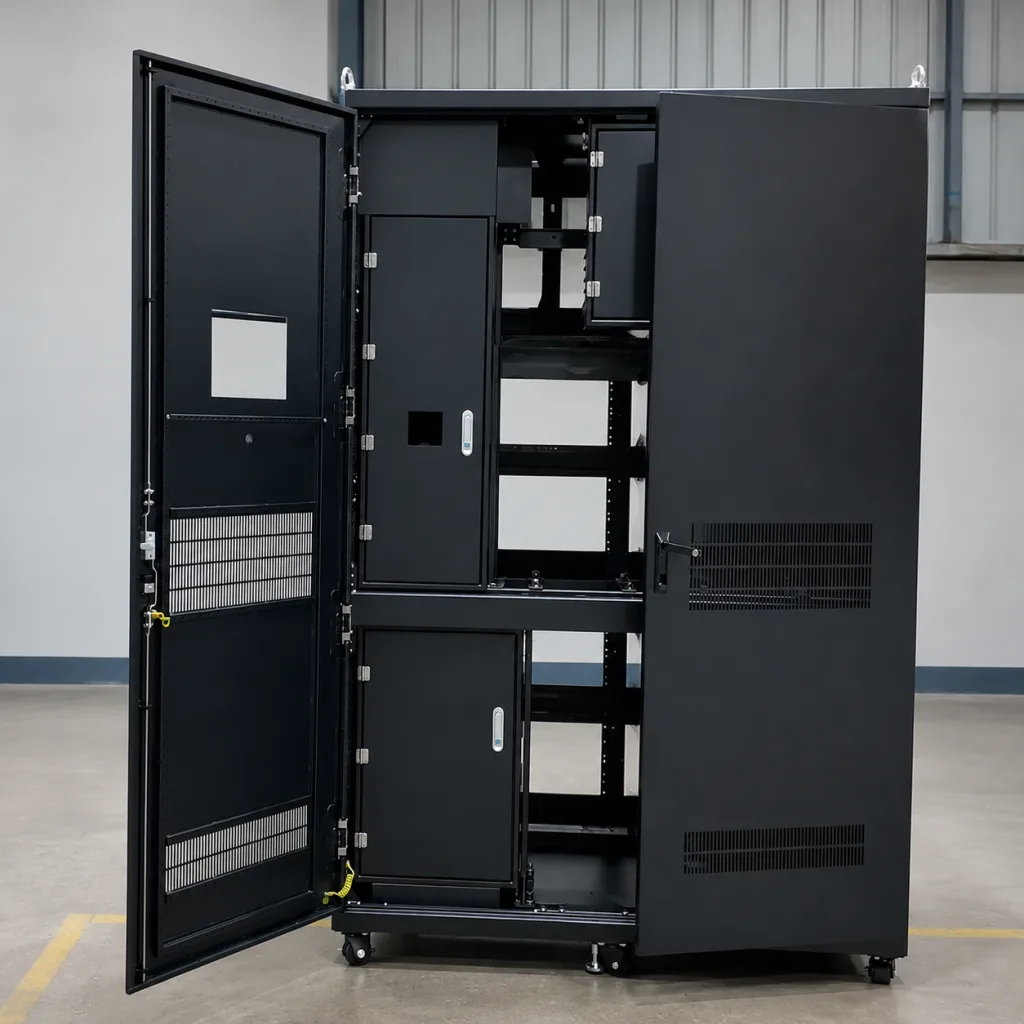
The cabinet shown here is a real example: a modular server rack built for a high-density IT environment, fitted with concealed stainless steel hinges. Several of the rack-specific points show up directly in the build. The cabinet is divided into multiple doored compartments, each of which has to open independently for service, so the hinges are chosen to give clean access to each section without the doors fouling one another. The doors carry ventilation louvers for cooling, and because the concealed hinges mount inside the frame, they sit clear of those vented areas rather than crowding them. And with the hinges hidden inside the door edge, the closed cabinet maintains a flat exterior with less exposed hinge hardware, suited to a shared IT environment. It is a good illustration of the principle in this guide: on a rack, the hinge is chosen for access, clearance, and a clean secure face, not just to let the door swing.
Door weight is only the starting point
Rack-hinge selection should never rest on total door weight alone. Two doors can weigh the same yet load the hinge very differently, because the moment depends on door height and width, the center of gravity, door-mounted hardware (screens, fan modules, locks, filters, framed windows), the number and spacing of hinges, frame stiffness, and shock during operation. A wide door places its center of gravity farther from the hinge axis, increasing the turning force on the hinge and mounting points. Avoid fixed rules like “two hinges for this weight” unless the manufacturer has validated that arrangement for the actual door geometry.
Engineering point: The hinge carries the door, but the mounting edge carries the hinge. A strong hinge on a weak or flexible sheet-metal edge can still produce door sag — so increasing the distance between the upper and lower hinges only helps if the mounting structure is strong enough, and when three or more hinges are used, the axes must be aligned or a middle hinge binds instead of helping.
Confirm internal mounting depth
A concealed hinge saves external space by moving the mechanism inside the rack, which makes internal mounting depth a critical selection factor. Check the hinge against equipment rails, cable-management channels, fan trays, filters, latch rods, lock housings, door stiffeners, and bonding straps — a hinge that fits the door edge in a drawing can still interfere with a moving latch rod or cable bundle after final assembly. Review the complete door-and-frame cross-section, not only the hinge dimensions, and for multi-compartment racks check each door separately, since internal hardware can differ between compartments even when the outside doors look identical.
Opening angle and aisle clearance
A large opening angle is only useful when the installed rack has room to use it. Before specifying the hinge, confirm the minimum service opening angle, the maximum angle before the door hits another object, adjacent-rack spacing, wall clearance, handle projection, and the vertical lift space for removable doors. A 90° opening may suit basic inspection but not the removal of servers, power modules, or cable assemblies; a 180° hinge sounds better but is pointless if the door contacts the adjacent rack at 110°. The opening angle should be based on the actual service procedure rather than the largest available hinge rating.

Open rack doors can quickly reduce usable aisle space, so the hinge swing path should be checked against neighboring cabinets before installation.
Airflow, security, and grounding
On airflow, the hinge is not the primary component — the perforated door, fan layout, blanking panels, and hot/cold-aisle design matter far more. The hinge matters only when it intrudes into a perforated region, reduces usable open area, prevents the door closing evenly, or interferes with a fan or filter. A concealed hinge helps keep the external face clear, but it does not automatically improve cooling; the correct question is whether the hinge and mounting preserve the intended door geometry and stay clear of the designed airflow path.
On security, concealed hinges reduce direct access to hinge fasteners and pins, but a secure closure depends on the whole system — retained or non-removable pins, door and frame stiffness, lock type, latch engagement, and facility access control. A good lock cannot compensate for a door that sags and only partially engages the latch. On grounding, do not assume the hinge provides dependable continuity between door and frame; paint, coating, oxidation, and wear all affect it, so use a dedicated bonding strap and route it so it does not catch in the hinge or block door removal. General enclosure bonding and sealing are covered in the electrical enclosure hinge guide.
Requesting a quote and validating the fit
Once the door configuration, mounting depth, opening angle, and clearance are defined, the fastest way to get an accurate quote is to send that information together rather than asking for “a server rack hinge” in general — the same RFQ discipline covered in the hinge RFQ guide applies here.
Before approving any hinge for production, install a sample on the real door and frame rather than judging it from a drawing alone, following the same sample-validation approach in the Proces vývoje zakázkových pantů.
Material and finish
Many server racks run in controlled indoor rooms, so extreme corrosion resistance is not always required — but confirm the environment rather than assume it, since edge, coastal, or humid sites change the answer. The grade decision itself, including where stainless is worth it, is covered in the Průvodce: nerezová ocel 304 vs. 316.
When the door configuration, mounting depth, opening angle, and access needs are defined, share them and náš tým inženýrů can match a hinge to the rack.
ČASTO KLADENÉ DOTAZY
What type of hinge is best for a server rack?
It depends on space, access, and security. Concealed hinges suit shared, modular, and high-density racks that need a flush exterior and protected hardware. Lift-off hinges suit deep racks where technicians must remove the door without tools. Surface-mounted or pivot hinges can suit utility or lightweight-door racks. Match the hinge to the door, clearance, and service procedure.
Why do server rack doors sag, and how is it prevented?
Sag usually comes from insufficient hinge capacity, hinges spaced too close, a flexible door or frame edge, misaligned hinge axes, loose fasteners, or accessories added after the hinge was chosen. Increasing the distance between upper and lower hinges helps if the mounting structure is strong enough, and any middle hinge must be aligned on-axis or it binds.
Do concealed hinges improve rack cooling?
Not directly. Cooling is driven by the perforated door, fan layout, blanking panels, and aisle design, not the hinge. A concealed hinge helps by keeping the external face clear and not intruding into perforated areas, but it should not be described as improving airflow on its own. The goal is to preserve the intended door geometry and stay clear of the designed airflow path.
How much opening angle does a rack door need?
Enough for the actual service procedure, no more. A 90-degree opening may suit inspection but not removing servers or cable assemblies, while a 180-degree hinge is pointless if the door hits the adjacent rack at 110 degrees. Confirm the minimum service angle, the maximum before contact, and the aisle and wall clearance before specifying.
Can a server rack hinge be used for grounding?
No, not reliably. Paint, coating, oxidation, vibration, and wear all affect continuity through a hinge joint. When bonding is required, use a dedicated door-to-frame bonding strap and verify the full enclosure grounding design, routing the strap so it does not catch in the hinge or block door removal.